
 Museum/Current place of storage:
 |
Olympia, Archaeological Museum. |
 Inv. no:
 |
Λ 144 |
 Dimensions:
 |
|
 Material:
 |
H. 1,90m., 0,42m. (head). |
 Findspot:
 |
On May 1st 1877, lying face down inside the cella of the temple of Hera, in front of the intercolumnar space between the first and second column of the right internal colonnade. |
 Original Display Location:
 |
In situ; its base must have stood at the same intercolumnar space (it was moved from its original display location in the imperial period to the cella of the temple of Hera, along with other sculptures of various dates for protection – Krumeich 2008, 82). |
 Date:
Date: |
Third quarter of the 1st c. CE. |
 Statuary Type (body) :
 |
“Kore/Persephone” of the “Ephesos” type. |
 Mode of Self-Representation (head):
 |
The coiffure follows slightly older imperial fashion protypes (“Modefrisur”), while the face is idealized. |
 Civic Presence (Social Role Represented):
 |
Priestess (due to the infula). |
 Inscribed Base:
 |
No |
 Author:
 |
Panagiotis Konstantinidis |
 Added:
 |
2024-09-28 |
 Edited:
 |
Description - Comments:
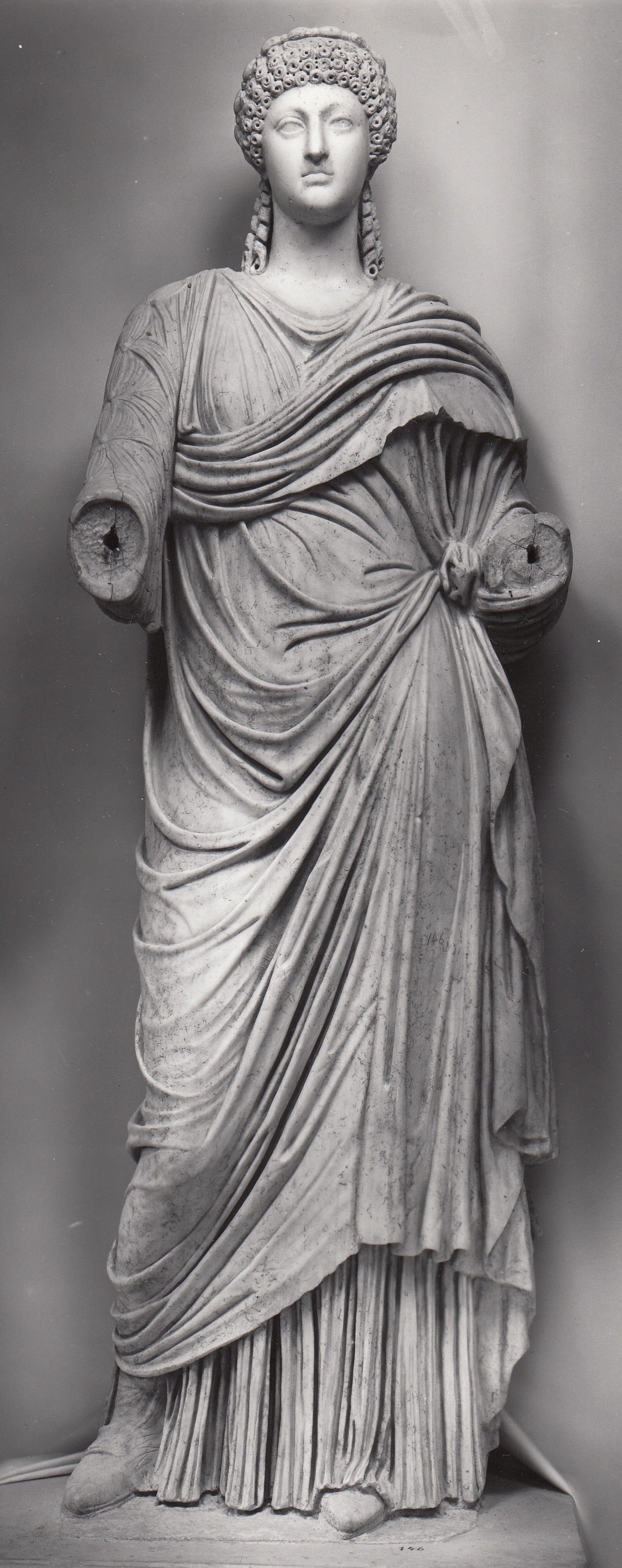
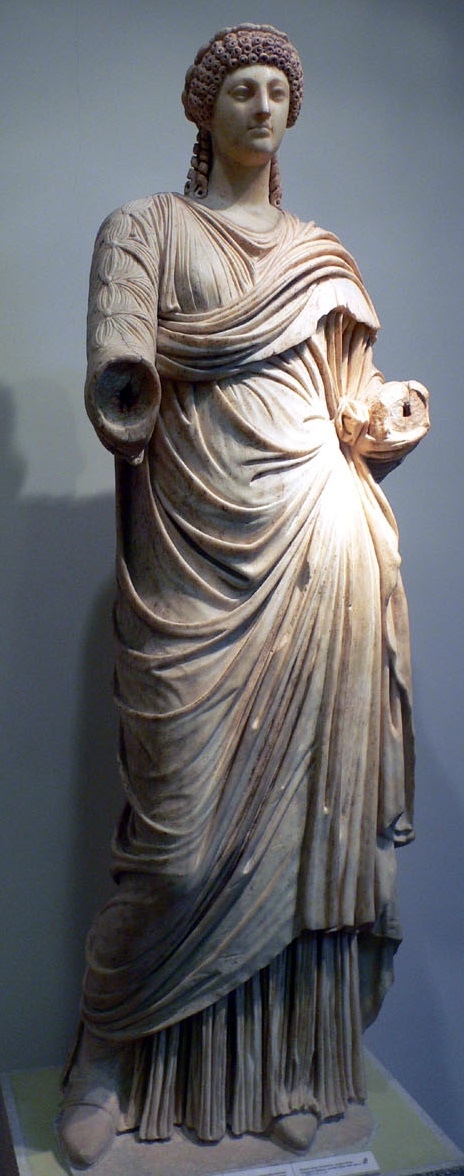
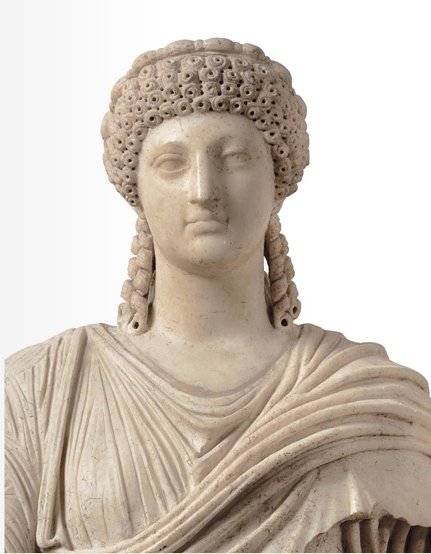
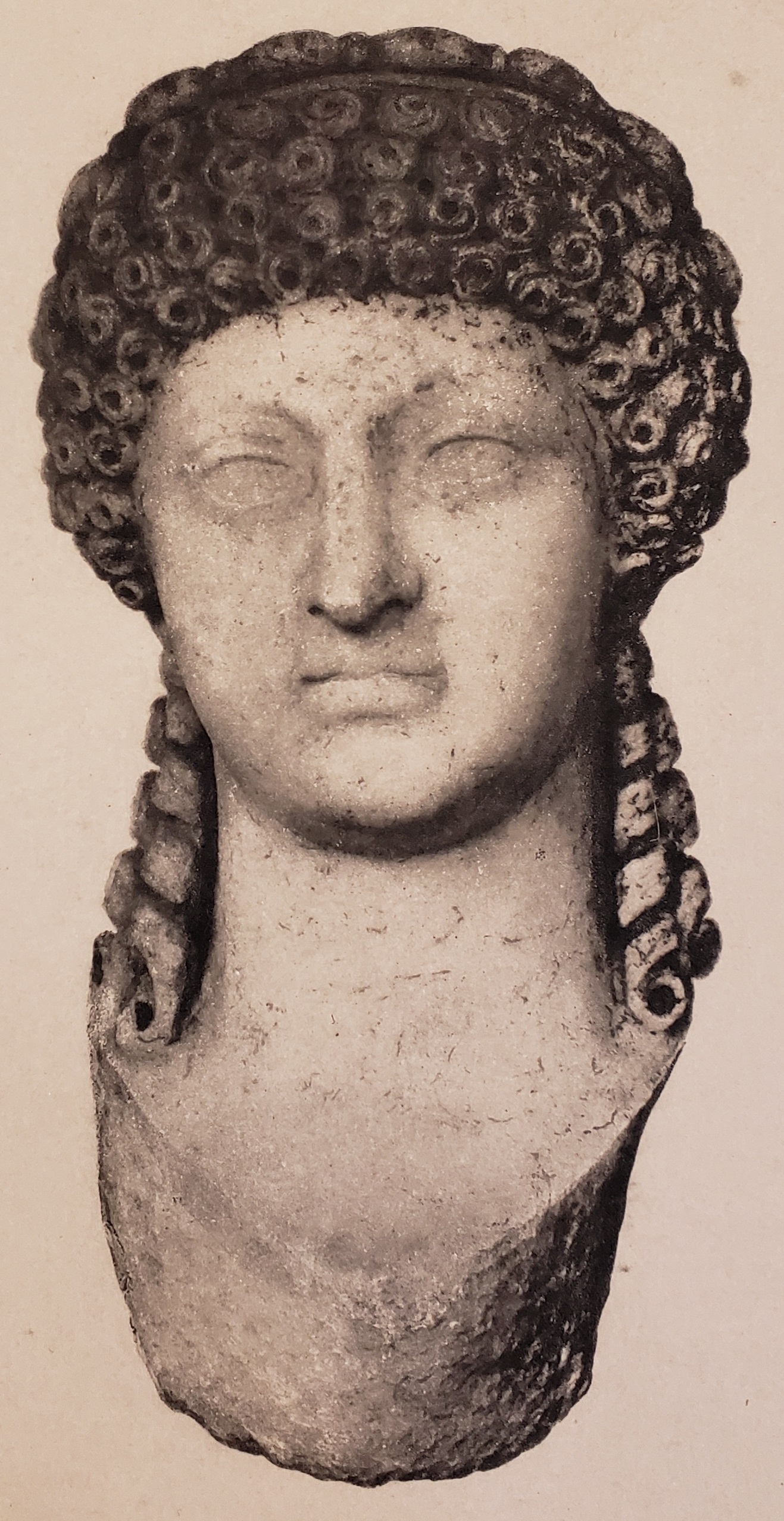
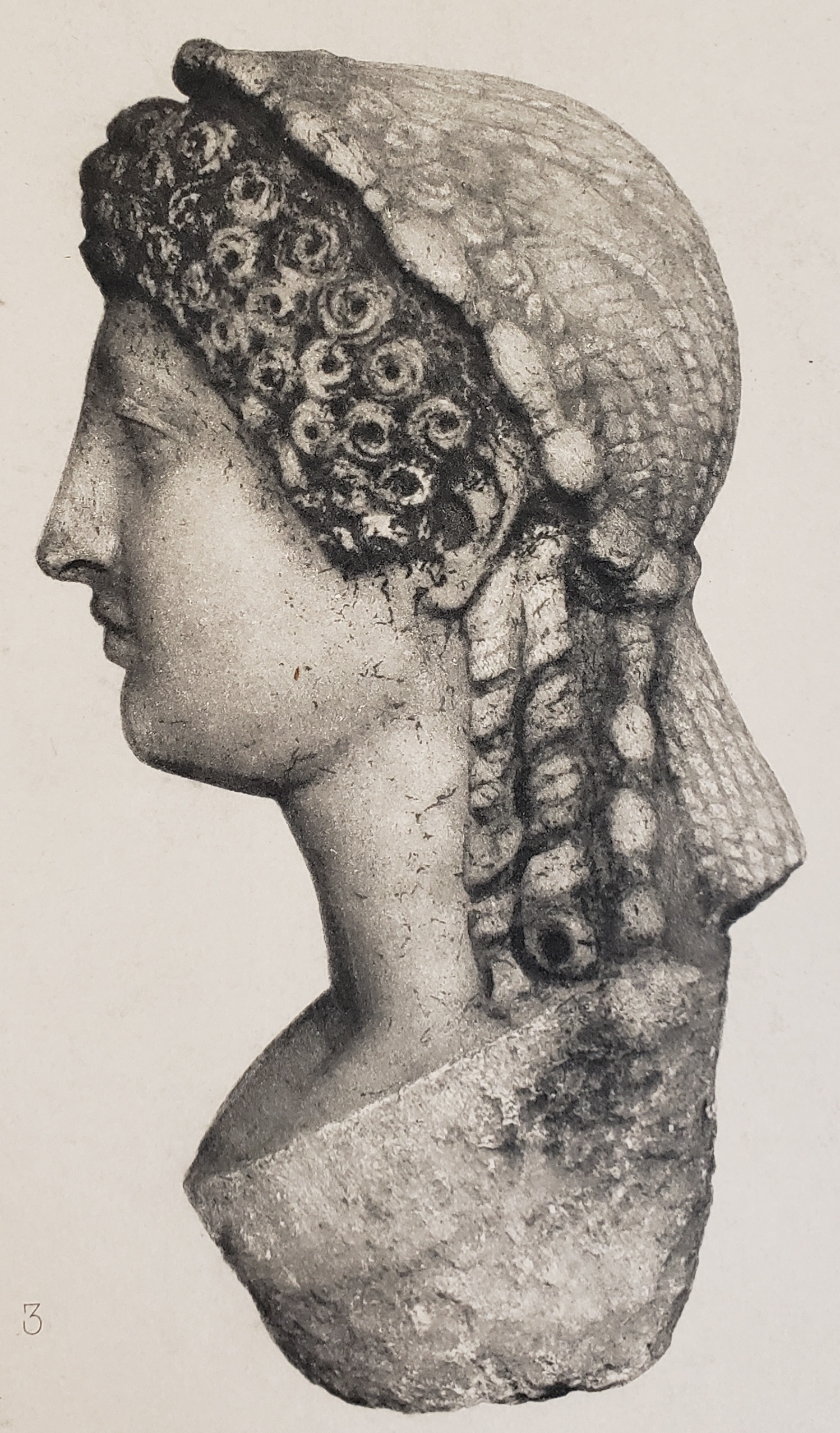
The statue is preserved essentially intact, with the exception of the two inset arms (both missing from the beginning of the forearm – dowel holes are preserved on the surface of the marble). The head was also inset. A small break is present in the rectangular mass of the himation at the height of the chest, while the arms are put together from several fragments. The plinth is rectangular. It depicts a standing, frontal female figure wearing a long chiton, a himation covering almost the entire chest area and left shoulder, and closed leather shoes (calcei muliebres). The right breast is left uncovered, while the S-shaped mass of the overfold of the himation is carried diagonally across the chest from the right armpit to the left shoulder, where it is partially unfolded. On the left part of the body, at the height of the waist, there is a circular mass of folds, characteristic of the statuary type, held by the elbow. The statuary type of the so-called “Kore/Persephone” of the “Ephesos” type is faithfully reproduced. The head is preserved intact. The oval, fleshy face, like the neck, is polished. The eyes are small and almond-shaped with wide lids, the mouth is narrow with fleshy lips, the nose is thin. The eyebrows are plastically rendered by means of ridges on the surface of the marble. The iris and pupil were rendered in paint. Around the face, the hair is arranged in six parallel superimposed rows of spiral locks, opened with the drill (the fifth row is hidden under the band worn by the figure, while the sixth is carved behind it). The back of the skull is covered by parallel alternating broad and thin braids, which join in an elongated bun (summarily worked) at the nape. The texture of the individual hairs on the surface of the braids is indicated by engraved triangles. Behind each uncovered ear are two large, helical strands of hair that reach the base of the neck. The woman wears a knotted woolen band (infula), symbol of priesthood, which is tied at the back of the head, its ends fall on either side of the neck. The front part of the coiffure and the helical strands are heavily drilled. The treatment of the whole work is somewhat “stiff” and manneristic. The coiffure combines iconographic protypes of the Julio-Claudian period with those of the Flavian period. More specifically, the front part of the coiffure framing the face with the superimposed rows of drilled spiral locks, the helical strands on either side of the neck, and the elongated bun at the nape are found again in the fourth portrait type of Agrippina the Younger (the so-called “Stuttgart” type), dated to ca. 54-55 CE (for the type see W. Trillmich, “Typologie der Bildnisse der Iulia Agrippina” in M. Moltesen, A.M. Nielsen eds., Agrippina Minor. Life and Afterlife, Kopenhagen 2007, 52-54; D. Boschung, “Die Bildnistypen der iulisch-claudischen Kaiserfamilie: ein kritische Forschungsbericht”, JRA 6 [1993], 74[Xd]; cf. especially the head at Petsworth House, J. Raeder, Die antiken Skulpturen in Petworth House [West Sussex], MAR 28, Mainz 2000, 173-174, cat. no. 61, fig. 2, pl. 77-78), while the helical strands on either side of the neck and the elongated bun are again present in the iconography of women of the house of Nero (cf. the head in the Museo Nazionale Romano alle Terme in Rome, inv. no. 124129: A. Giuliano ed., Le sculture del Museo Nazionale Romano I, Roma 1979, 286-287, cat. no. 178 [V. Picciotti Giornetti]; K. Fittschen, P. Zanker, Katalog der Capitolinischen Museen III, Mainz am Rhein 1983, 48, cat. no. 61 note 1 [empress of the Neronian period]; Boschung 1993, 77 with bibliography [private individual]). The closest parallel for the physiognomy of the figure is the priestess from the sanctuary of the imperial cult (?) in the Macellum of Pompeii, Naples, Museo Archeologico Nazionale inv. no. 6041, dated to the period of Nero, who sports a similar coiffure framing the face (for the statue see C. Murer, Stadtraum und Bürgerin. Aufstellungsorte kaiserzeitlicher Ehrenstatuen in Italien und Nordafrika, Urban Spaces 5, Berlin 2017, 27–29, 152, cat. no. 2, pl. 2). In this portrait we see again drills opened between the locks of the coiffure, a technical feature also present in the statue of Olympia, and which frequently appears in the Flavian period (cf. the portraits in the Museo Nazionale Romano alle Terme in Rome, D.D.D. Kleiner, Roman Sculpture, New Haven 1992, 179, figs. 147-148). The rendering of the spiral locks of the Olympia portrait also fits better in the Flavian period (cf. e.g. the portraits of the early Flavian period, C. Murer, Stadtraum und Bürgerin. Aufstellungsorte kaiserzeitlicher Ehrenstatuen in Italien und Nordafrika, Urban Spaces 5, Berlin 2017, cat. no. 19, pl. 19, cat. no. 32, pl. 32). Both the Pompei and Olympia statues wear a woolen beaded band (infula; in the Pompeian statue it is combined with a wreath). The infula is a symbol of priesthood (Krumeich 2008, 83 note 60 with bibliography; E.A. Hemelrijk, “Local Empresses: Priestesses of the Imperial Cult in the Cities of the Latin West”, Phoenix 61, 2008, 331-332 with bibliography), which - to my knowledge – although it is present in the relief decoration of altars, is absent from Greek portraits (see also C.B. Rose, Dynastic commemoration and Imperial Portraiture in the Julio-Claudian Period, Cambridge 1997, 97 with bibliography), thus indicating that the Olympia statue should be considered as a Roman holding a priestly office (as also inferred by the findspot). A prominent woman of Elis, whose family would have had a connection with Italy (cf. {https://achaeanwomen.eie.gr/en/sculpture/?statue_id=723}) and where she would probably have assumed priestly offices, should be recognized in the imposing statue of Olympia (see also Krumeich 2008, 83-84 [priestess of Hera]). The exact priestly office in which she served is more difficult to identify. It is possible that she was a priestess of the imperial cult (or of a female member of the imperial family) at Olympia, as are several portraits wearing infulae in the western part of the empire (see S.E. Wood, “Diva Drusilla Panthea and the Sisters of Caligula”, AJA 99 [1995], 471-479; for the imperial cult in the sanctuary see in brief A. Hupfloher, “Kaiserkult in einem überregionalen Heiligtum: das Beispiel Olympia”, in K. Strobel ed., Kult, Politik, Ethnos: überregionale Heiligtümer im Spannungsfeld von Kult und Politik: Kolloquium, Münster, 23.-24. November 2001, Leiden/Boston 2012, 239-263), or a priestess of Demeter Chamyne, the highest female priestly office in the sanctuary (as proposed by R. Bol [1995, 180]; also Bol 2008, 155, where the identification with Flavia Gorgo, wife of L. Vettulenus Laetus, and mother of Numisia Teisis, whose portrait statue was set up in the pronaos of the temple of Hera {867}[], like that of the mother of Flavia Gorgo, Claudia Alcinoa [{8}] is mentioned; for Flavia Gorgo see S. Zoumbaki, Elis und Olympia in der Kaiserzeit: das Leben einer Gesellschaft zwischen Stadt und Heiligtum auf prosopographischer Grundlage, Athen 2001, 391, no. Φ48· idem 243, no. B9 for L. Vettulenus Laetus). The priestesses of Demeter Chamyne that are known to us in the sources are among the most important women not only of Elis, but also of the province of Achaea or even of the Empire, since this position was taken by Claudia Baebia Baebiana, daughter of the proconsul Claudius Demetrius (IvO 941, beginning of the 3rd c. CE [?]), but also by Regilla, wife of Herodes Atticus, in the 2nd c. CE (for female priestly offices in Olympia see in brief S. Zoumbaki, «Παρατηρήσεις στην κοινωνία της Ηλείας», στο Πρακτικά του Ε’ Διεθνούς Συνεδρίου Πελοποννησιακών Σπουδών, Άργος – Ναύπλιον, 6-10 Σεπτεμβρίου 1995, Athens 1996-1997, Peloponnesiaka Suppl. 22, Α´, 281-282; Zoumbaki 2001, 79 with note 198; J.B. Connely, Portrait of a Priestess. Women and Ritual in Ancient Greece, Princeton/Oxford 2007, 213; A. Hupfloher, “Heraion und Herakult im kaiserzeitlichen Olympia”, Archiv für Religionsgeschichte 13 [2011], 225-252; J. Barringer, Olympia. A Cultural History, Princeton/Oxfrod 2021, 225-226). In this case, the original display location for the statue would have been some prominent area of the sacred precinct, before been transported to the cella of the Heraion for protection (the sanctuary of Demeter Chamyne itself has been recently excavated to the north of the Olympia stadium, outside the sacred precinct (see C. Liangouras, “Das Heiligtum Der Demeter Chamyne in Olympia”, in W.D. Heilmeyer et al. eds., Mythos Olympia: Kult und Spiele , München 2012, 152-155; Barringer 2021, 26-28, 225-226, pl. 8).
Bibliography:
G. Treu, Olympia III. Die Bildwerke von Olympia in Stein und Thon, Berlin 1894, 259, pl. 63.6, 64.2-3; H. Kruse, Römische weibliche Gewandstatuen des zweiten jahrhunderts n.Chr., Göttingen 1975, 100-101 (Domitia); M. Bieber, Ancient Copies, New York 1977, 196, figs. 805-806; A. Mallwitz, H.V. Herrmann eds., Die Funde aus Olympia. Ergebnisse hundertjähriger Ausgrabungstätigkeit, Athen 1980, 209, cat. no. 149, pl. 149 (Neronian; priestess); R. Bol, “Ideal-und Porträtplastik der römischen Kaiserzeit in Olympia”, Nikephoros 8 (1995), 180, pl. 15.1 (priestess of Demeter Chamyne; reign of Domitian); S. Schmidt, “Uber den Umgang mit Vorbildern. Bildhauerarbeit im 4. Jahrhundert v. Chr.”, AM 111 (1996), 192, note 1; R. Bol, “Die Bildniststatue der Antonia Cleodice im Kontext ihrer Aufesttung im olympischen Heraion”, in N. Zapheiropoulos ed., Amicitiae Gratia. Τιμητικός τόμος Α. Σταυρίδη, Athens 2008, 155 (Flavia Gorgo; priestess of Demeter Chamyne); R. Krumeich, “Vom Haus der Gottheit zum Museum? Zu Ausstattung und Funktion des Heraion von Olympia und des Athenatempels von Lindos”, AntK 51 (2008), 83-84 (Neronian – early Flavian); O. Palagia, “Sculptures form the Peloponnese in the Roman Imperial Period”, in A.D. Rizakis, C.E. Lepenioti, Roman Peloponnese III. Society, Economy and Culture under the Roman Empire: Continuity and Innovation, Athens 2010, 431, with note 3, fig. 1; Ο. Palagia, “An Imperial Portrait from Megara”, in E. Voutiras, E. Papagianni, N. Kazakidi eds., Bonae Gratiae. Μελέτες ρωμαϊκής γλυπτικής προς τιμήν της Καθηγήτριας Θεοδοσίας Στεφανίδου–Τιβερίου, Thessaloniki 2017, 175 (empress); J. Barringer, Olympia. A Cultural History, Princeton/Oxfrod 2021, 219, fig. 5.9; P. Konstantinidis, Γυναικείοι δυναστικοί εικονιστικοί ανδριάντες αυτοκρατορικής περιόδου από την Ελλάδα (τέλη 1ου αι. π.Χ. – 5ος αι. μ.Χ.), Athens 2024, 54 note 99, 88 note 56, 188 note 357; https://arachne.dainst.org/entity/1083468?fl=20&q=%22Olympia,%20Griechenland%22&resultIndex=88