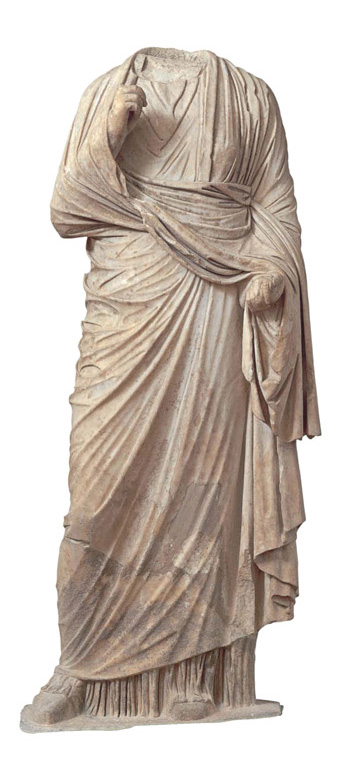
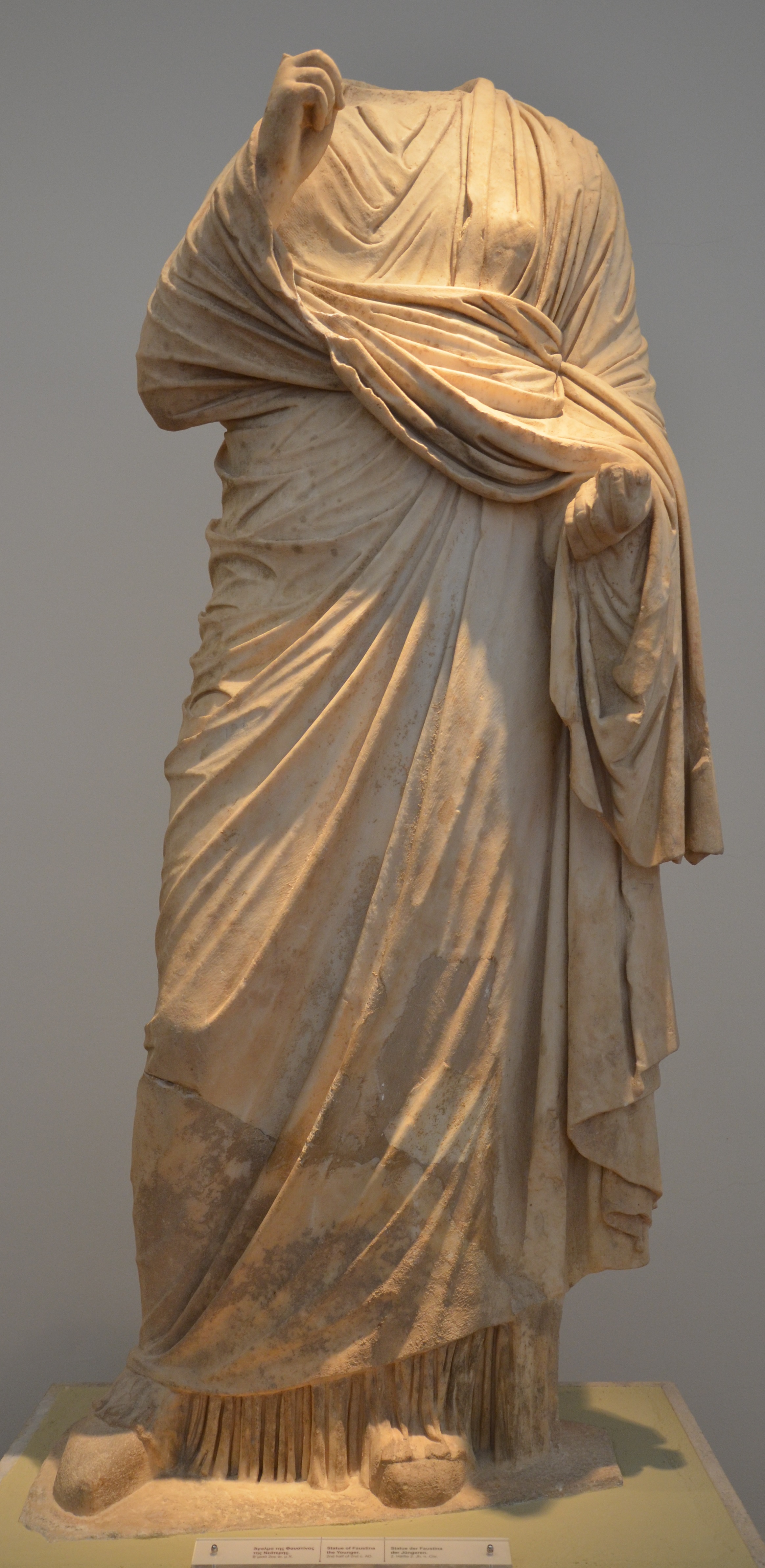
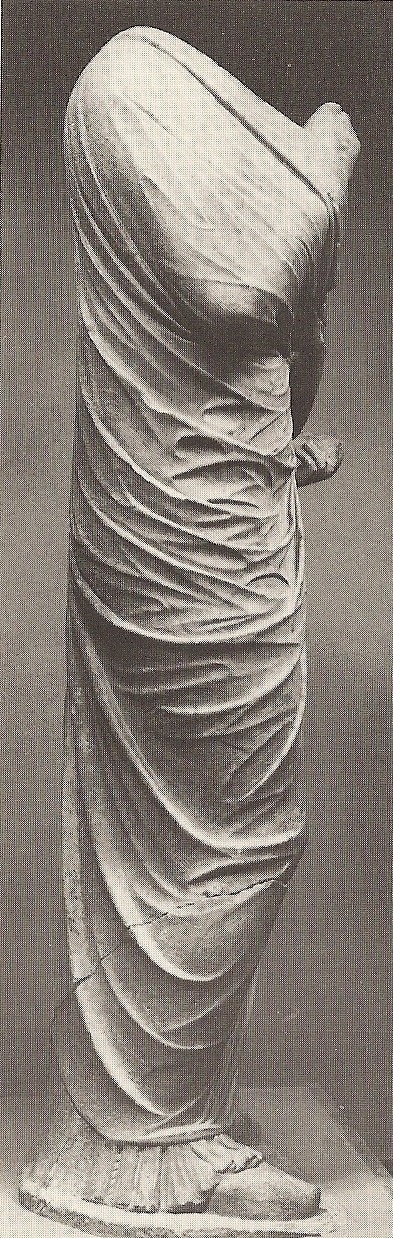
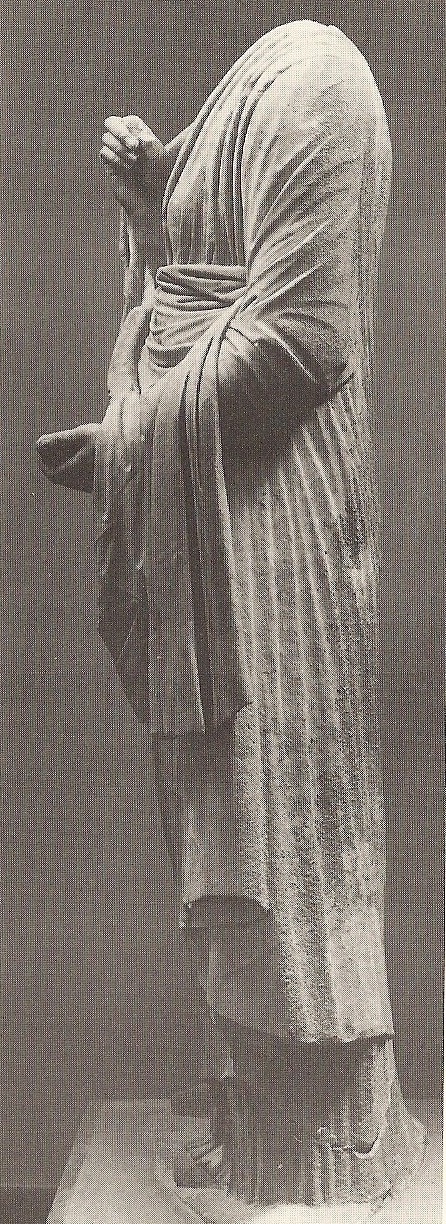
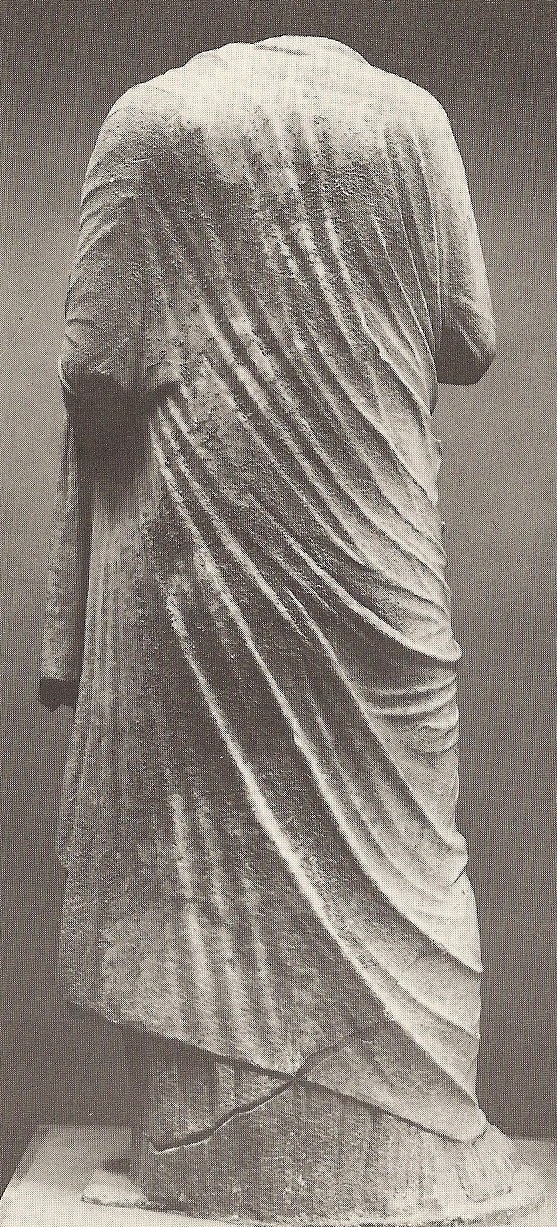
The inset head of the statue is missing. Put together from two fragments. Smaller breaks and chipping are evident sporadically on the surface of the marble, especially on the folds of the garments. Small sections in the front lower part of the figure have been filled in with plaster. The statue depicts a standing, frontal female figure, wearing a long chiton, a wide himation that is wrapped tightly around the body (a small round tassel is indicated at the angular end of the himation on the right), and closed leather shoes (calcei muliebres). More specifically, the himation is wrapped in a rather complex way around the body, following the statuary type of the so-called “Formia”. It wraps tightly under the chest, while its front edge creates a characteristic triangular shape in its course from the right shoulder (covering the whole of the right arm except for the wrist) to the slightly bent left forearm (its edge falls on the latter). The statue can be dated fairly precisely to the period 149-153 CE, during the principate of Antoninus Pius, based on the surviving inscriptions on the pedestals of the other statues of the Nymphaeum (Bol 1984, 98-100). The identity of the figure is uncertain. It is slightly smaller in size than the majority of the rest of the Nymphaeum statues (about the same scale as the portrait statue of Athenais {Γ108}, and exactly the same scale as the headless statue {Γ111}, usually identified as the daughter of Herodes Atticus, Elpinike), indicating young age. It could therefore be either a younger member of Herode’s family or Faustina the Younger, who in 149-153 CE was about seventeen years old. R. Bol identifies the figure as Faustina the Younger at a young age (attributing it to the inscribed base IvO 614; Bol 1984, 114-116 no. cat. 15, fig. 48, pl. 5), and places it in the second from the right niche of the ground floor of the Nymphaeum’s exedra. Conversely, K. Hitzl and A. Kropp (2013) place the statue in the second from the right niche of the upper floor of the Nymphaeum’s exedra.
G. Treu, Olympia III. Die Bildwerke von Olympia in Stein und Thon, Berlin 1894, 264, 268, 274, pl. 67.5; H. Kruse, Römische weibliche Gewandstatuen des zweiten jahrhunderts n.Chr., Göttingen 1975, 177, 375, cat. no. D89; R. Bol, Das Statuenprogramm des Herodes-Atticus-Nymphäums, OlForsch 15, Berlin 1984, 114-116 cat. no. 15, fig. 48, pl. 5 (base), 179-180, cat. no. 42, pls. 46-47 (Faustina Minor); Κ. Hitzl, A. Kropp, “Das Heiligtum von Olympia im 2. Jh. n. Chr. - Alte und neue Impressionen”, Boreas 36 (2013), 53-89; S. Tuccinardi, “Sculture romane da Formia. Una proposta di lettura in contest”, in C. Capaldi, C. Gasparri eds., Complessi monumentali e arredo scultoreo nella Regio I Latium et Campania: nuove scoperte e proposte di lettura in contest. Atti del convegno internazionale, Napoli, 5 e 6 dicembre 2013, Napoli 2017, 61 note 88; P. Konstantinidis, Γυναικείοι δυναστικοί εικονιστικοί ανδριάντες αυτοκρατορικής περιόδου από την Ελλάδα (τέλη 1ου αι. π.Χ. – 5ος αι. μ.Χ.), Athens 2024, 171, note 268;
https://arachne.dainst.org/entity/1083482?fl=20&q=%22Olympia,%20Griechenland%22&resultIndex=62