
 Museum/Current place of storage:
 |
Olympia, Archaeological Museum. |
 Inv. no:
 |
Λ 141 |
 Dimensions:
 |
|
 Material:
 |
H. 1,70m. |
 Findspot:
 |
Olympia, sacred precinct; Broken into two fragments, incorporated into a byzantine (?) wall built over the SE corner of the peristyle of the temple of Hera. |
 Original Display Location:
 |
In the southern part of the pronaos of the temple of Hera (the inscribed base still in situ; IvO 435). |
 Date:
Date: |
Mid-1st c. CE (ca. 53 CE). |
 Statuary Type (body) :
 |
“Kore/Persephone” of the “Ephesos” type. |
 Mode of Self-Representation (head):
 |
- |
 Civic Presence (Social Role Represented):
 |
Member of an elite family of Elis. |
 Inscribed Base:
 |
Yes (IvO 435) |
 Author:
 |
Panagiotis Konstantinidis |
 Added:
 |
2024-09-23 |
 Edited:
 |
2024-09-23 |
Description - Comments:
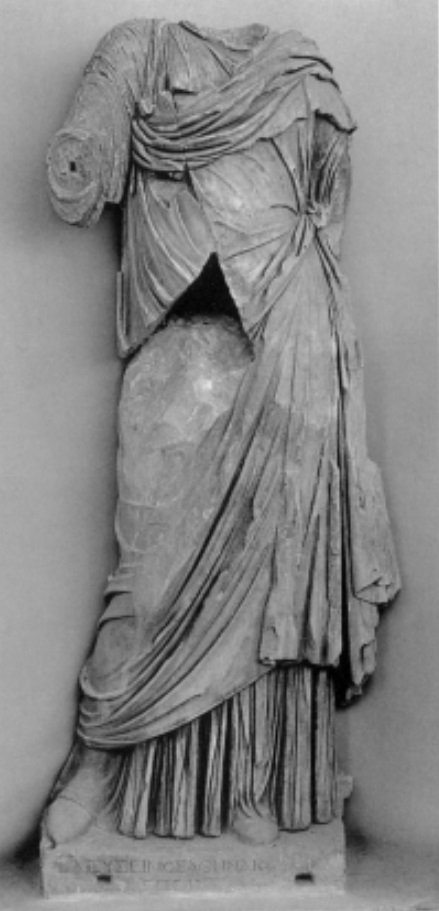
Broken into two main fragments and later put together. The inset head, the right inset forearm and the left arm in its entirety are missing. On the surface of the socket at the right elbow, the round hole for the insertion of the metal dowel for the right forearm is preserved. A large section of the front part of the figure (at waist level) is broken off (today filled in with plaster), while smaller breaks and chipping are attested sporadically on the surface of the marble, especially on the drapery. The statue was fixed on the base by means of metal cramps, as evident from the rectangular cuttings for their insertion preserved on the front part of the plinth. The latter also bears an inscription mentioning the name of the artist, the Athenian Eleusinios (cf. S. Kansteiner et al., Der neue Overbeck: die antiken Schriftquellen zu den bildenden Künsten der Griechen, Berlin 2014, no. 4147 [K. Hallof, S. Kansteiner]). The standing, frontal figure wears a long chiton, a long himation that covers almost the entire chest area and left shoulder, and soft leather shoes (calcei muliebres). The right part of the chest is left uncovered. The himation forms an S-shaped elongated mass of drapery, placed diagonally across the chest, from the right armpit to the left shoulder, where it is partially unfolded. The characteristic for the statuary type circular mass of drapery of the himation is gathered on the left, at waist level, where it is held by the elbow. Faithful replica of the so-called “Ephesos Kore/Persephone” statuary type. According to the inscribed base, preserved in situ in the south part of the pronaos of the temple of Hera (on the left of the door of the cella), the statue – set up by the city of Elis - depicts Claudia Alcinoa, daughter of Claudius Theogenes and Iulia Chrysareta, and wife of Lucius Vetlenus Florus (Zoumbaki 2001, 295, no. K33). Claudia Alcinoa is the grandmother of Numisia Teisis, whose portrait statue was set up on the north side of the pronaos of the temple of Hera (on the right of the door of the cella), some years later ({Γ106}; for the Vettuleni family see Zoumbaki 2001, 244-248 with stemma). The dating of the statue around the middle of the 1st c. CE based on its style (cf. {Γ106}) is consistent with the fact that Claudia Alcinoa’s husband, Lucius Vetlenus (Vettulenus) Florus, set up in the sanctuary in 53 CE the portrait statue of the Olympian victor Tiberius Claudius Aphrodeseius, thus dating the activity of the couple firmly to the principate of Claudius-Nero (Zoumbaki 2001, 246 with bibliography).
Bibliography:
G. Treu, Olympia III. Die Bildwerke von Olympia in Stein und Thon, Berlin 1894, 252-255, 258, figs. 288-290, pl. 63,5; W. Dittenberg, K. Purgold, Olympia V. Die inschriften von Olympia, Berlin 1896, no. 435; M. Wegner, Das Römische Herrscherbild II.4. Die Herrscherbildnisse in antoninscher Zeit, Berlin 1939, 216; U. Kron, “Eine Pandion-Statue in Rom. Mit einem Exkurs zu Inschriften auf Plinthen”, JdI 92 (1977), 150, fig. 11· S.C. Stone III, “The Imperial Sculptural Group in the Metroon of Olympia”, AM 100 (1985), 386, pl. 85,2; R. Bol, "Ideal-und Portratplastik der romischen Kaiserzeit in Olympia", Nikephoros 8 (1995), 180-182, pl. 15.2; S. Schmidt, “Uber den Umgang mit Vorbildern. Bildhauerarbeit im 4. Jahrhundert v. Chr.”, AM 111 (1996), 192, pl. 33,1; S. Zoumbaki, Elis und Olympia in der Kaiserzeit: Das Leben einer Gesellschaft zwischen Stadt und Heiligtum auf prosopographischer Grundlage, Athen 2001, 295, no. Κ33; R. Bol, “Die Bildnisstatue der Antonia Cleodice im Kontext ihrer Aufstellung im Olympischen Heraion”, in Amicitiae Gratiae. Τόμος στη μνήμη Αλκμήνης Σταυρίδη, Athens 2008, 155; R. Krumeich, “Vom Haus der Gottheit zum Museum? Zu Ausstattung und Funktion des Heraion von Olympia und des Athenatempels von Lindos”, AntK 51 (2008), 85, pl. 15,4; O. Palagia, “Sculptures from the Peloponnese in the Roman Imperial Period”, in A.D. Rizakis, C.E. Lepenioti eds., Roman Peloponnese III. Society, Economy and Culture under the Roman Empire: Continuity and Innovation, Athens 2010, 437; Ο. Palagia, “An Imperial Portrait from Megara”, in Ε. Βουτυράς, Ε. Παπαγιάννη, Ν. Καζακίδη eds., Bonae Gratiae. Μελέτες ρωμαϊκής γλυπτικής προς τιμήν της Καθηγήτριας Θεοδοσίας Στεφανίδου – Τιβερίου, Thessaloniki 2017, 174-175; P. Konstantinidis, Γυναικείοι δυναστικοί εικονιστικοί ανδριάντες αυτοκρατορικής περιόδου από την Ελλάδα (τέλη 1ου αι. π.Χ. – 5ος αι. μ.Χ.), Athens 2024, 222, note 181;
https://arachne.dainst.org/entity/1193745?fl=20&q=%22Olympia,%20Griechenland%22&resultIndex=1028
https://arachne.dainst.org/entity/1083450?fl=20&q=%22Olympia,%20Griechenland%22&resultIndex=171