
 Museum/Current place of storage:
 |
Athens, National Archaeological Museum |
 Inv. no:
 |
4019 |
 Dimensions:
 |
|
 Material:
 |
H. 0,53m. (max.), h. 0,14m (head). |
 Findspot:
 |
In 1951 at the site of “Imero Klima” near the village of Pentalofos, on the border between Akarnania and Aitolia. Roman graves (probably part of a wider cemetery) are also reported at the site (see Petropoulos 1991, 115, no. 51; Zachos 2016, 211). |
 Original Display Location:
 |
In a funerary monument of unknown type. |
 Date:
Date: |
Second half of the 2nd c. CE (period of Faustina the Younger, probably ca. 160 CE). |
 Statuary Type (body) :
 |
“Artemis Colonna”. |
 Mode of Self-Representation (head):
 |
The hairstyle draws upon the iconography of Faustina the Younger, while the face is idealized with certain traits adopted from the iconography of Faustina the Younger (“Bildnisanleichung”). It belongs to the – rare in the case of the province of Achaea – group of theomorphic portrait-statues (“in formam deorum”; see in general H. Wrede, Consecratio in formam deorum: vergöttlichte Privatpersonen in der römischen Kaiserzeit, Mainz am Rhein 1981). |
 Civic Presence (Social Role Represented):
 |
Unknown. |
 Inscribed Base:
 |
No |
 Author:
 |
Panagiotis Konstantinidis |
 Added:
 |
2024-04-25 |
 Edited:
 |
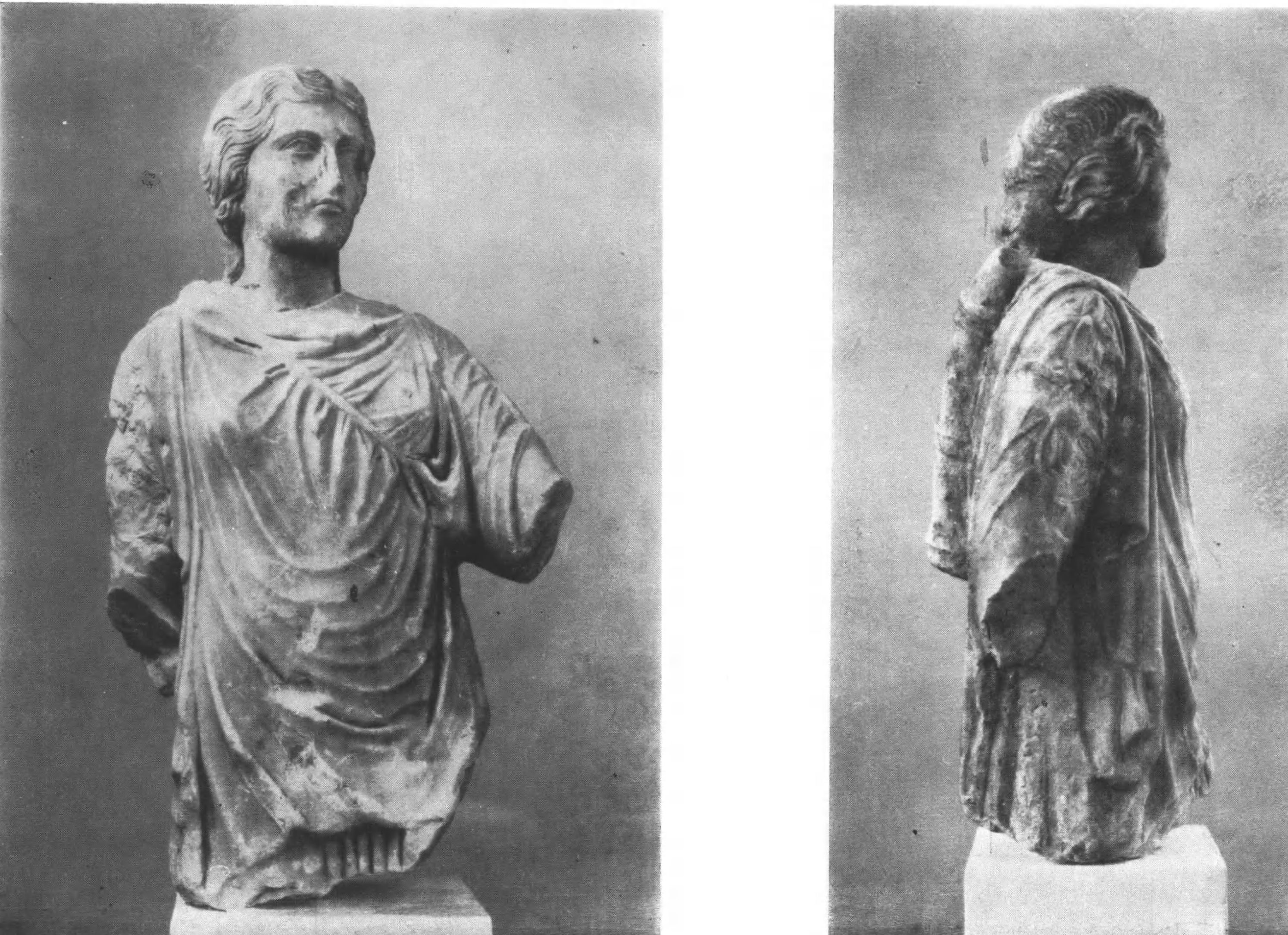
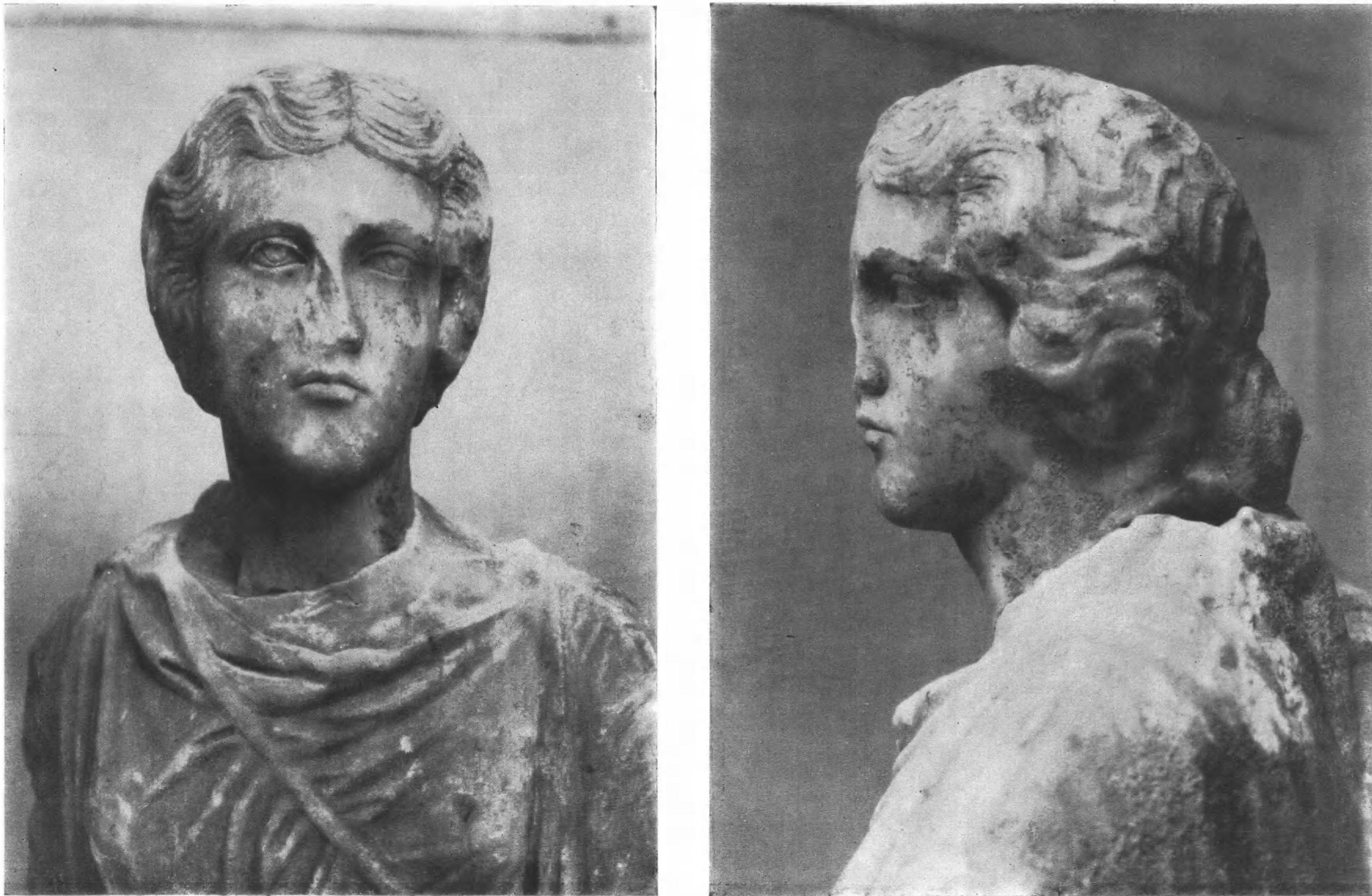
Description - Comments:
Only the upper part of the figure, up to the knees is preserved. Part of the neck is also missing as well as the arms from the elbows. The head is broken and today re-attached to the body. Chipping is evident on the face (nose and chin), on the forehead, and on the folds of the garments. The figure of a young woman, slightly under-life-sized, is depicted standing, in the guise of Artemis (in the “Artemis Colonna” statuary type). She wears a sleeved chiton and an open to the right peplos with an unbelted overfold. A quiver is worn above the peplos, its strap placed diagonally over the left breast. The left hand was extended in front, while the right hand was lowered and almost touched the torso. The head turns sharply to the left. The face is elongated and smooth, with round cheeks and a short fleshy mouth, all traits present in the iconography of Faustina the Younger, in addition to the almond-shaped eyes with thick upper and slightly protruding lower eyelids. The tear-duct, iris and pupil are marked (the latter has a shield-like shape – see Konstantinidis 2024, 397-398, notes 524 and 531). The mass of hair is divided at the center of the forehead into two equal parts. A wreath-like mass of hair surrounds the face at the front and the sides of the head, and is directed in large waves towards the back, covering the ears, ending in a large round bun of superimposed braids (summarily rendered). In the upper part of the head, the hair is combed downwards, almost vertically to the lower wreath-like part of the coiffure. The latter follows quite faithfully the sixth portrait-type of Faustina the Younger, dated ca. 160 CE (for the dating of the type see Chioti 2012, 514-515).
Bibliography:
S. Papaspyridi-Karouzou, “Άγαλμα Αρτέμιδος εξ Αιτωλικού”, ΑrchΕph 1953-1954 Α´, 63-80, figs. 1-2, 5, 14, pls. 1-2· BCH 80 (1956), 295; A. Philippson, E. Kirsten, Der Nordwesten der griechischen Halbinsel II. Das westliche Mittelgriechenland und die westgriechischen Inseln, Frankfurt am Main 1958, 400, note 1; C.C. Vermeule, “Greek, Etruscan, and Roman Sculptures in the Museum of Fine Arts, Boston”, AJA 68 (1964), 331 note 77; S. Karouzou, Εθνικόν Αρχαιολογικόν Μουσείον. Συλλογή γλυπτών, περιγραφικός κατάλογος, Athens 1967, 159; C.C. Vermeule, Roman Imperial Art from Greece and Asia Minor, Cambridge MA 1968, 283, 396 no. 8; A. Datsouli-Stavridi, “Εικονιστική κεφαλή Φαυστίνας της νεωτέρας εις το Μουσείον Πατρών”, ΑΑΑ 6.1 (1973), 168, note 19; M. Wegner, R. Unger, “Verzeichnis der kaiserbildnisse von Antoninus Pius bis Commodus II”, Boreas 3 (1980), 13-14; Κ. Fittschen, Die Bildnistypen der Faustina minor und die Fecunditas Augustae, Göttingen 1982, 54 note 34p; LIMC II (1984) s.v. Artemis, 639 no. 168 (L. Kahil); M. Petropoulos, “Η Αιτωλοακαρνανία κατά τη ρωμαϊκή περίοδο”, in Α’ Αρχαιολογικό και ιστορικό συνέδριο Αιτωλοακαρνανίας, 1991, 115, no. 51; D. Strauch, Römische Politik und griechische Tradition: die Umgestaltung Nordwest-Griechenlands unter römischer Herrschaft, München 1996, 350; N. Kaltsas, Εθνικό Αρχαιολογικό Μουσείο, τα γλυπτά, κατάλογος, Athens 2001, 250, cat. no. 519; G. Zachos, Tabula Imperii Romani J34 – Athens. Achaia Phthiotis – Malis – Aenis – Oitaia – Doris – Eurytania – East and West Locris – Phokis – Aitolia – Akarnania, Athens 2016, 211; E. Chioti, Αυτοκρατορικά και ιδιωτικά πορτρέτα της εποχής των Αντωνίνων στην Ελλάδα (Ph.D. thesis Aristotle University of Thessaloniki), Thessaloniki 2012, 353, cat. no. 203, pls. 163γ, 164; E. Chioti, “Επιδράσεις του έκτου εικονιστικού τύπου της Φαυστίνας της νεότερης στα ιδιωτικά πορτρέτα του ελλαδικού χώρου”, in Th. Stefanidou-Tiveriou, P. Karanastasi, D. Damaskos (eds.), Κλασική παράδοση και νεωτερικά στοιχεία στην πλαστική της ρωμαϊκής Ελλάδας, πρακτικά διεθνούς συνεδρίου, Θεσσαλονίκη, 7-9 Μαΐου 2009, Thessaloniki 2012, 515, 517, fig. 3 (influenced by the sixth portrait-type of Faustina the Younger, ca. 160 CE, work of a less skilled Athenian sculptor); S. Katakis, "Copies of Greek Statuary from Greece in the Roman Imperial Period", in O. Palagia (ed.), Handbook of Greek Sculpture, Berlin 2019, 633, fig. 20.9; P. Konstantinidis, Γυναικείοι δυναστικοί εικονιστικοί ανδριάντες αυτοκρατορικής περιόδου από την Ελλάδα (τέλη 1ου αι. π.Χ. – 5ος αι. μ.Χ.), Athens 2024, 210 note 90.