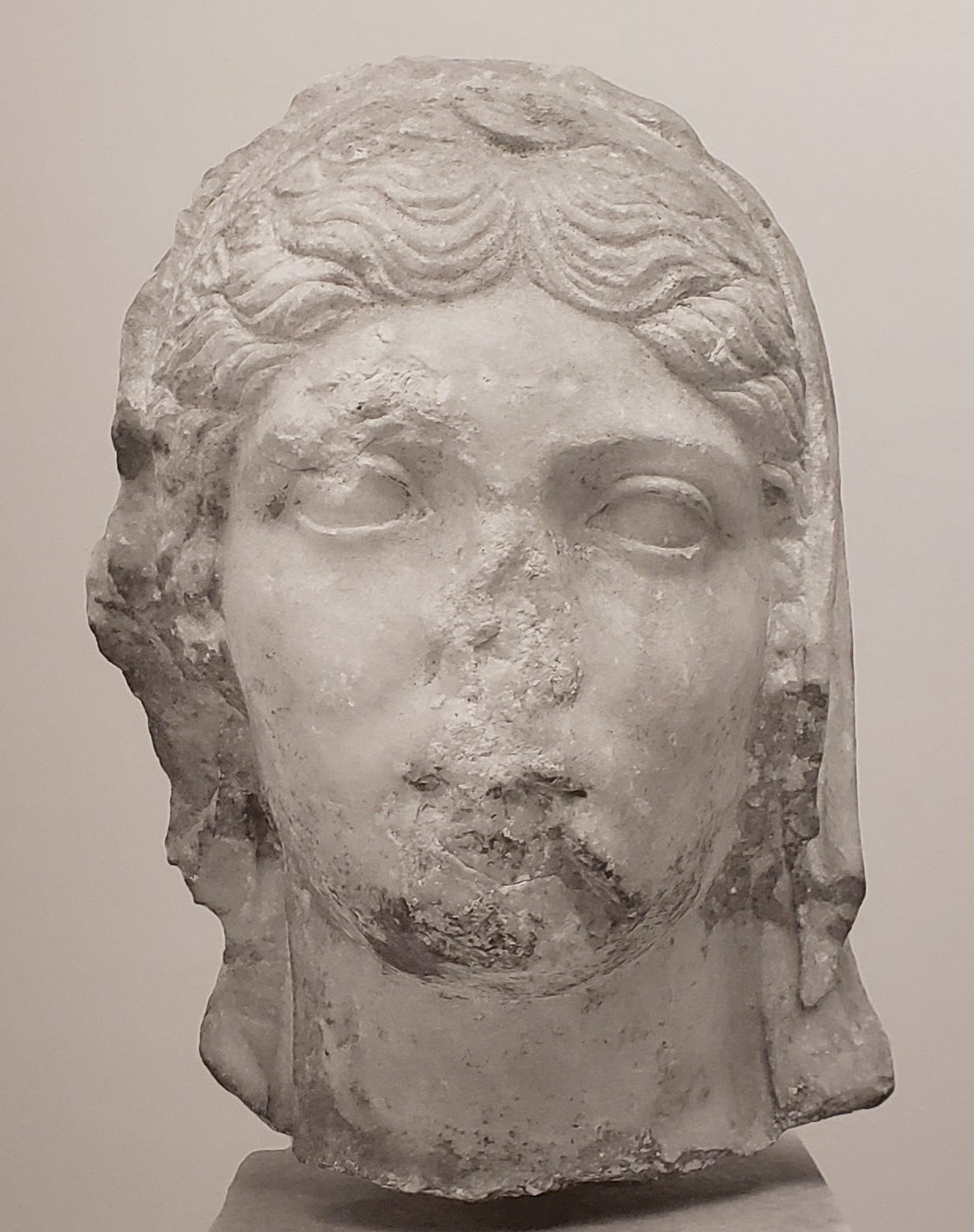
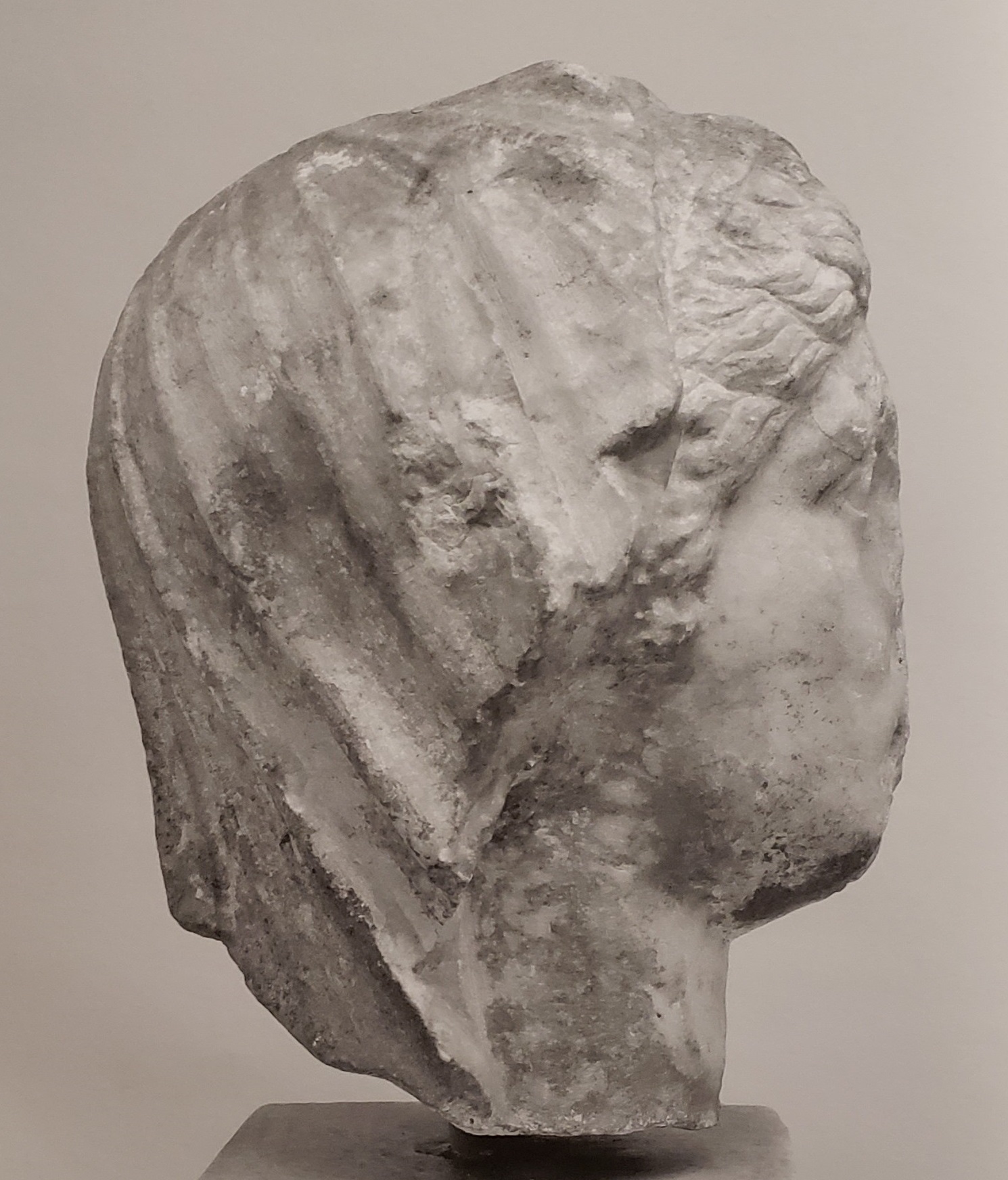
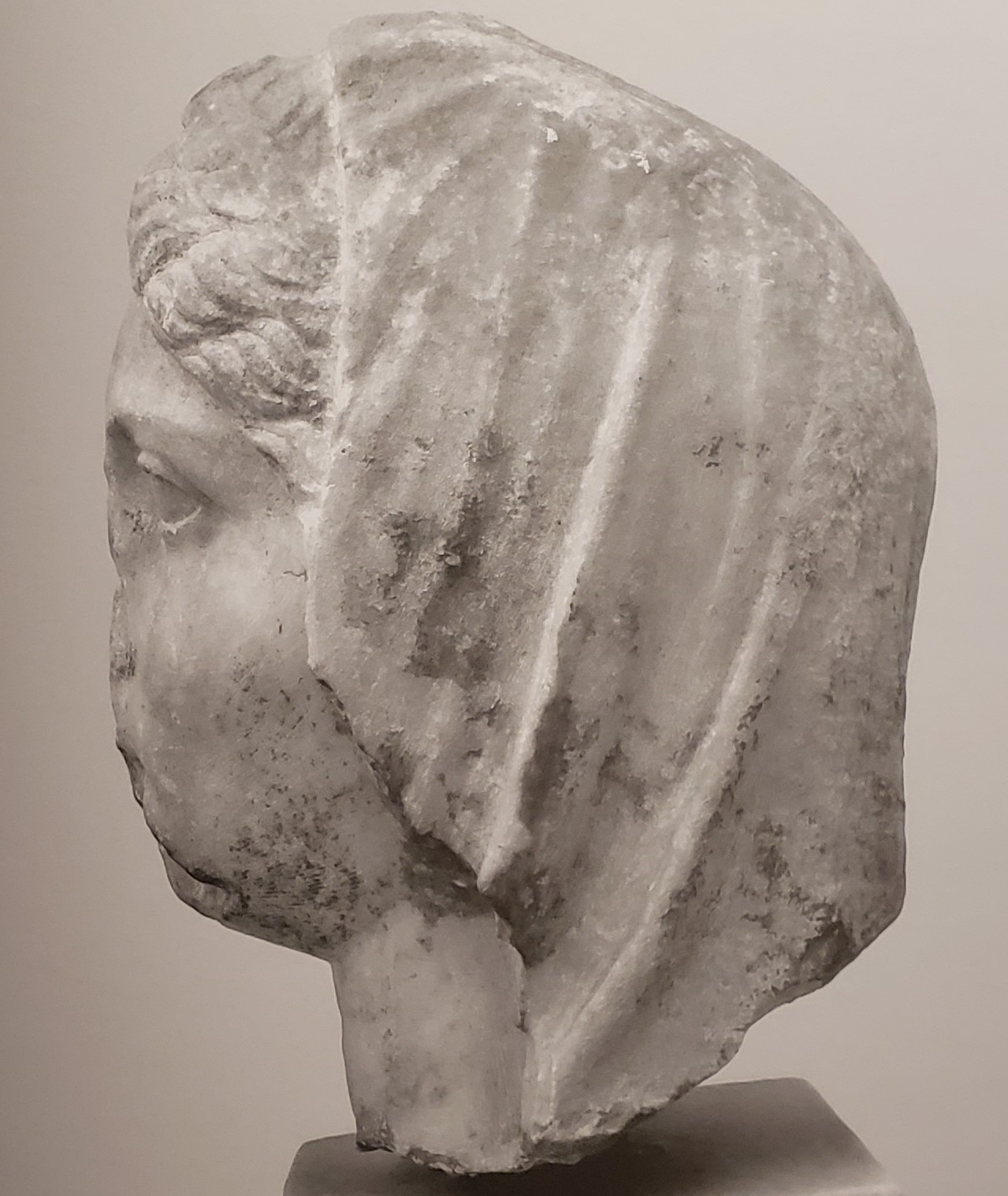
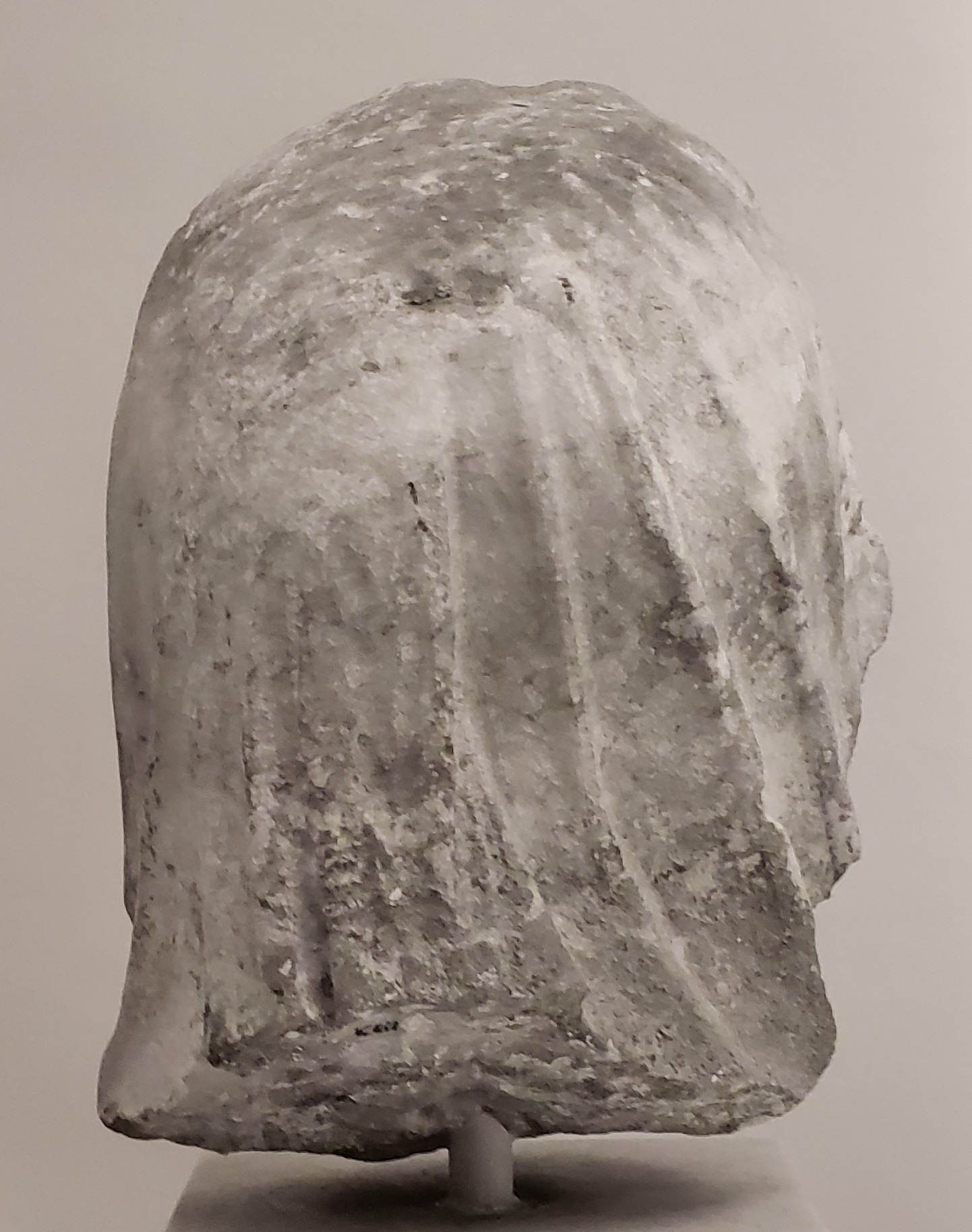
The head is preserved up to the lower part of the neck. The nose, mouth and chin are broken. Small breaks and chipping are evident on the right eyelid, the brow area, sporadically on the surface of the hair, as well as on the himation that covers the head. The edges of the latter are broken on both sides, from the height of the cheeks. The head depicts a young woman with a plump round face, large wide-lidded eyes, a small round chin, and a broad, robust neck bearing a shallow horizontal wrinkle (denoting a “Venus ring”). As already mentioned, the head is covered by the himation, indicating piety (capite velato). Only the front part of the headdress, around the face, is visible, bearing a band-shaped ornament consisting of laurel leaves and a central medallion (an imitation of a real ornament probably made of precious metal). The hair is divided at the top of the forehead into two equal parts, and then combed towards the neck, completely covering (along with the himation) the ears. It is articulated in superimposed, almost flat ridges, which dip one below the next, giving the impression of the wavy surface around the face that we see in portraits of Livia of the “Salus” type (ca. 22/23 CE - cf. the colossal seated figure of Livia from Paestum, now in Madrid, A. Alexandridis, Die Frauen des römischen Kaiserhauses: eine Untersuchung ihrer bildlichen Darstellung von Livia bis Iulia Domna, Mainz am Rhein 2004, 124-125, cat. no. 23, pl. 10.1-2 with previous bibliography [early principate of Tiberius]). The woman depicted borrows the physiognomic traits of the empress. The thin idealistic features of the face with the narrow mouth and chin and the robust neck with “Venus rings” are individual features of Livia, also present in the portrait from Thespies, although the contour of the face appears in the latter clearly wider in its lower part; the cheeks are also clearly fuller. The presence of the leafy ornament indicates the function of priesthood. Wreaths with central medallions (or not), diadems and strophia, are characteristic insignia of local officials and members of the imperial family on the one hand, and of piety, initiation and priesthood on the other. Although the laurel is a symbol closely associated with the imperial house of the Julio-Claudians, Augustus in particular, it is not necessary to identify the figure as a priestess of the imperial cult or of a female member of the imperial house, in this case Livia (more on the issue of the ornament, its symbolism and function see in brief Stephanidou-Tiveriou - Kaltsas 2020, cat. no. IV.1.39, 150-151 with bibliography [E. Vlachogianni]). The laurel is also a preeminent symbol of Apollo, father of the Muses, whose sanctuary lies close to where the work was found, and from which it is likely to have come.
ArchDelt 1890, 140, no. 18; P. Kavvadias, Γλυπτά του Εθνικού Μουσείου: κατάλογος περιγραφικός, Athens 1890, 294, no. 567; P. Kastriotis, Γλυπτά του Εθνικού Μουσείου: κατάλογος περιγραφικός, Athens 1908, 89, nos. 567-568; A. De Ridder, “Fouilles de Thespies et de l’hiéron des muses de l’Hélicon. Monuments figurés”, BCH 46 (1922), 249-250, no. 61, fig. 28 (drawing); A. Datsouli-Stavridi, “Συμβoλή στην εικoνoγραφία της αυτoκράτειρας Λιβίας Δρoυσίλλας στον ελληνικó χώρo”, in Στήλη. Τόμος εις μνήμην Νικολάου Κοντολέοντος, Athens 1980, 300ff, pls. 131-134; A. Datsouli-Stavridi, Ρωμαϊκά Πορτραίτα στο Εθνικό Αρχαιολογικό Μουσείο της Αθήνας, Athens 1985, 29-30, pls. 16-17; R. Winkes, Livia, Octavia, Iulia: Porträts und Darstellungen, Providence R.I. 1995, 200, no. 143 (priestess); K. Romiopoulou, Εθνικό Αρχαιολογικό Μουσείο: συλλογή ρωμαϊκών γλυπτών, Athens 1997, 39, no. 26; M. Bonanno-Aravantinos, “I ritratti di età romana della Beozia: considerazioni preliminary”, in V. Aravantinos ed., Επετηρίς της Εταιρείας Βοιωτικών Μελετών Γ΄. Διεθνές συνέδριο βοιωτικών μελετών, Θήβα 4-8 Σεπτεμβρίου 1996, Athens 2000, 768–770, figs. 6-9 with bibliography (Livia?); N. Kaltsas, Εθνικό Αρχαιολογικό Μουσείο. Τα γλυπτά κατάλογος, Athens 2001, 317, cat. no. 663 with bibliography; M. Kantiréa, Les dieux et les dieux augustes: le culte impérial en Grèce sous les Julio-claudiens et les Flaviens: études épigraphiques et archéologiques, Athènes 2007, 143, 241, no. 19, pl. 24 (posthumous portrait of Livia); Μ. Bonanno-Aravantinos, “La scultura di età romana nella Beozia: importazioni e produzioni locali”, in Th. Stepahnidou-Tiveriou, P. Karanastasi, D. Damaskos eds., Κλασική παράδοση και νεωτερικά στοιχεία στην πλαστική της ρωμαϊκής Ελλάδας. Πρακτικά διεθνούς συνεδρίου, Θεσσαλονίκη, 7-9 Μαϊου 2009, Athens 2012, 238 (Livia); Th. Stephanidou-Tiveriou, N. Kaltsas eds., Εθνικό Αρχαιολογικό Μουσείο. Κατάλογος γλυπτών IV.1. Γλυπτά των ρωμαϊκών χρόνων: τα αυτοκρατορικά πορτρέτα, Athens 2020, 148-153, cat. no. IV.1.39, figs. 159-162 (E. Vlachogianni; Livia or an unknown to us woman, principate of Claudius); P. Konstantinidis, Γυναικείοι δυναστικοί εικονιστικοί ανδριάντες αυτοκρατορικής περιόδου από την Ελλάδα (τέλη 1ου αι. π.Χ. – 5ος αι. μ.Χ.), Athens 2024, 188 note 357, 243-244 no. 1, figs. 46-50 (priestess, principate of Tiberius).