
 Museum/Current place of storage:
 |
Aigina, Kolona, Archaeological Museum. |
 Inv. no:
 |
- |
 Dimensions:
 |
|
 Material:
 |
- |
 Findspot:
 |
Unknown (Aegina?; Aegina was the first seat of the National Archaeological Museum of Greece [1829; see A. Kokkou, Η μέριμνα για τις αρχαιότητες στην Ελλάδα και τα πρώτα μουσεία, Athens 1977, 61-68], in which antiquities from both the island and the rest of the country were gathered until 1837, when the vast majority of them were transported to Athens; even today the Aigina Museum houses antiquities from other parts of Greece, such as Megara and Delos, remnants of the original national collection of antiquities). |
 Original Display Location:
 |
Unknown. |
 Date:
Date: |
Period of Faustina the Younger (ca. 166 CE?). |
 Statuary Type (body) :
 |
- |
 Mode of Self-Representation (head):
 |
The hairstyle follows contemporary imperial fashion protypes (“ModeFrisur”), while the face is idealized with the exception of some individual physiognomic traits. |
 Civic Presence (Social Role Represented):
 |
Unknown. |
 Inscribed Base:
 |
No |
 Author:
 |
Panagiotis Konstantinidis |
 Added:
 |
2024-04-26 |
 Edited:
 |
2024-09-15 |
Description - Comments:
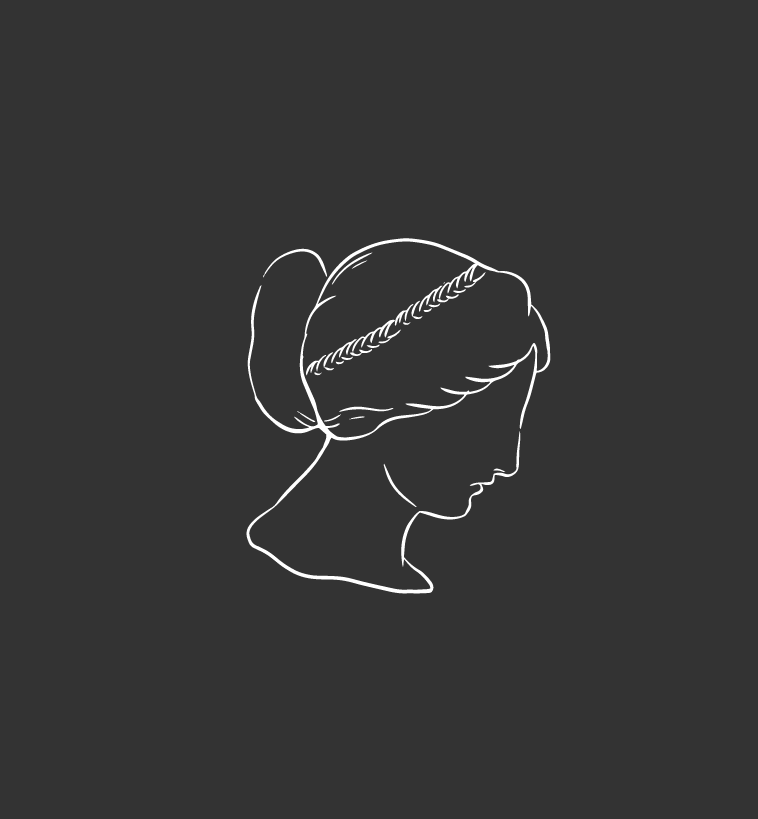
The head is preserved almost intact with the exception of the nose (the two drill-holes for the nostrils are still visible on the surface of the marble), the lower right part of the face, and a large part of the bun at the rear. Chipping and smaller breaks are attested sporadically on the marble surface. The head depicts a woman sporting an oval face, small eyes with thin lids and a unibrow. The individual hairs on the surface of the brow are rendered meticulously with small incisions with the point. The iris and pupil are marked (the latter is almost-heart shaped). The hairstyle follows closely contemporary imperial fashion protypes, in particular the second portrait type of the wife of Lucius Verus, Lucilla (for the type see Fittschen 1982, 78-80, ca. 166 CE). The hair is parted at the top of the head in two equal parts that form strong waves towards the back of the head, where it is gathered in a large circular bun consisting of three individual overlapping braids. The texture of the individual hairs is indicated by dense deep parallel wavy incisions on the surface of the marble. Small lunate locks of hair are indicated in relief on the surface of the marble at the forehead on either side of the parting, at the level of the outer corner of the eyebrows, and in front of the earlobes (the only part of the ears left uncovered by the mass of the hair). High quality product of an Attic workshop.
Bibliography:
K. Fittschen, Die Bildnistypen der Faustina minor und die Fecunditas Augustae , Göttingen 1982, 81, note 44n (follows the second portrait type of Lucilla, ca. 166 CE)· E. Chioti, Αυτοκρατορικά και ιδιωτικά πορτρέτα της εποχής των Αντωνίνων στην Ελλάδα (Ph.D. thesis Aristotle University of Thessaloniki), Thessaloniki 2012, 150, 154, 343-344, cat. no. 185, pl. 151γ-δ (follows the second portrait type of Lucilla, ca. 166 CE)· P. Konstantinidis, Γυναικείοι δυναστικοί εικονιστικοί ανδριάντες αυτοκρατορικής περιόδου από την Ελλάδα (τέλη 1ου αι. π.Χ. – 5ος αι. μ.Χ.), Athens 2024, 212 note 101α·
arachne.dainst.org/entity/1060440