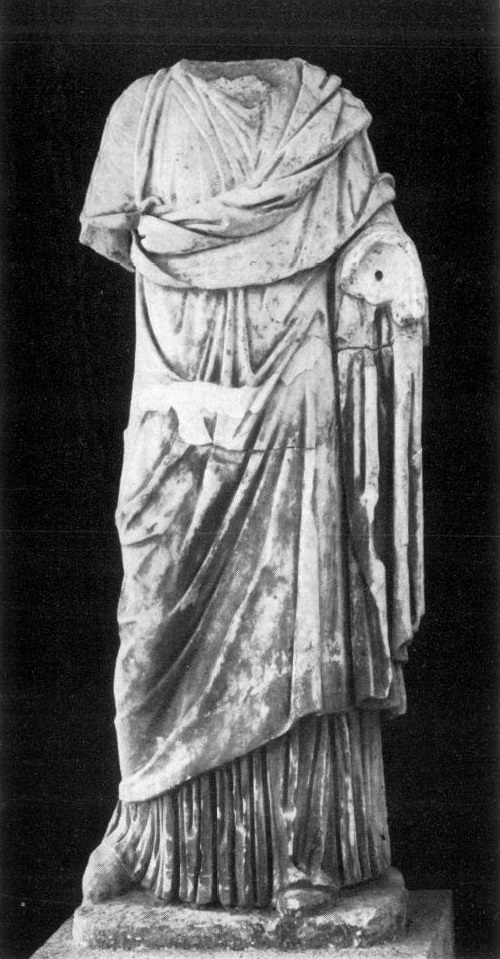
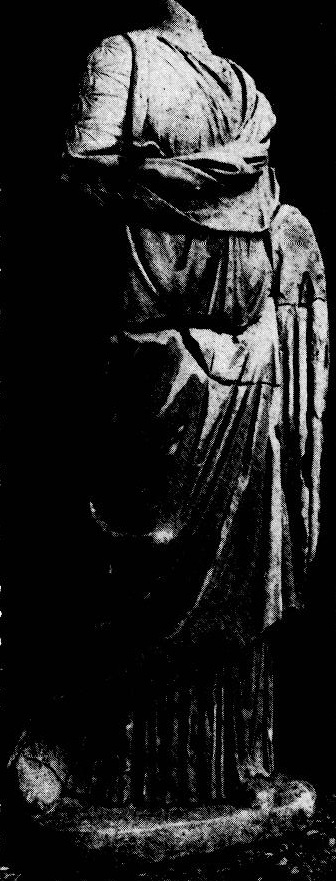
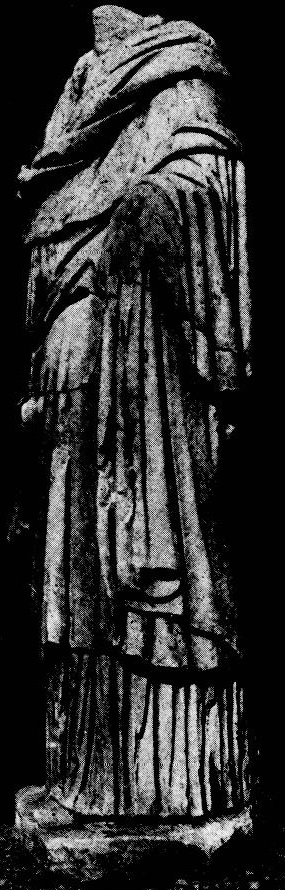
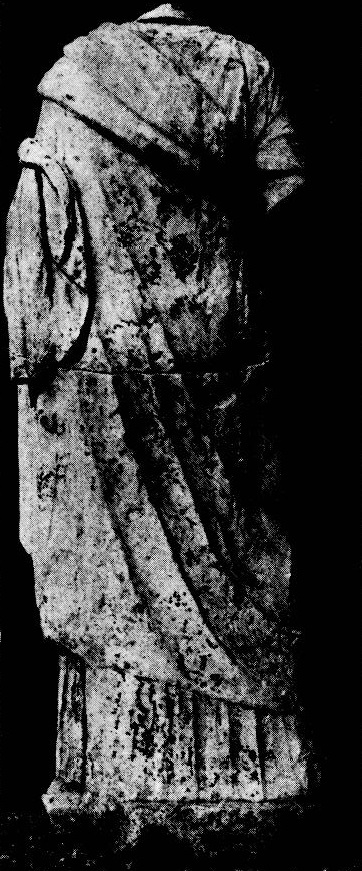
Missing are the head (along with the neck; J. Marcadé [1957, 429] mentions traces of mortar for the setting of the head in its socket), the right arm from the biscep and the left from the middle of the forearm. Chipping is evident sporadically on the surface of the marble. The statue is assembled from three separate main fragments, two for the body and a smaller one for the left arm (a small section at the junction of the torso has been filled with plaster). There is a small puntello on the right hip. The figure is depicted standing, frontal, wearing a sleaved chiton (together with a peronatris according to A. Filges), a himation, and, as far as can be discerned from the available photographs, closed leather shoes (non vidi). The figure rests on the left leg, while the right, bent at the knee, is carried sideways and slightly backwards. The left arm, bent at the elbow is brought forward, while the right would probably be lowered and placed parallel the right thigh. The himation covers most of the body, except for the right part of the chest, forming at the front a diagonal cylindrical mass, partially unfolded, from the height of the right armpit to the left shoulder, from where it continues to the back. Its front edge falls on the left extended arm. The identification of the figure as a portrait is not certain (“dubium”), given its small size (cf. the small size of the three Muses, Manderscheid 1981, cat. nos. 142-144, found in the same space [the Frigidarium]) and findspot (bath complex), although the smaller scale does not exclude it (cf. the small size of the portrait statues of the priestesses of Artemis Orthia in her sanctuary in Messene {Γ125}, {Γ126}, and {Γ127}).
J. Marcadé, E. Raftopoulou, “Sculptures argiennes”, BCH 81 (1957), 407 note 1, 427-429, no. 7, figs. 1e, 14a-d; I. Linfert-Reich, Musen- und Dichterinnenfiguren des vierten und frühen dritten Jahrhunderts, Köln 1971, 58; J. Marcadé, “Sculptures argiennes III”, in Études argiennes, BCH Suppl. 6 (1980), 143, no. 7, fig. 9; H. Manderscheid, Die Skulpturenausstattung der kaiserzeitlichen Thermenanlagen, Berlin 1981, 85, cat. no. 147, pl. 24 (Antonine period· Sappho?); A. Filges, Standbilder jugendlicher Göttinnen, Köln-Weimar-Wien 1997, 107, 108, 164, 169, 171, 205, 221, 277, cat. no. 166 with fig. (early Hadrianic period); https://arachne.dainst.org/entity/1061074?fl=20