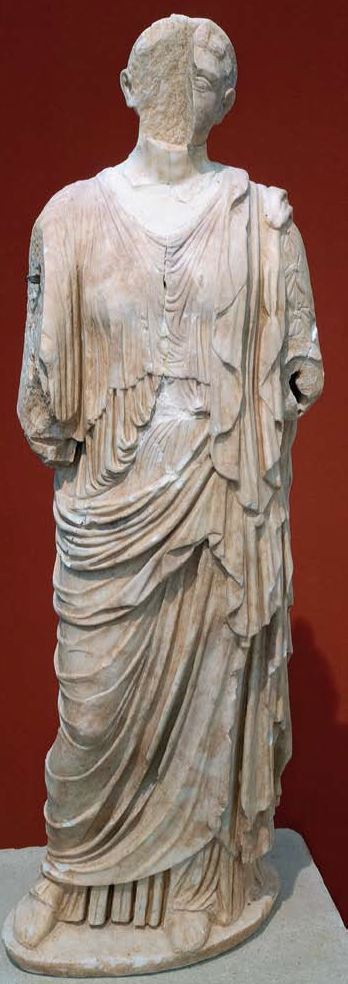
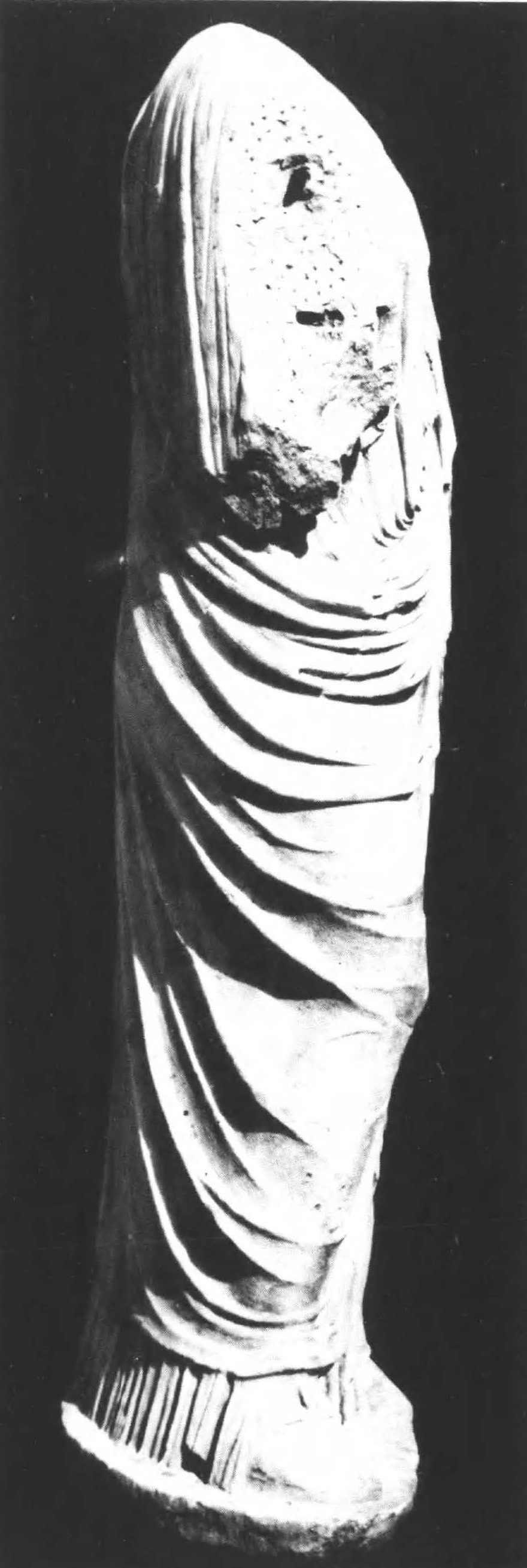
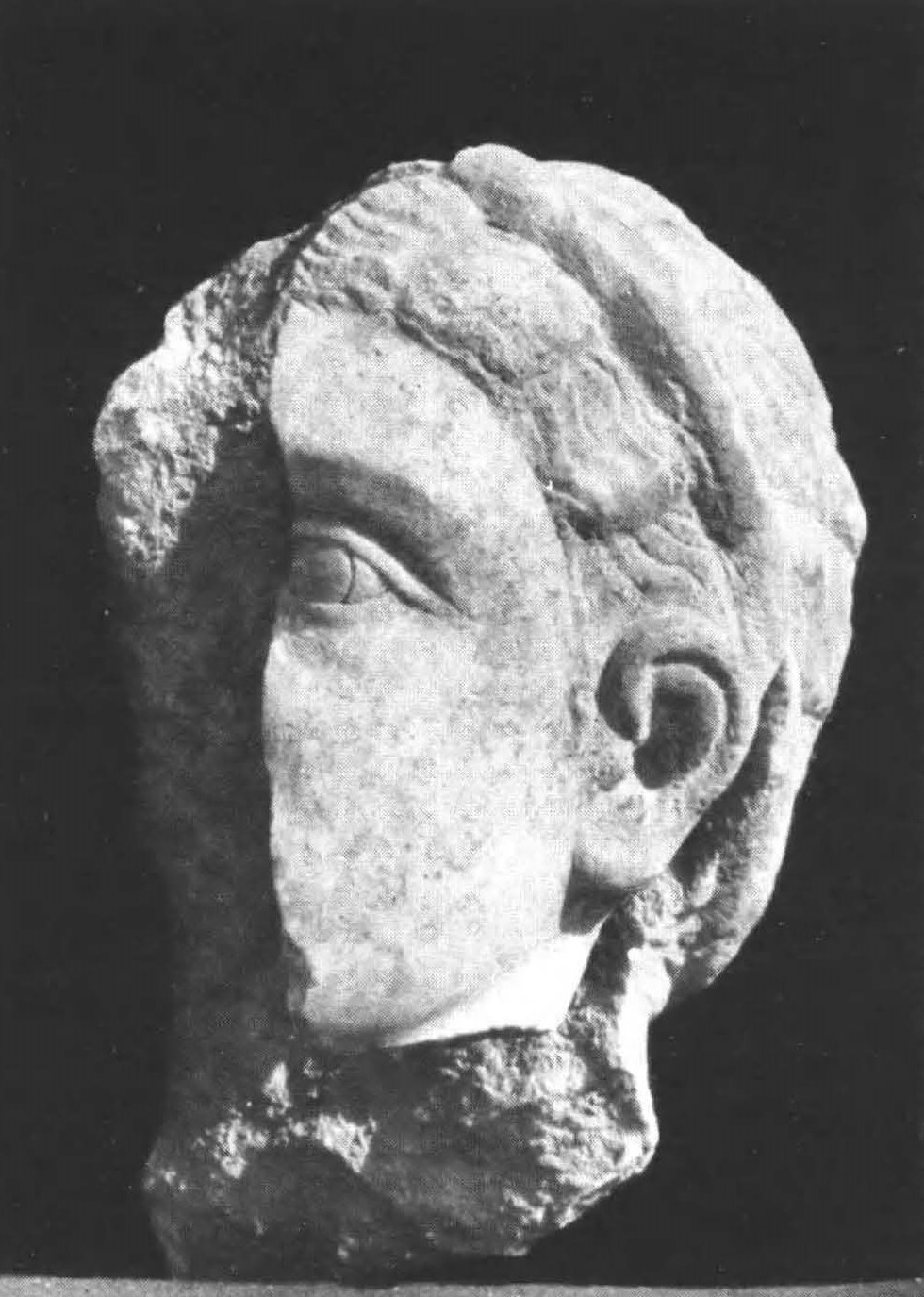
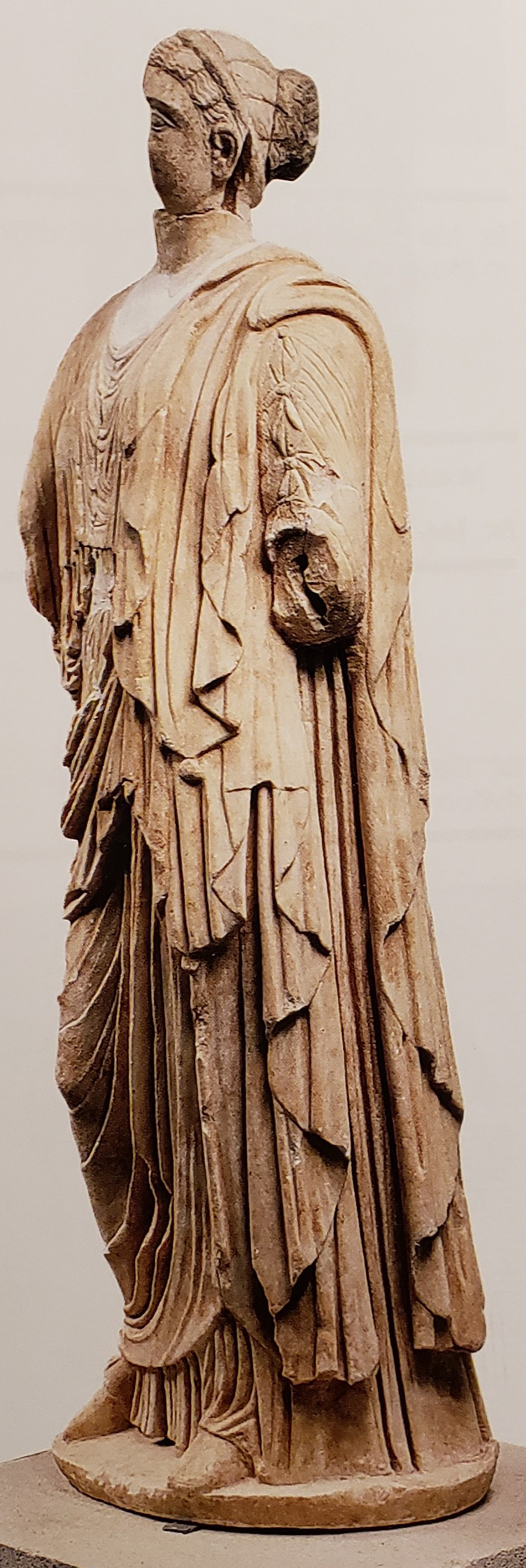
The body of the statue is preserved (put together from several fragments) with a large part of the head and neck (with the tenon). The front right part of the head and the inset arms are missing; the right arm from the shoulder (the surface of the marble has been appropriately chiseled with the point, while there are also two dowel-holes, one of which also preserves the rectangular metal dowel itself [0.009x0.004m; it protrudes ca. 0.018m.]), and the left from about the height of the elbow (on the surface of the marble a curved dowel-hole is preserved). The head was also inset (the insertion cavity which is now covered with plaster bore on its bed a deep dowel-hole). The underside of the plinth has been worked with the point, its vertical sides with the flat chisel, while on the back there are two 0.03m and 0.04 m. long and 0.005m. deep grooves at a distance of 0,15m between them for the insertion of metal cramps in order to fix the plinth to the base (according to G. Despinis [1966, 221] they are probably a little later than the statue). The drill has been used in the carving of the drapery of the garments. Smaller breaks and chipping are observed sporadically on the surface of the marble, especially along the ridges of the folds of the garments. The rear is worked with precision. It depicts a standing (on an oval plinth), frontal smaller than life-size female figure. The weight of the body falls on the left leg, while the right leg is slightly bent. Based on the statuary type, the right arm was brought down, while the left was placed forward. She wears a sleeved chiton with an overfold and kolpos, a long himation, and closed leather shoes (calcei muliebres). It is a fairly faithful, small-scale replica of the cult statue of the Nemesis of Rhamnous. The head and neck are put together from several fragments. The surviving eye is almond-shaped with thin eyelids, while the eyebrow is also thin, ending in a sharp edge. The iris and pupil of the eyes are marked, the cheeks are round. The face is smoothed with the rasp. She wears a “melon” coiffure ending in a bun at the back, as well as a strophion, a symbol of priesthood (probably the statuettes {Γ124} and {Γ125} wore also strophia). Based on both the marking of the iris and pupil of the eyes and the thorough stylistic analysis of G. Despinis (1966, 222-237) the statuette can be dated to the late principate of Hadrian or in the early Antonine period. Mediocre quality of workmanship. The cylindrical inscribed base on which the figure stood (see above) identifies the young woman with the priestess of Artemis, Kallis, daughter of Aristokles; the statuette was commissioned after the successful tenure of her priesthood and dedicated by a state council of elders (οἱ τᾶς Οὐπησίας ἱεροί γέροντες), charged with overseeing the functioning of the sanctuary. In the outstretched, now broken, left hand she probably held an incense box (two hands holding incense boxes in the same material and scale have been found in the oikos of Artemis - see Orlandos 1962, 112ζ, pl. 118β; Despinis 1966, 235, pl. XXXIXα and γ; Themelis 1994, 117, pl. 22; for priestesses holding incense boxes see also P. Konstantinidis, “Archaeology of Anaphe (1100 B.C.-A.D. 600). Part 2”, Ostraka XXX [2021], 102-103 in cat. no. 14).
A. Orlandos, “Μεσσήνη”, Ergon 1962, 127, fig. 151; A. Orlandos, “Ανασκαφή Μεσσήνης”, Prakt 1962, 112β-γ no. 6, pl. Α[13], pl. Β[δ], p. 112ε, 112ζ-θ, pl. 114α-β, 118α, 120β; G.I. Despinis, “Ανδριάς ιέρειας εκ Μεσσήνης”, in Χαριστήριον εις Αναστάσιον Κ. Ορλάνδον ΙΙ, Athens 1966, 220-238, pls. ΧΧΧΙΙ-ΧΧΧIV and XXXVIII; SEG 23 [1968], 216; N. Kaltsas, Αρχαία Μεσσήνη, Athens 1989, 38, no. 14, fig. 23; P. Themelis, “Artemis Ortheia at Messene. The Epigraphical and Archaeological Evidence”, in R. Hägg ed., Ancient Greek Cult Practice from the Epigraphical Evidence, Stockholm 1994, 119, figs. 24-25; E.A. Chlepa, Μεσσήνη. Το Αρτεμίσιο και οι οίκοι της δυτικής πτέρυγας του Ασκληπιείου, Athens 2001, 34, fig. 10[Σ1]); P. Themelis, Αρχαία Μεσσήνη, Ιστορία - Άνθρωποι – Μνημεία, Athens 2010, 321; P. Themelis, Αρχαία Μεσσήνη, Athens 2014, 143, fig. 164.