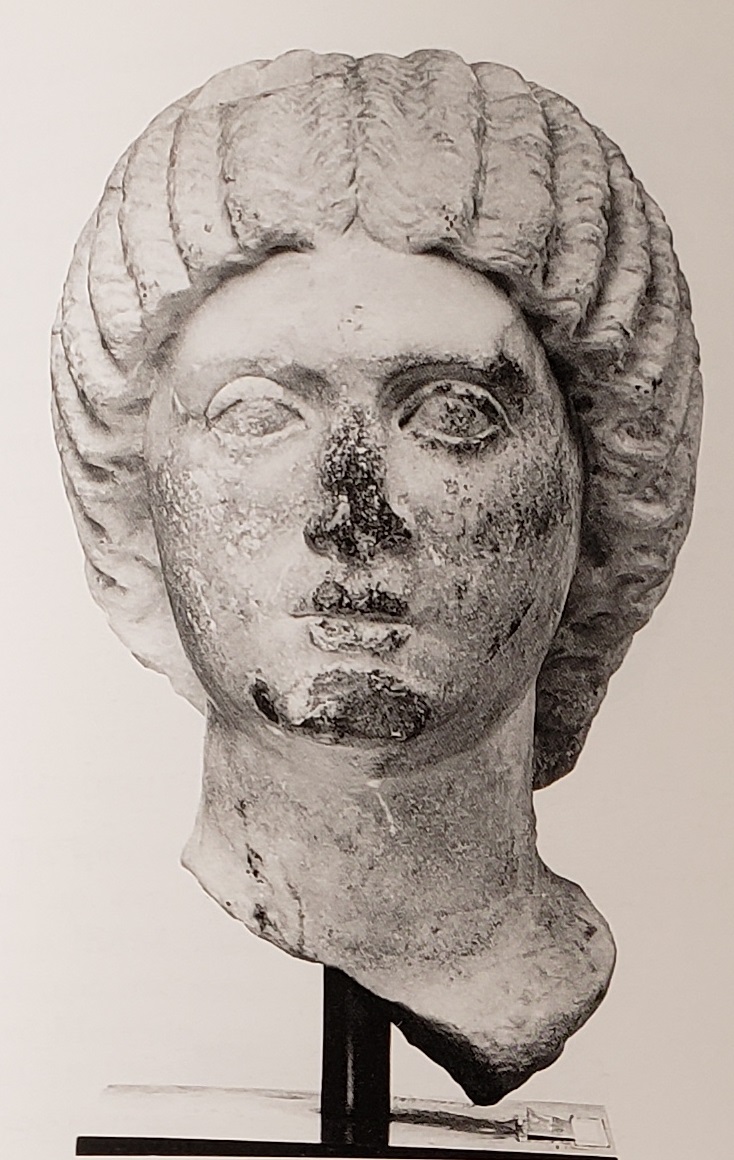
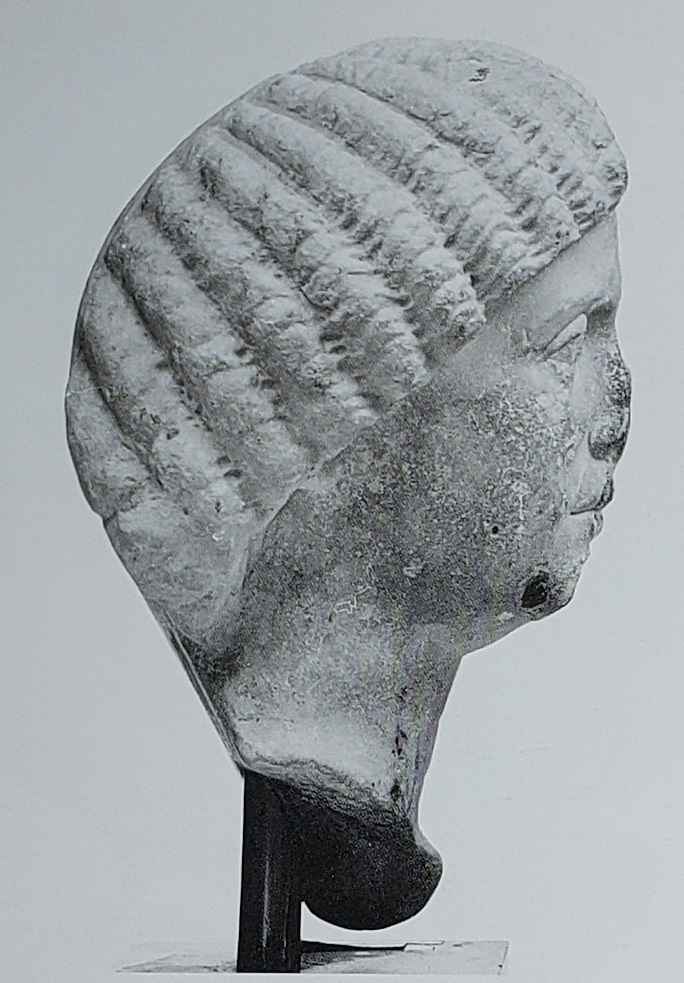
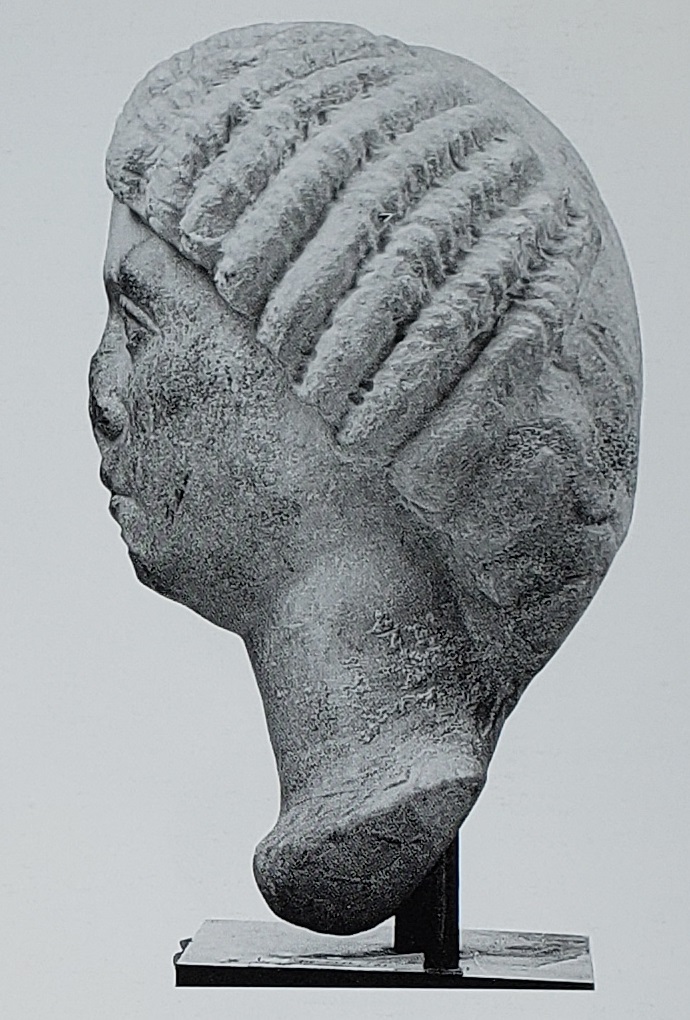
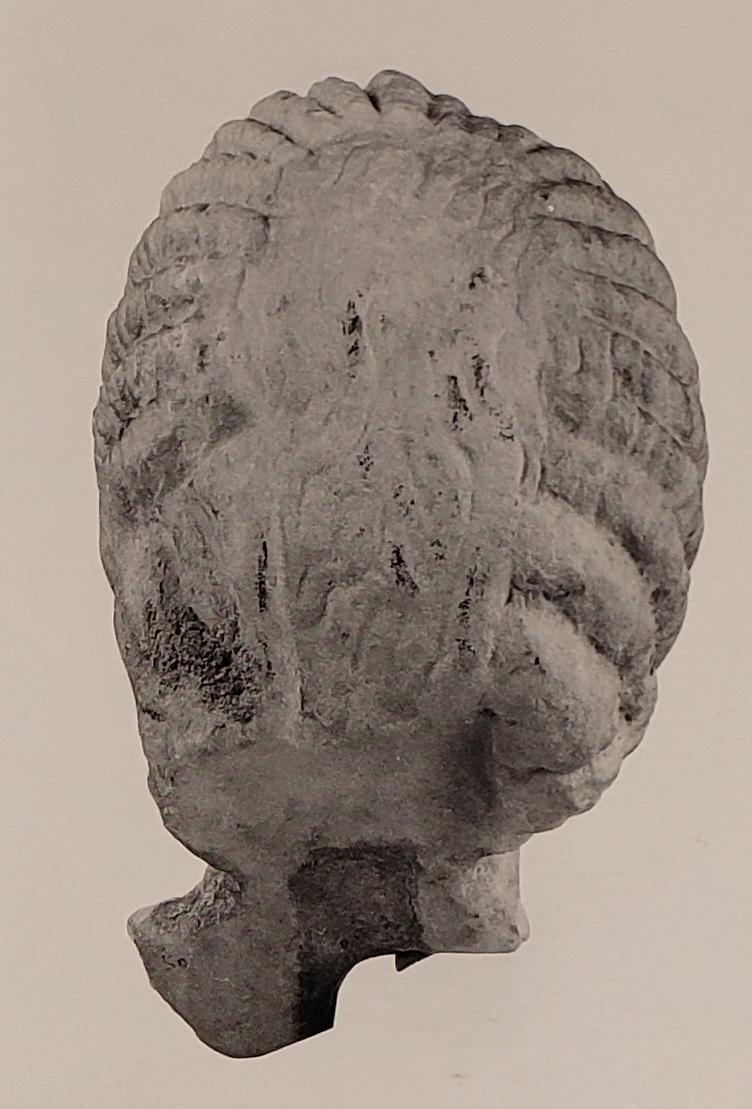
The head is well preserved, together with the neck and the left part of the tenon. The nose (only the nostrils are discernible), the chin and part from the upper right side of the coiffure are broken (the latter perhaps due to the presence of a natural imperfection in the marble). Smaller breaks and chipping are evident on the eyes, cheeks and lips. The rectangular cuttings at the back of the head are modern. The brownish discoloration of the marble may be due to its contact with a metal object (Romiopoulou 2002, 319). The head depicts a young woman with an oval polished face and large almond-shaped eyes with thin lids. The iris (but not the pupil) and tear-duct are indicated. The mouth is small with fleshy lips. Below the broken chin a double chin is indicated, while on the surface of the neck there is a “Venus ring” (individual characteristics of the woman depicted?). The headdress consists of an elaborately carved wig (the texture of the individual strands of hair is indicated by incised parallel lines on the surface of the marble). The wig is divided at the top of the forehead into two equal parts and then combed in narrow, elongated waves (twelve on each side) that cover the entire skull like a cap. At the back of the head, a vertical area from the crown to the nape is left roughly worked with the chisel and point, probably to save labor, indicating that this part of the head was not meant to be seen. According to K. Romiopoulou (2002, 320), the drill-holes on the lower surface of the wig around the face, as well as the non-rendering of the details of the eyebrows and the eyes (e.g. the non-marking of the pupil) do not indicate that the head was left unfinished, but are interpreted as intended by the sculptor. The coiffure follows the iconography of the empress Julia Domna. More specifically, it draws upon the first portrait type of the empress (the so-called “Gabii” type, dated to the period ca. 193-209 CE - for the type see J. Meischer, Das Frauenporträt der Severerzeit, Berlin 1967, 30-63, 122, 130, pls. 36-37; P. Konstantinidis, Γυναικείοι δυναστικοί εικονιστικοί ανδριάντες αυτοκρατορικής περιόδου από την Ελλάδα [τέλη 1ου αι. π.Χ. – 5ος αι. μ.Χ.], Athens 2024, 67 with note 160), indicating a late 2nd – early 3rd c. CE dating for the sculpture.
K. Romiopoulou, “Τρία πορτραίτα της μέσης αυτοκρατορικής περιόδου στο Εθνικό Αρχαιολογικό Μουσείο” in D. Damaskos (ed.), Αρχαία ελληνική γλυπτική. Αφιέρωμα στη μνήμη του γλύπτη Στέλιου Τριάντη, Athens 2002 (Benaki Museum 1st Suppl.), 319-321, figs. 9-12 (Julia Domna?).