
 Museum/Current place of storage:
 |
London, British Museum. |
 Inv. no:
 |
1895,1021.1. |
 Dimensions:
 |
|
 Material:
 |
H. 0,252m. |
 Findspot:
 |
Athens. Purchased by the British Museum in 1895 from Konstantinos Drakopoulos. |
 Original Display Location:
 |
Not known. |
 Date:
Date: |
1st c. CE. |
 Statuary Type (body) :
 |
- |
 Mode of Self-Representation (head):
 |
The coiffure combines wider classicistic protypes with some contemporary traits of the imperial period, while the face is idealized (“non-portrait”). |
 Civic Presence (Social Role Represented):
 |
Priestess or initiate (due to the presence of the strophion). |
 Inscribed Base:
 |
Νο. |
 Author:
 |
Panagiotis Konstantinidis |
 Added:
 |
2024-09-07 |
 Edited:
 |
Description - Comments:
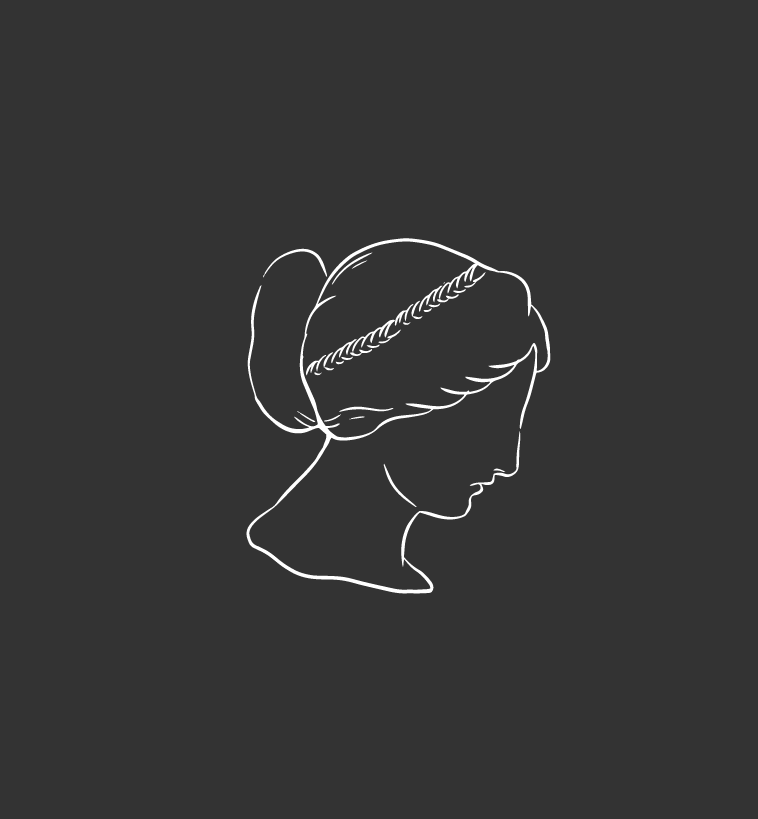
The head is well preserved, with most of the neck. Broken are part of the strophion in front and on the right, part of the neck on the right, as well as the nose (only the drill-holes for the nostrils are visible). Smaller breaks and chipping are evident on the mouth, chin and cheeks. The head depicts a young woman with a plump oval face, smooth cheeks, round eyes with thin lids and a narrow mouth with full lips. The eyebrows are plastically rendered by means of sharp ridges on the surface of the marble. A “Venus-ring” can be seen on the neck. She wears a large cylindrical strophion (the texture of the wrapped cloth is indicated by diagonal parallel incisions, while the two free ends of the binding are not rendered on the back). The hair is divided at the top of the forehead into two equal parts, which frame the forehead and sides of the head, passing over the ears, combed in flat wide waves. At the back of the head, the hair is folded at the nape to form a rectangular bun, held in place by a band. On the entire surface of the coiffure (including the upper part within the space of the strophion), the texture of the individual strands of hair is indicated by engraving of parallel curved lines. As E. Kalavria (2015, 244) observes, the simple classicizing headdress of flat waves around the face derives from the iconography of deities and other mythological figures and of the Classical period. On the contrary, the type of the bun (folded and tied with and horizontal band) and its placement low, at the nape, find parallels in the iconography of female members of the Julio-Claudian dynasty (cf. D. Boschung, “Die Bildnistypen der iulisch-claudischen Kaiserfamilie: ein kritische Forschungsbericht”, JRA 6 [1993], 41-79; see also Kalavria 2015, 244; a similar type of bun - minus the horizontal band and placed higher at the back of the head - can be found in statues of Aphrodite of the so-called “Aspremont-Lynden” type: cf. N. Kaltsas, Εθνικό Αρχαιολογικό Μουσείο, Τα γλυπτά, Κατάλογος, Αθήνα, 244, cat. no. 510, 1st c. CE; A. Pasquier, J.L. Martinez eds., Praxitèle. Paris Musée du Louvre, Paris 2007, 156-157, cat. no. 27 [A. Pasquier], 1st c. CE). These elements combined with the similarity of the face to that of probably a goddess (Nemesis?) from the Agora of Athens, Stoa of Attalos, inv. S 1055 (M.A. Frantz, Agora XXIV: Late Antiquity A.D. 267-700, Princeton NJ 1988, 41, πίν. 39a; P. Konstantinidis, Γυναικείοι δυναστικοί εικονιστικοί ανδριάντες από την Ελλάδα [τέλη 1ου αι. π.Χ. – 5ος αι. μ.Χ.], Athens, 212, note 104, fig. 44; cf. also the similar rendering of the texture of the hair), place the work in the 1st c. CE, perhaps in the middle of the century.
Bibliography:
Α.Η. Smith, A Catalogue of Sculpture in the Department of Greek and Roman Antiquities British Museum III , London 1904, 186, cat. no. 1994, pl. XXI; E. Kalavria, Αττικά πορτρέτα κατά την εποχή της ρωμαιοκρατίας (1ος αι. π.Χ. - αρχ. 2ου αι. μ.Χ.), ζητήματα τυπολογίας, λειτουργίας και παραγωγής (PhD thesis, National and Kapodistrian University of Athens), Athens 2015, 243-245, 483, cat. no. 85, pl. 85 (first half of the 1st c. CE); https://www.britishmuseum.org/collection/object/G_1895-1021-1