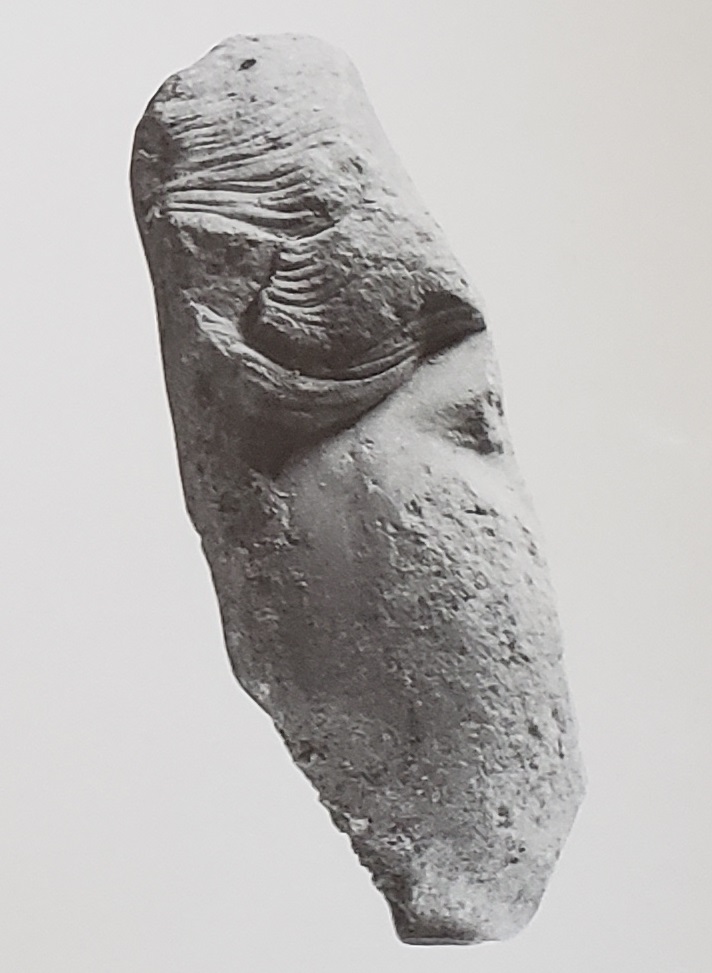
Only a small section of the front right part of the head is preserved, with a small part of the coiffure, the eye and the cheek. All other sides are broken. Abrasions are observed on the surface of the cheek and headdress. It depicts a woman with smooth cheeks. The hair framing the forehead is combed in waves (the texture of individual locks is indicated by dense incisions), directed to the sides and back. Above the temple there are two superimposed clusters of wavy locks of hair. In front of the ear a hook-like lock turns towards the face. As I. Chioti (2012, 148-149) rightly points out, although the small part of the coiffure that survives seems to be influenced by the fourth portrait type of Faustina the Younger (see K. Fittschen, Die Bildnistypen der Faustina minor und die Fecunditas Augustae, Göttingen 1982, 49-51, pls. 17.2-4, 18 [151 CE]) the fragmentary state of preservation of the head does not exclude the influence of later iconographic types of the empress or of the iconography of her daughter, Lucilla. Hence, a dating in the period 151-170 CE is best indicated for the head.
G. Dontas, Corpus Signorum Imperii Romani. Greece I.1 Les portraits attiques au Musée de l'Acropole, Athènes 2004, 66-67, cat. no. 46, pl. 36 (Faustina the Younger; Pentelic marble); I. Chioti, Αυτοκρατορικά και ιδιωτικά πορτρέτα της εποχής των Αντωνίνων στην Ελλάδα (PhD thesis, Aristotle University of Thessaloniki), Thessaloniki 2012, 147, 148-149, 339, cat. no. 177, pl. 132δ (151-170 CE; follows the fourth iconographic type of Faustina the Younger).