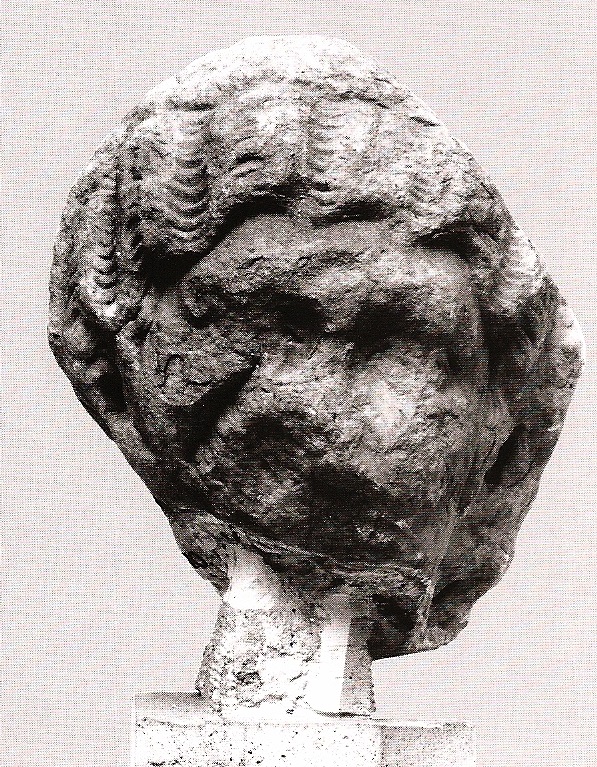
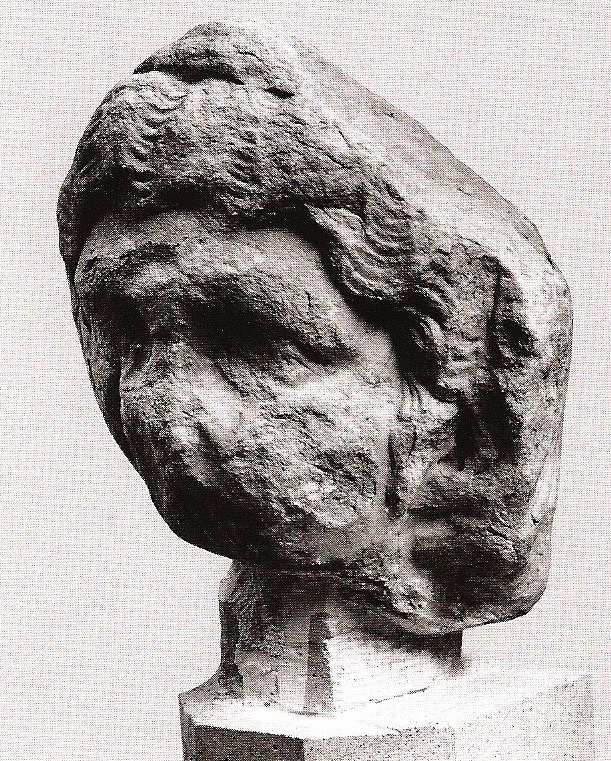
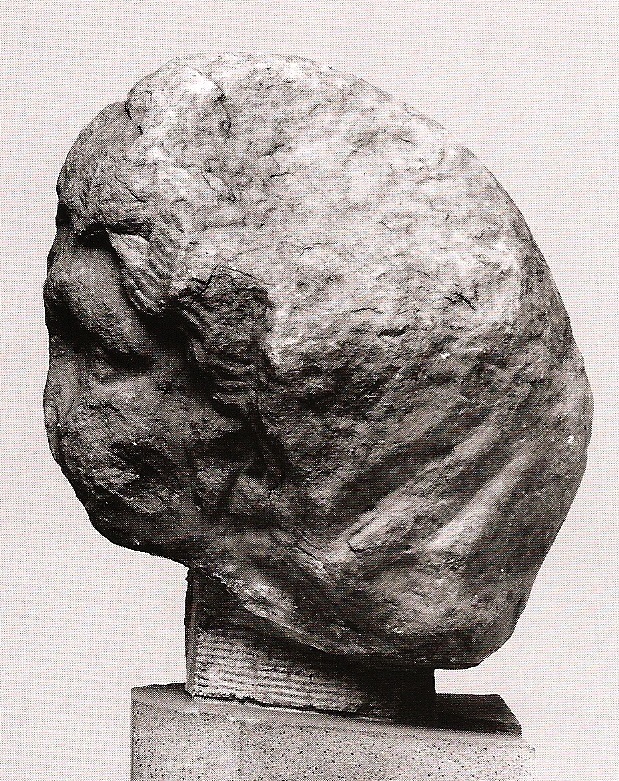
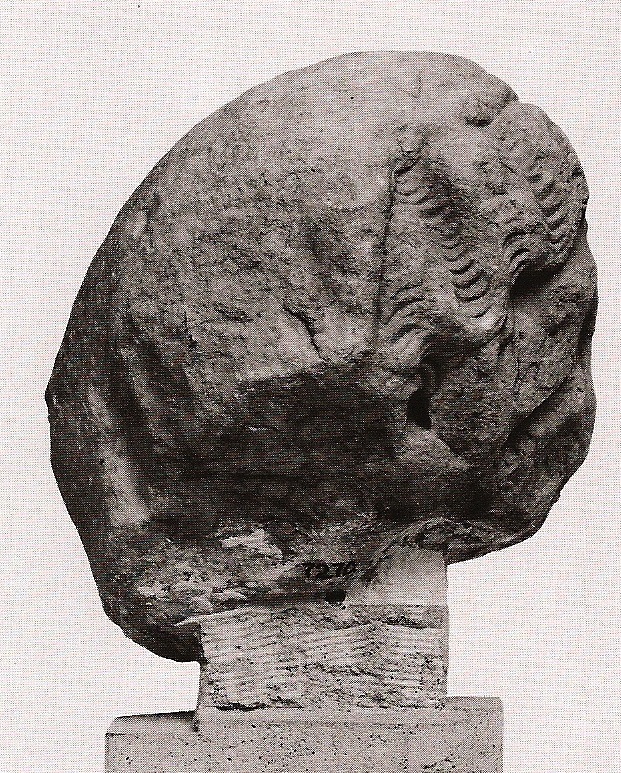
The slightly larger-than-life-size head, is not well preserved. Sections of the upper left (broken diagonally) and lower right part of the head are missing. The lower part of the face, with the nose, as well as part of the himation at the back are also broken off. The part of the head that remains, especially the face, is strongly eroded, with only the outline of the eyes and a small part of the eyelids still discernible. Smaller breaks and chipping are evident sporadically on the surface of the marble. It depicts a woman with her head covered by the himation (capite velato), turning slightly to the right. A wreath (or strophion) is discernible just below the himation. As far as it can be discerned, the woman has a plump oval face with smooth cheeks, and thin eyelids. The hair is divided at the top of the forehead into two equal parts and is combed in deep waves towards the back, where it was probably gathered into a small bun (the texture of the individual stands of hair is carefully rendered with deep parallel incisions on the surface of the marble, worked with the point). A cluster of locks falls in front of each ear. According to the analysis of I. Chioti (2012, 149), the coiffure combines elements from the fourth and fifth portrait types of Faustina the Younger and therefore must be dated to the period 151-159/160 CE (for the fourth and fifth portrait types of the empress see K. Fittschen, Die Bildnistypen der Faustina minor und die Fecunditas Augustae, Göttingen 1982, 49-53). The dating is commensurate with the style of the head, which, as also argued by G. Dontas (2004, 64), is close to the portrait statue from Thera, Athens, National Archaeological Museum inv. no. 708, dated to ca. 147-160 CE (Th. Stephanidou-Tiveriou, N. Kaltsas eds., Εθνικό Αρχαιολογικό Μουσείο. Κατάλογος Γλυπτών IV.1. Γλυπτά των ρωμαϊκών αυτοκρατορικών χρόνων: πορτρέτα αυτοκρατορικά [ανδρικά, γυναικεία, παιδικά], Athens 2020, 160-162, cat. no. IV.1.41, figs. 167-173 [K. Fittschen]; possibly Faustina the Younger).
G. Dontas, Corpus Signorum Imperii Romani. Greece I.1 Les portraits attiques au Musée de l'Acropole, Athènes 2004, 64, cat. no. 41, pl. 32 (priestess); I. Chioti, Αυτοκρατορικά και ιδιωτικά πορτρέτα της εποχής των Αντωνίνων στην Ελλάδα (PhD thesis, Aristotle University of Thessaloniki), Thessaloniki 2012, 149, 339, cat. no. 178, pl. 144 (151-160 CE; draws upon the fourth and fifth iconographic types of Faustina the Younger).