SCULPTURE

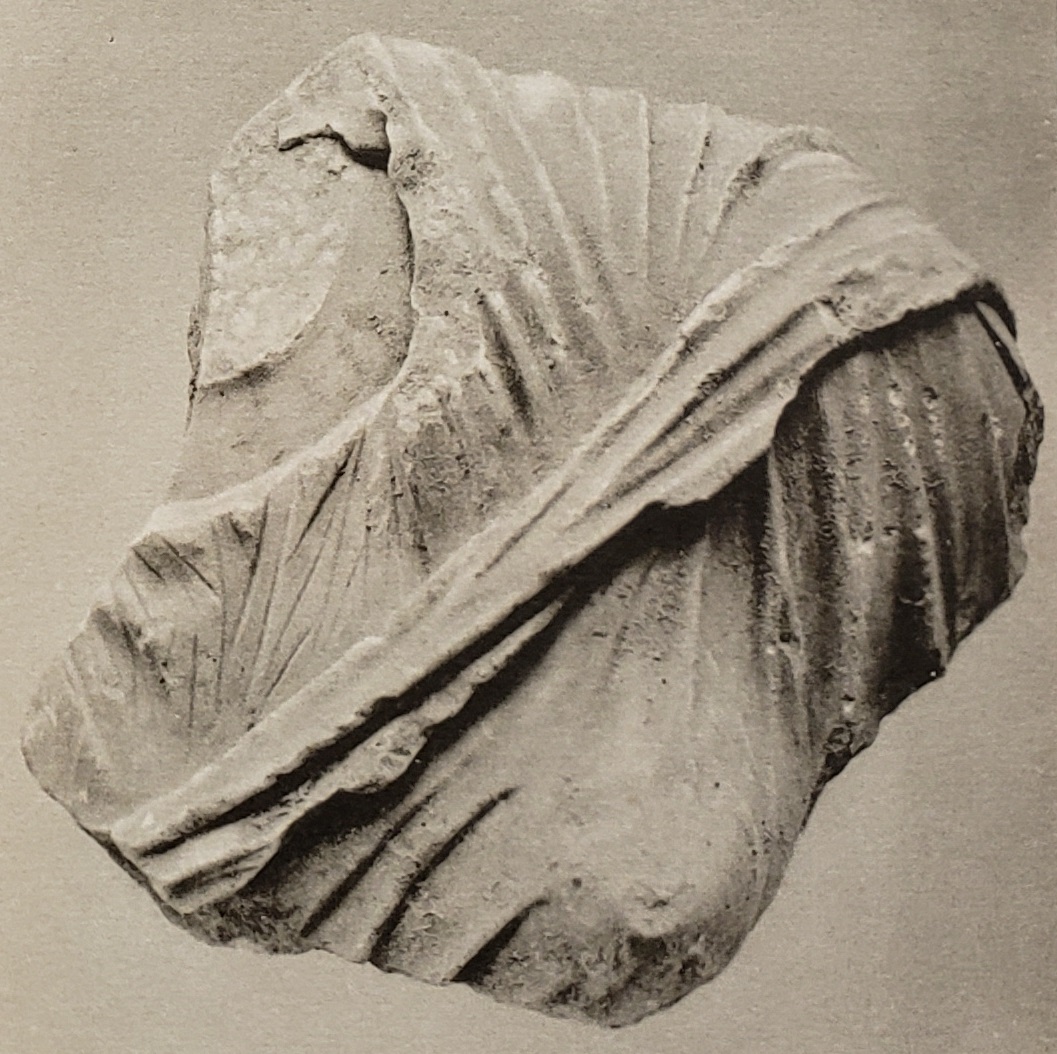
Female portrait statue Γ56

  Museum/Current place of storage: Athens, Kerameikos Museum.
  Inv. no: P 184+P 207+P 255
  Dimensions:
  Material: H. 0,33m. w. 0,39m. (fragment P 184), h. 0,55m., w. 0,45m. (fragment P 207), h. 0,31m. (fragment P 255).
  Findspot:

In Athens, in the Kerameikos necropolis, by the Sacred Gate (see in brief E. Greco ed. Topografia di Atene 4. Ceramico, Dipylon e Accademia, Atene-Paestum 2014, 1275-1276, no. 10.18 [M.C. Monaco]).

  Original Display Location:

Most probably, either part of an honorary portrait statue erected by or close to the Sacred Gate, or part of the sculptural decoration of an impressive funerary monument (mausoleum/Heroon) in the area of the Sacred Gate (cf. the mausoleum of Flavia Nike in the area just in front of the Dipylon – see E. Greco ed., Topografia di Atene 4. Ceramico, Dipylon e Accademia, Atene-Paestum 2014, 1321-1324, fig. 816 [D. Marchiandi]; see also J. Stroszeck, “Römische Gräber und Grabbauten vor dem Dipylon”, in S. Vlizos ed., Athens During the Roman Period. Recent Discoveries, New Evidence, Athens 2008, Mouseio Benaki, 4th Supplement, 291-309).

  Date: Late Hadrianic – early Antonine period.
  Statuary Type (body) : “Large Herculaneum Woman”.
  Mode of Self-Representation (head): -
  Civic Presence (Social Role Represented): Unknown.
  Inscribed Base: No.
  Author: Panagiotis Konstantinidis
  Added: 2024-09-17
  Edited:

Description - Comments:

Only three fragments of the figure survive; the upper left part of the torso with the shoulder, part of the abdominal area, and the lower part of the left leg. Rasp marks are observed on the surface of the marble. Traces of mortar indicate that the fragments were used as building material. The statue depicts a standing female figure wearing a long chiton and a wide himation that covers most of the body, following the “Large Herculaneum Woman” type. Based on the stylistic analysis, the statue can be dated to the late principate of Hadrian or the early Antonine period (see Kruse 1975, 49-50, 275).

Bibliography:

H. Riemann, Kerameikos: Ergebnisse der Ausgrabungen II. Die Skulpturen vom 5. Jahrhundert bis in römische Zeit, Berlin 1940, 96-97, no. 131 (P 207), no. 133 (P 184), pl. 24 (Hadrianic); H. Kruse, Römische weibliche Gewandstatuen des zweiten jahrhunderts n.Chr., Göttingen 1975, 49-50, 260 no. 20, 275, cat. no. Β 17, pl. 18 (late Hadrianic period, ca. 130s CE); A. Alexandridis, Die Frauen des römischen Kaiserhauses: eine Untersuchung ihrer bildlichen Darstellung von Livia bis Iulia Domna, Mainz am Rhein 2004, 239, no. 19; J. Daehner ed., The Herculaneum Women. History, Context, Identities, Los Angeles 2007, 167 note 21; J. Trimble, Women and Visual Replication in Roman Imperial Art and Culture, Cambridge 2011, 362-363, cat. no. 3.