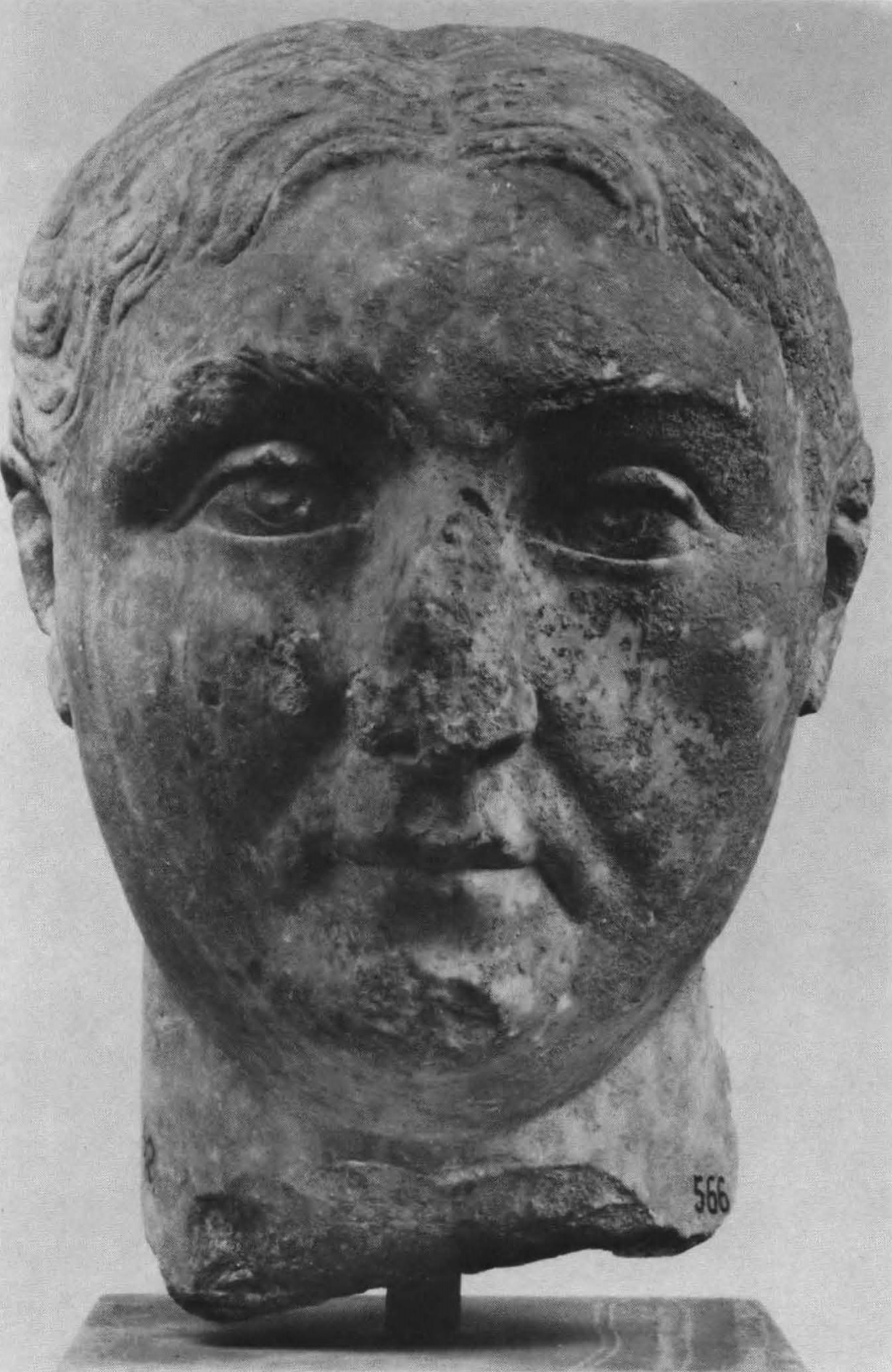
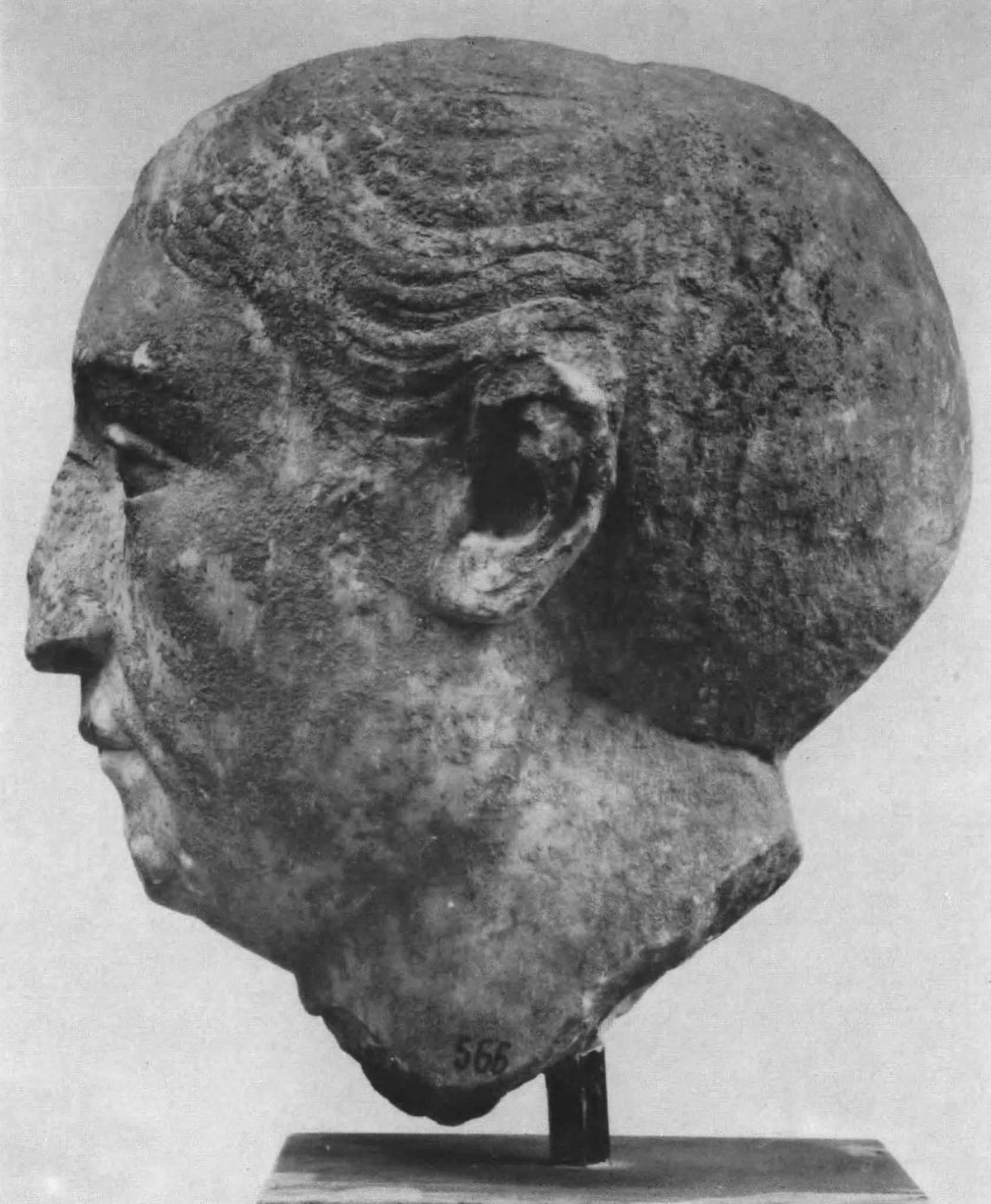
Only the head of the statue survives, broken at about the middle of the neck. The chin and nose are also partially broken. It depicts a middle-aged woman with a plump, puffy face, narrow chin, and a broad, plump neck and double chin. The iris and pupil of the eyes are marked (the pupil is round in shape). The texture of the individual eyebrow hairs is meticulously rendered with small incisions. The nasolabial folds are accentuated (probably an individual trait of the woman depicted). The headdress is rendered without particular volume, almost in relief (worked with the point and flat chisel). The mass of hair is divided at the top of the forehead into two equal parts (the first fringes are very short and left free on either side of the parting), and then combed into a flat wavy pattern towards the back of the head, where a hemispherical mass of marble is left rough-worked with the flat chisel (this part of the head was probably not meant to be seen). The latter also indicates that a bun would probably occupy the entire back of the head. The ears are left completely uncovered. Although the broad bun at the back of the head, is reminiscent of the broad wig bun in the official iconography of Julia Domna (193-211 CE; J. Meischer, Das Frauenporträt der Severerzeit, Berlin 1967, pl. 1, nos. 1-2), the arrangement of the hair at the front part of the head, framing the face (parting, short locks of hair on either side, soft flat waves; also uncovered ears) is close to the second portrait type of the empress Plautilla (the so called “Vatican Sala dei Busti 300” type, 202 CE; see Meischner 1967, 83-84; H.B. Wiggers, M. Wegner, Das Römische Herrscherbild. III.1. Caracalla, Geta, Plautilla, Macrinus bis Balbinus, Berlin 1971, 118-120). In the same portrait type we also see a broad, nevertheless completely flat, bun that occupies the entire back part of the head, although the hair arrangement of the lateral sides is different (probably in the head of the National Museum the sculptor simplified the whole arrangement).
L. von Sybel, Katalog der Skulpturen zu Athen, Marburg 1881, no. 3093; P. Kavvadias, Γλυπτά του Εθνικού Μουσείου: κατάλογος περιγραφικός, Athens 1890, 294, no. 566; P. Kastriotis, Γλυπτά του Εθνικού Μουσείου: κατάλογος περιγραφικός, Athens 1908, 88, no. 566; A. Datsouli - Stavridis, “Γυναικεία πορτρέτα της εποχής των Σεβήρων στο Αρχαιολογικό Μουσείο Αθηνών”, ArchEph 1979, 229, pl. 71α-β; A. Datsuli - Stavridis, Ρωμαϊκά πορτραίτα στο Εθνικό Αρχαιολογικό Μουσείο της Αθήνας, Athens 1985, 74-75, no. 566, pls. 97-98.