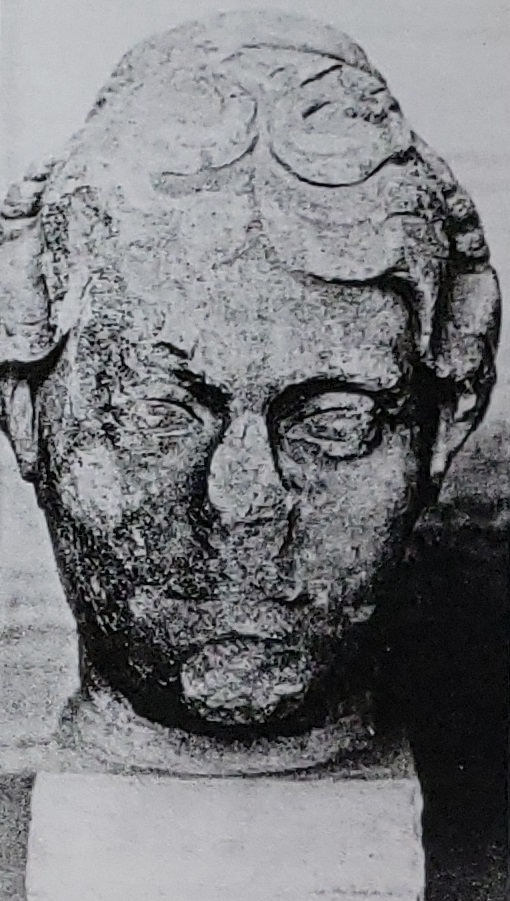
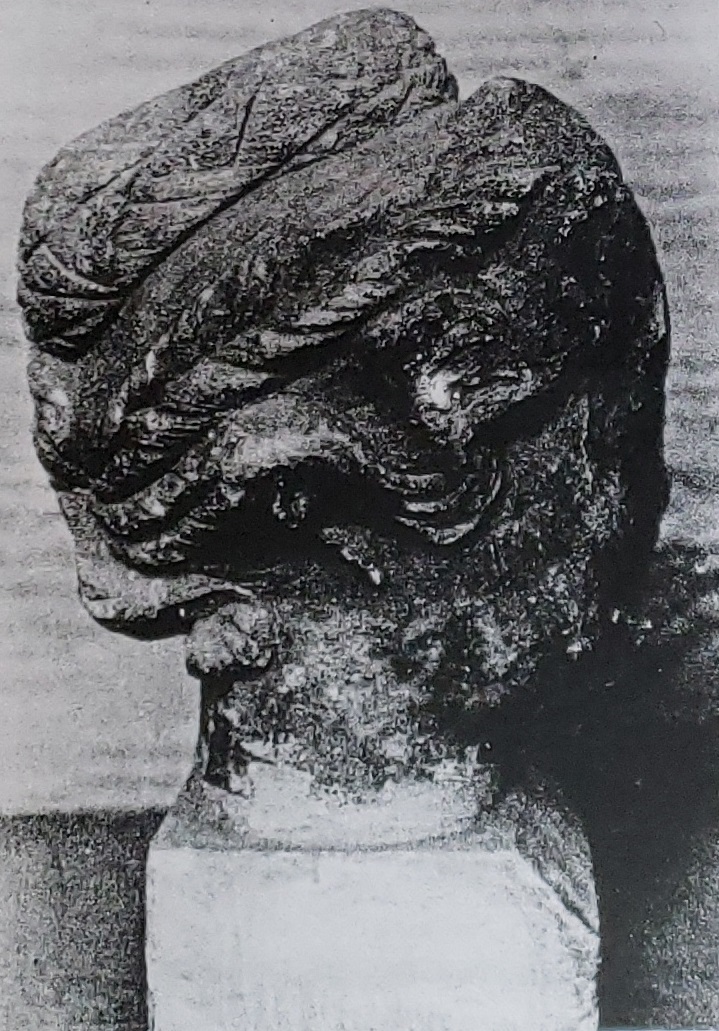
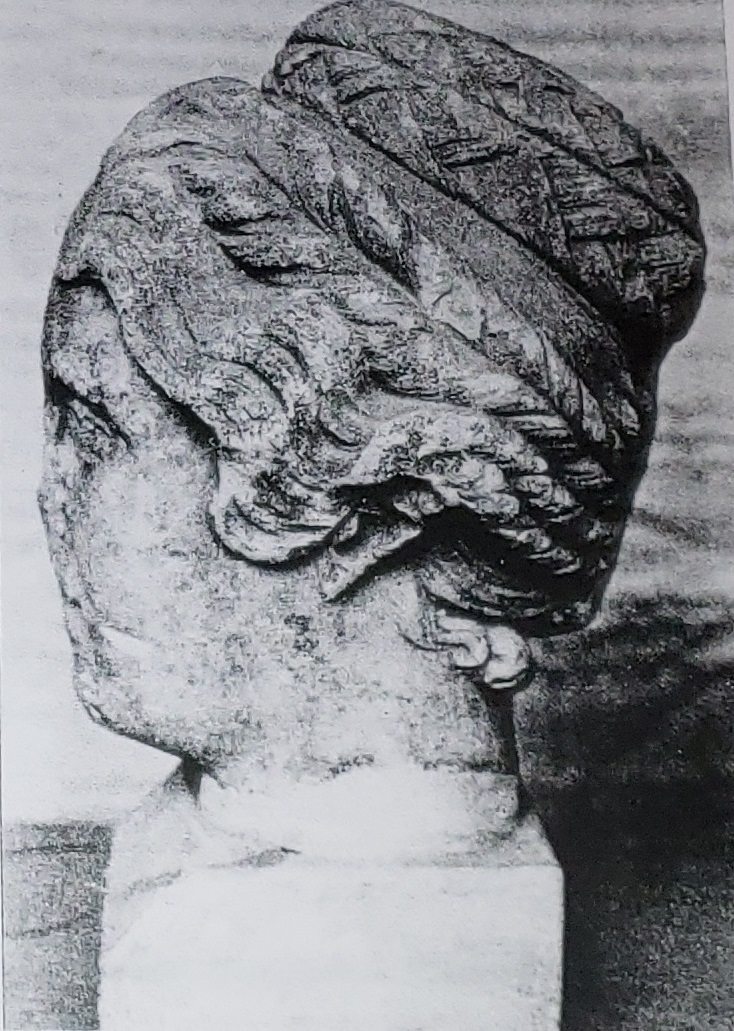
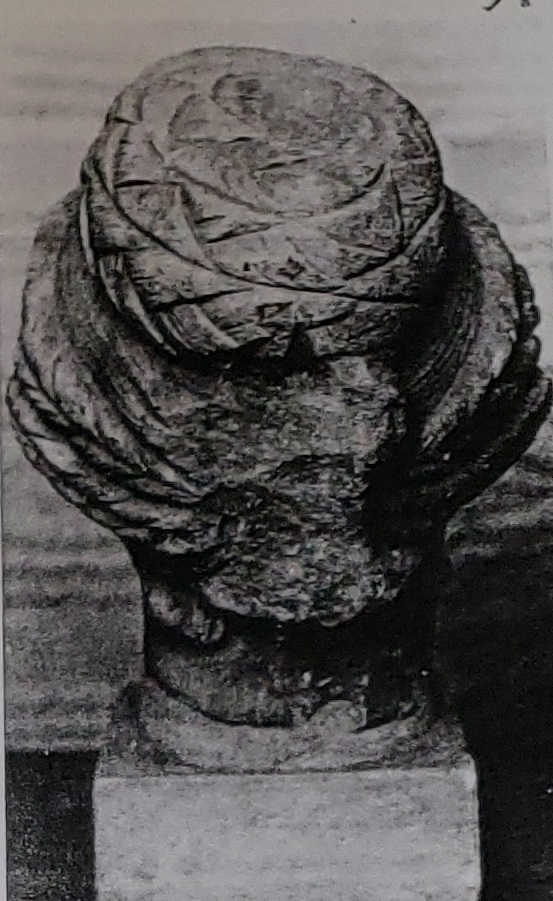
The head is preserved with the beginning of the neck. The nose, mouth, chin and part of the coiffure at the back are broken. Smaller breaks and chipping are observed on the forehead, cheeks, eyes, ears, as well as sporadically on the surface of the hair. Traces of weathering are visible on the entire surface of the marble. It depicts a mature woman turning slightly to the left. She has an oval plump face, broad forehead and smooth cheeks. The eyebrows are thin, the eyes almond-shaped with wide lids. The iris, pupil and tear-duct are marked. The hair is divided at the top of the forehead into two equal parts, which form large waves and are directed to the sides, covering most of the ears; behind the latter they form two superimposed twisted plaits. Another two thick twisted plaits follow above, while even higher and placed at an angle there is a cylindrical bun made of braids. Another vertical braid (now broken) started from the nape and ended into the bun. The texture of the locks of hair on the surface of the braids is indicated by triangles and zig zag incisions. Several small curly locks of hair are left free on the surface of the nape. The coiffure follows the fourth iconographic type of Faustina the younger, dated to ca. 151 CE (K. Fittschen, Die Bildnistypen der Faustina minor und die Fecunditas Augustae, Göttingen 1982, 49-51, pl. 17.2- 4) with a few differences, such as the smaller number of braids forming the bun, the twisted plaits in which end the waves framing the face, but also the partial covering of the ears.
A. Datsulis-Stavridis, “Antoninische Porträts in Dimitsana, Arkadien”, Boreas 12 (1989), 136, pl. 37; I. Chioti, Αυτοκρατορικά και ιδιωτικά πορτρέτα της εποχής των Αντωνίνων στην Ελλάδα (PhD. thesis Aristotle University of Thessaloniki), Thessaloniki 2012, 338, cat. no. 175, pl. 142 (draws on the fourth iconographic type of Faustina the Younger).