
 Museum/Current place of storage:
 |
Messene, Archaeological Museum. |
 Inv. no:
 |
12286+14481 |
 Dimensions:
 |
|
 Material:
 |
H. 2,02m., w. 0,66m., th. 0,357m. |
 Findspot:
 |
In fragments, in 2002 and 2005 in the east parodos of the theatre of Messene, next to the inscribed base Messene Archaeological Museum inv. no. 11152 (Themelis 2000, 80-81, pl. 45α-β), which was found inside the eastern niche of the scaenae frons (for the theatre see in brief P. Themelis, Τα θέατρα της Μεσσήνης [Ancient Theatres 4], Athens 2010, 19-39; Themelis 2010, 92-114; Geivanidou 2021, 170-173). |
 Original Display Location:
 |
Inside the east niche of the scaenae frons of the theatre, next to the portrait statue of her son, Tiberius Claudius Saethidas Caelianus I (inscribed base Messene, Archaeological Museum inv. no. 9625: Themelis 2000, 78-79, pls. 43-44). |
 Date:
Date: |
Antonine period (ca. the decade 150-160 CE). |
 Statuary Type (body) :
 |
“Large Herculaneum Woman”. |
 Mode of Self-Representation (head):
 |
- |
 Civic Presence (Social Role Represented):
 |
Member of a local elite family (the Saithidai). |
 Inscribed Base:
 |
Yes. For the lengthy honorary decree inscribed on the base that characterizes her as “Hestia of the city” see Themelis 2000, 80-81, l. 25; SEG 51, 458; A.D. Rizakis, s. Zoumbaki, Cl. Lepenioti, Roman Peloponnese II. Roman Personal Names in Their Social Context (Laconia and Messenia) Meletemata 36, Athens 2004, 508, no. MES 123; SEG 55 (2005), 516. |
 Author:
 |
Panagiotis Konstantinidis |
 Added:
 |
2024-09-18 |
 Edited:
 |
Description - Comments:
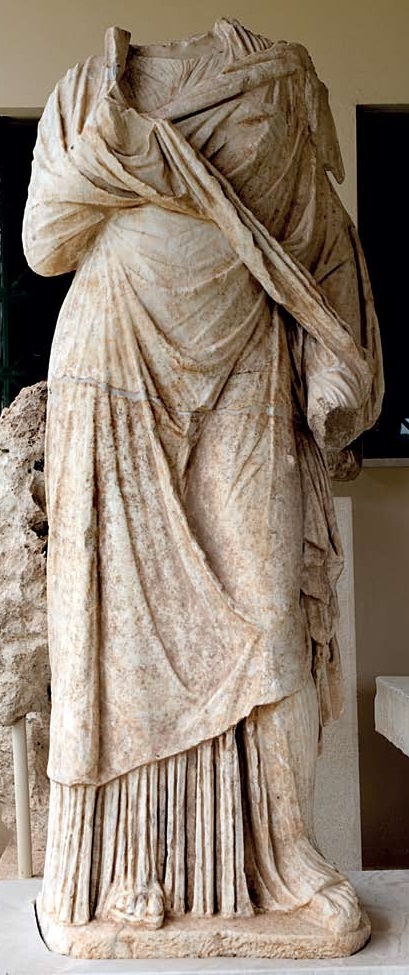
The statue is rejoined at the height of the thighs from two fragments. The inset head and the wrists are missing. Smaller breaks and chipping are attested sporadically on the surface of the marble, especially along the ridges of the folds of the garments. It depicts a standing (on a rectangular plinth), frontal female figure wearing a long chiton, a wide long himation that covers most of the body, and sandals. The weight of the body falls on the right leg, while the left leg is slightly bent and placed forwards. It faithfully follows the statuary type of the so-called “Large Herculaneum Woman” (the hands hold the edges of the himation in the manner characteristic of the type, forming a kind of triangle on the right part of the torso). Based on the lengthy honorary decree of the city of Messene which narrates the history of the Saethidai, inscribed on the two statue bases set up in the rectangular eastern niche of the scaenae frons of the theater (Messene, Archaeological Museum, inv. nos. 9625 and 11152 - see above), the latter probably bore the portrait-statue of Tiberius Claudius Saithidas Caelianus I (active under Trajan and Hadrian), and that of his mother, Claudia Fronteina, depicted as “Hestia of the city” (Rizakis et al. 2004, nos. MES 156 and MES 123 respectively [it is stated that Claudia Fronteina could alternatively be Tiberius Claudius Saithidas I’s wife]). The depicted are the grandfather of the same name and great grandmother respectively of the sponsor of the reconstruction of the scaenae frons of the theater (dated to 163-169 CE - see P. Themelis, “Ανασκαφή Μεσσήνης», Prakt 2010, 56, 58; P. Themelis, Τα θέατρα της Μεσσήνης [Ancient theaters 4], Athens 2010, 28-36), Tiberius Claudius Frontinus Saethidas Caelianus II (Rizakis et al. 2004, no. MES 157; see also {Γ122}), indicating that the scaenae frons was decorated, among other themes, with sculptural representations of his illustrious ancestors. Lastly, it should be noted that P. Themelis in a 2015 publication (2015, 214), expressed a different opinion regarding the identity of the statue, and that of the one set up on the adjacent base inside the eastern niche of the scaenae frons of the theater, identifying it as a portrait statue of the wife or mother of the benefactor Tiberius Claudius Saethidas Caelianus II; the portrait statue of himself would have stood on the adjacent base in the niche. If we accept this version, and recognize the statue as the benefactor's mother, then the portrait head {Γ121} should belong to the present statue. Based on stylistic analysis (cf. the portrait statues G. Despinis, Th. Stephanidou-Tiveriou, E. Voutiras eds., Κατάλογος γλυπτών του Αρχαιολογικού Μουσείου Θεσσαλονίκης Ι, Thessaloniki 1997, cat. no. 83, figs. 209-212, ca. 150 CE; H. Kruse, Römische weibliche Gewandstatuen des zweiten jahrhunderts n.Chr., Göttingen 1975, cat. no. B40, pl. 26, ca. 160 CE), but also the dating of the reconstruction of the scaenae frons, the statue should be dated to the Antonine period, around the decade 150-160 CE.
Bibliography:
P. Themelis, “Ανασκαφή Μεσσήνης”, Prakt 155 (2000), 80-81, pl. 45α-β; P. Themelis, “Μεσσήνη”, Ergon 49 (2002), 30; P. Themelis, “Ανασκαφή Μεσσήνης”, Prakt 157 (2002), 26-27, pls. 18-19; P. Themelis, “Ανασκαφή Μεσσήνης”, Prakt 160 (2005), 46-47, pls. 26β, 27; P. Themelis, “Μεσσήνη”, Ergon 54 (2007), 45-46, fig. 41; P. Themelis, “Ανασκαφή Μεσσήνης”, Prakt 162 (2007), 26-27, pl. 25β; P. Themelis, Τα θέατρα της Μεσσήνης (Ancient theaters 4), Athens 2010, 30, fig. 35; P. Themelis, Αρχαία Μεσσήνη, Ιστορία - Άνθρωποι – Μνημεία, Athens 2010, 341 (Claudia Fronteina, mother of Tiberius Claudius Saethidas Caelianus I, as “Hestia of the city”); V. Di Napoli, Teatri della grecia romana: forma, decorazione, funzioni. La provincia d'Acaia, Meletemata 67, Athens 2013, 78, 187-188, 219, no. 29.13, pl. 26.1; P. Themelis, Αρχαία Μεσσήνη, Athens 2014, 59, 151, fig. 180; P. Themelis, “The Theater of Messene”, in R. Frederiksen, E.R. Gebhard, A. Sokolicek eds., The Architecture of the Ancient Greek Theatre. Acts of an International Conference at the Danish Institute at Athens 27-30 January 2012, Aarhus 2015, 214; M. Geivanidou, Εικονιστικοί ανδριάντες στα θέατρα των ρωμαϊκών ανατολικών επαρχιών, Thessaloniki 2021, 55-56, 172, cat. no. 77, pl. 10.1.