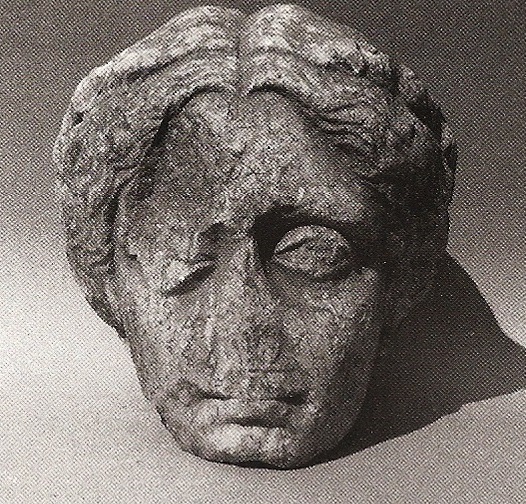
The head is preserved up to the beginning of the neck. Broken are the left eye, the nose, the upper lip, partially the chin, as well as a small part on the top of the head. Smaller breaks and chipping are observed sporadically on the surface of the marble. According to I. Chioti (2012, 363) the bun at the back of the head has been reworked. The surface of the face is polished. It depicts a mature woman with an oval face, broad forehead and broad cheeks. The eyes are large, almond-shaped, with wide lids. The iris is incised (better preserved on the left eye). The mouth is wide, with fleshy lips. The nasolabial folds (as far as one can tell from the available photographs) are accentuated, a sign of mature age. The coiffure draws upon the first portrait type of Lucilla, dated to ca. 165 CE (see K. Fittschen, Die Bildnistypen der Faustina minor und die Fecunditas Augustae, Göttingen 1982, 75-77), omitting, however, certain features, such as the broad parallel “bands” of hair on the upper part of the skull. More specifically, the hair is divided at the top of the forehead into two equal parts, which are combed in waves towards the back of the head (covering on the way the ears, except for the lobes), where they form a bun. The hair on the rest of the skull is rendered with incised curved shallow lines. A small lunate lock of hair is left free on the surface of the left cheek. The hea wears a wreath sporting six holes for the attachment of metal elements (probably leaves).
G.B. Waywell, J.J. Wilkes, “Excavations at the Ancient Theatre of Sparta 1992-1994”, BSA 90 (1995), 457-458, no. 2, pl. 48a-b (160-180 CE); I. Chioti, Αυτοκρατορικά και ιδιωτικά πορτρέτα της εποχής των Αντωνίνων στην Ελλάδα (PhD thesis Aristotle University of Thessaloniki), Thessaloniki 2012, 167, 363, cat. no. 217, pl. 175γ-δ (draws upon the first portrait type of Lucilla; 165-180 CE); M. Geivanidou, Εικονιστικοί ανδριάντες στα θέατρα των ρωμαϊκών ανατολικών επαρχιών, Thessaloniki 2021, 58, 174-175, cat. no. 92, pl. 11.4.