
 Museum/Current place of storage:
 |
Neapolis Voion, Archaeological Museum (formerly in the garden of the Sparta Archaeological Museum). |
 Inv. no:
 |
- |
 Dimensions:
 |
|
 Material:
 |
- |
 Findspot:
 |
In 1908 “in a corner plot” on the left of the main street of the town of Neapolis (Vatika), leading from the shore, together with the headless portrait statue {https://achaeanwomen.eie.gr/γλυπτό/?statue_id=848}, an inscribed block of marble (IG V 1, 957a-b), and a seated figure, which was buried again. Earlier in the same plot another inscribed marble block (IG V 1, 956), and the lower part of a male standing figure (preserving the feet and lower part of legs) had been found. From the above, and based on the inscriptions, it can be deduced that all belonged to a family statue group (see Wace – Hasluck 1908, 171; Rizakis et al. 2004, cat. nos. LAC 383, 392 and 488 with bibliography). |
 Original Display Location:
 |
Unknown. |
 Date:
Date: |
Second quarter of the 2nd c. CE (the dating is consistent with the letter form on the inscription, dated to the 2nd c. CE – cf. IG V 1, 956-957a-b). |
 Statuary Type (body) :
 |
“Kore/Persephone” of the “Berlin/London” type. |
 Mode of Self-Representation (head):
 |
- |
 Civic Presence (Social Role Represented):
 |
Member of an elite family of Boiai. It represents either Iulia Philocratis or Iulia Claeaneta, daughter and wife respectively of the dedicator, C. Iulius Thraseas (IG V 1, 957a-b; Rizakis et al. 2004, cat. no. LAC 383 and 392). Part of a larger family statue group that also included the dedicator’s father-in-law, C. Iulius Panthales, son of Euenor (IG V 1, 956; Rizakis et al. 2004, cat. no. LAC 488), as well as without a doubt the dedicator himself (see Rizakis et al. 2004, cat. no. LAC 511). |
 Inscribed Base:
 |
Yes (IG V 1, 956-957a-b). |
 Author:
 |
Panagiotis Konstantinidis |
 Added:
 |
2024-09-19 |
 Edited:
 |
Description - Comments:
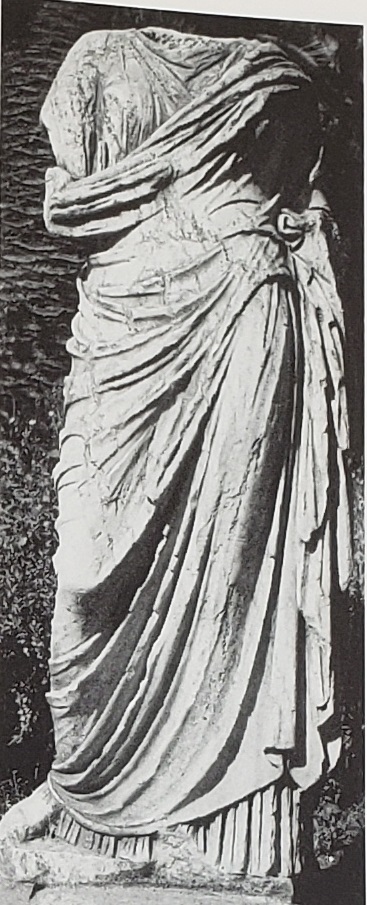
The statue is preserved essentially intact with the exception of the inset parts (head and forearms). Smaller breaks and chipping are attested sporadically on the surface of the marble. The rectangular plinth is also broken at the front, together with the left foot. The figure is depicted standing, frontal, wearing closed leather shoes (calcei muliebres), a long chiton, and a long himation which covers most of the body (except for the right part of the chest) and forms on the left the characteristic round gathering of folds of the “Berlin/London” statuary type between the body and the left elbow. At the front, the himation is placed diagonally across the chest, from the right elbow to the left shoulder (left unfolded). Based on stylistic parallels, it can be dated to ca. the middle of the 2nd c. CE (cf. the female portrait statues from the Olympia Nymphaeum {Γ109} and {Γ113}, 149-153 CE, as well as the portrait statue Filges 1997, 244, cat. no. 14, fig. 14, Hadrianic period). Good quality of workmanship; probably the product of an Attic workshop.
Bibliography:
A.J.B. Wace, F.W. Hasluck, “Laconia II. Topography”, BSA 14 (1908), 171, no. 4, fig. 1c (on the right); A. Filges, Standbilder jugendlicher Göttinnen, Köln-Weimar-Wien 1997, 15, 17, 18, 244, cat. no. 15, fig. 15 (early Hadrianic period); A. Alexandridis, Die Frauen des römischen Kaiserhauses: eine Untersuchung ihrer bildlichen Darstellung von Livia bis Iulia Domna, Mainz am Rhein 2004, 267, no. 33 (Julio-Claudian period); A.D. Rizakis, S. Zoumbaki, Cl. Lepenioti, Roman Peloponnese II. Roman Personal Names in Their Social Context, Athens 2004, cat. nos. LAC 383 and 392; A. Maltezou, Ch. Kakourou, N. Palaiologou, Exhibition of the Archaeological Museum of Neapolis Voion, Ephorate of Antiquities of Laconia, Ministry of Culture and Sports, Sparta 2015, 7 fig. (second figure from the left); Ephorate of Antiquities of Laconia, Archaeological Imprints, Work 2015-2018, Sparta 2018, 18 (fig. at the bottom of the page, second statue from the left); https://arachne.dainst.org/entity/1089849?fl=20&q=Sparta&resultIndex=138