
 Museum/Current place of storage:
 |
Thebes, Archaeological Museum. |
 Inv. no:
 |
ΒΕ 65 |
 Dimensions:
 |
|
 Material:
 |
H. 0,97m. |
 Findspot:
 |
In Novenber 1941 incorporated into a wall of the late-Roman bath complex, built over part of the cella of the temple of Artemis Aulideia (for the bath complex see I. Threpsiadis, “Ανασκαφαί εν Αυλίδι”, Prakt 1956, 97). |
 Original Display Location:
 |
In the sanctuary of Artemis Aulideia (the exact display location is unknown). |
 Date:
Date: |
Antonine period. |
 Statuary Type (body) :
 |
Muse of the “Athens/Thebes” type. |
 Mode of Self-Representation (head):
 |
- |
 Civic Presence (Social Role Represented):
 |
Unknown. |
 Inscribed Base:
 |
No. |
 Author:
 |
Panagiotis Konstantinidis |
 Added:
 |
2024-04-26 |
 Edited:
 |
Description - Comments:
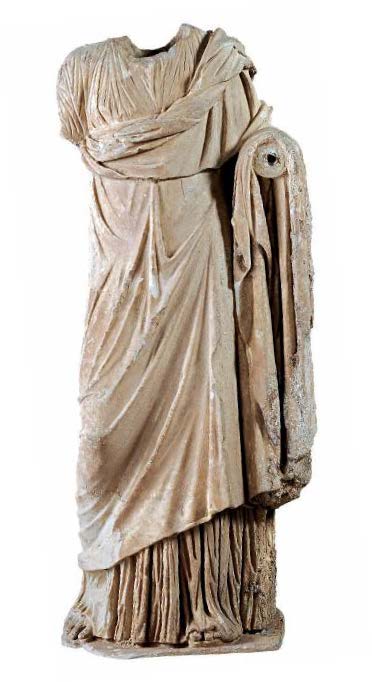
Good state of preservation. Missing are the inset head, right arm from mid-biscep and left extended inset forearm (a socket for the insertion of a metal tenon is preserved on the surface of the marble). Smaller breaks and chipping are evident sporadically on the surface of the marble, especially at the edges of the folds of the garments. The front part of the almost rectangular plinth is also broken off. The statue depicts a standing, frontal, under-life-sized female figure, wearing a long crinkly chiton, a himation that wraps tightly around the body, and Hellenistic-type sandals (the soles follow the outline of the toes; the straps would be rendered in paint). The figure closely follows the statuary type of the “Athens/Thebes(Q) type Muse. More specifically, the weight of the figure is carried on the left leg, while the right leg, bent at the knee, is carried sideways and slightly backwards. The left arm, bent at the elbow is brought forward, while the right would probably be lowered and placed along the right thigh. The himation covers the greater part of the body, except for the right part of the chest, forming an almost diagonal cylindrical mass, partly unfolded, from the height of the right armpit to the left shoulder, from where it continues to the back, ending on the bent at the elbow and extended left arm. It can be dated to the Antonine period based on stylistic parallels (the rendering of the drapery of the chiton is particularly close to that on the female portrait-statue from the Olympia Nymphaeum, Olympia, Archaeological Museum, inv. Λ 165, usually identified with the daughter of Herodes Atticus, Elpiniki, 149 -153 CE [{Γ111}]). Good quality of workmanship.
Bibliography:
I. Threpsiadis, “Επανέκθεσις Μουσείου Θηβών”, ArchEph 1963 Chronicles, 21, pls. ΙΘα, ΚΑ (center); K. Demakopoulou, D. Konsola, Archaeological Museum of Thebes, Athens 1981, 80, no. BE 65; A. Filges, Standbilder jugendlicher Göttinnen, Köln-Weimar-Wien 1997, 106, 107, 108, 168, 170, 190, 192 note 905, 205, 226, 277, cat. no. 170 (early Antonine period; priestess); V. Aravantinos, Το Αρχαιολογικό Μουσείο Θηβών, Athens 2010, 345 (right; first half of the 2nd c. CE); Μ. Bonanno-Aravantinos, “La scultura di età romana nella Beozia: importazioni e produzioni locali”, in Th. Stephanidou-Tiveriou, P. Karanastasi, D. Damaskos eds., Κλασική παράδοση και νεωτερικά στοιχεία στην πλαστική της ρωμαϊκής Ελλάδας. Πρακτικά διεθνούς συνεδρίου, Θεσσαλονίκη, 7-9 Μαϊου 2009, Athens 2012, 235 (priestess).