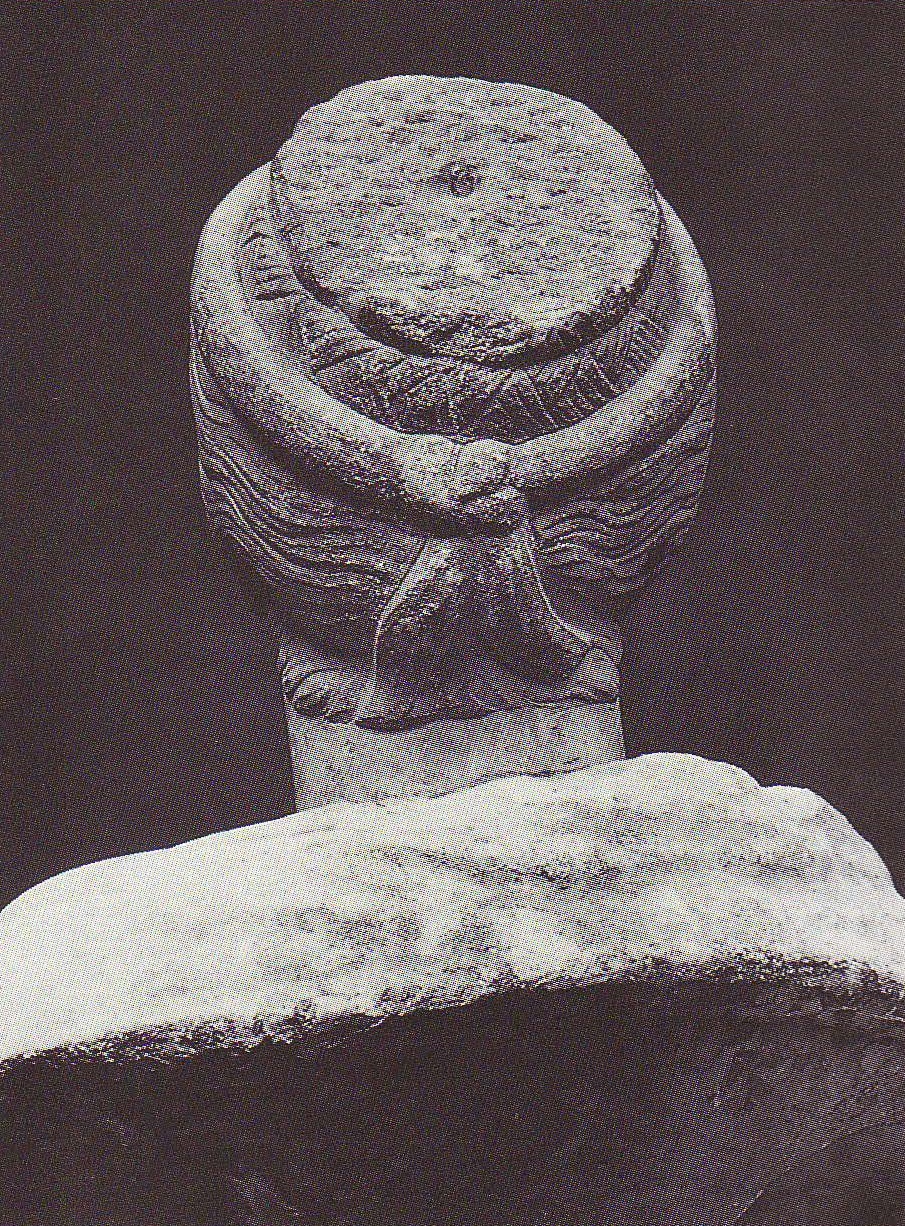
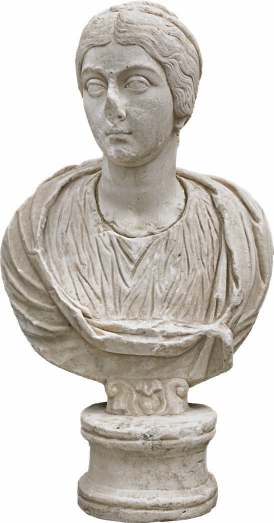
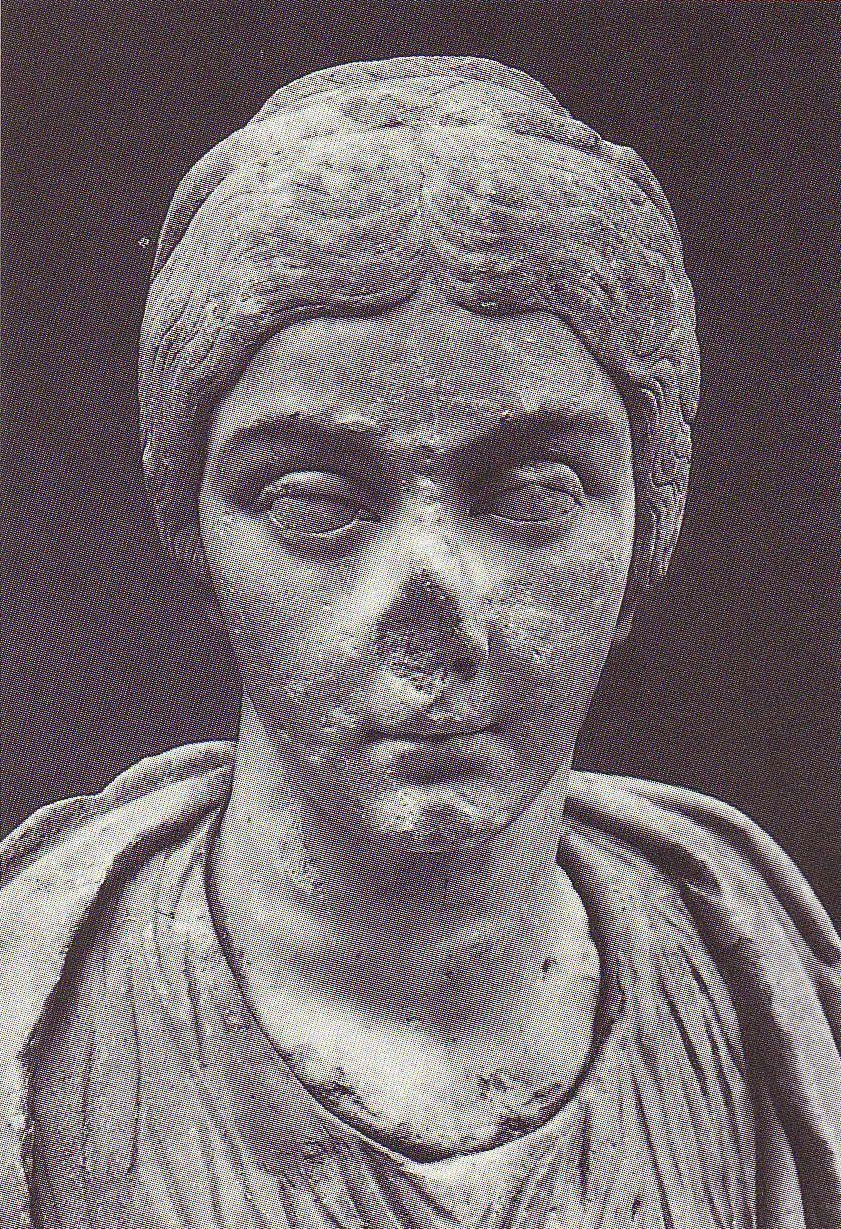
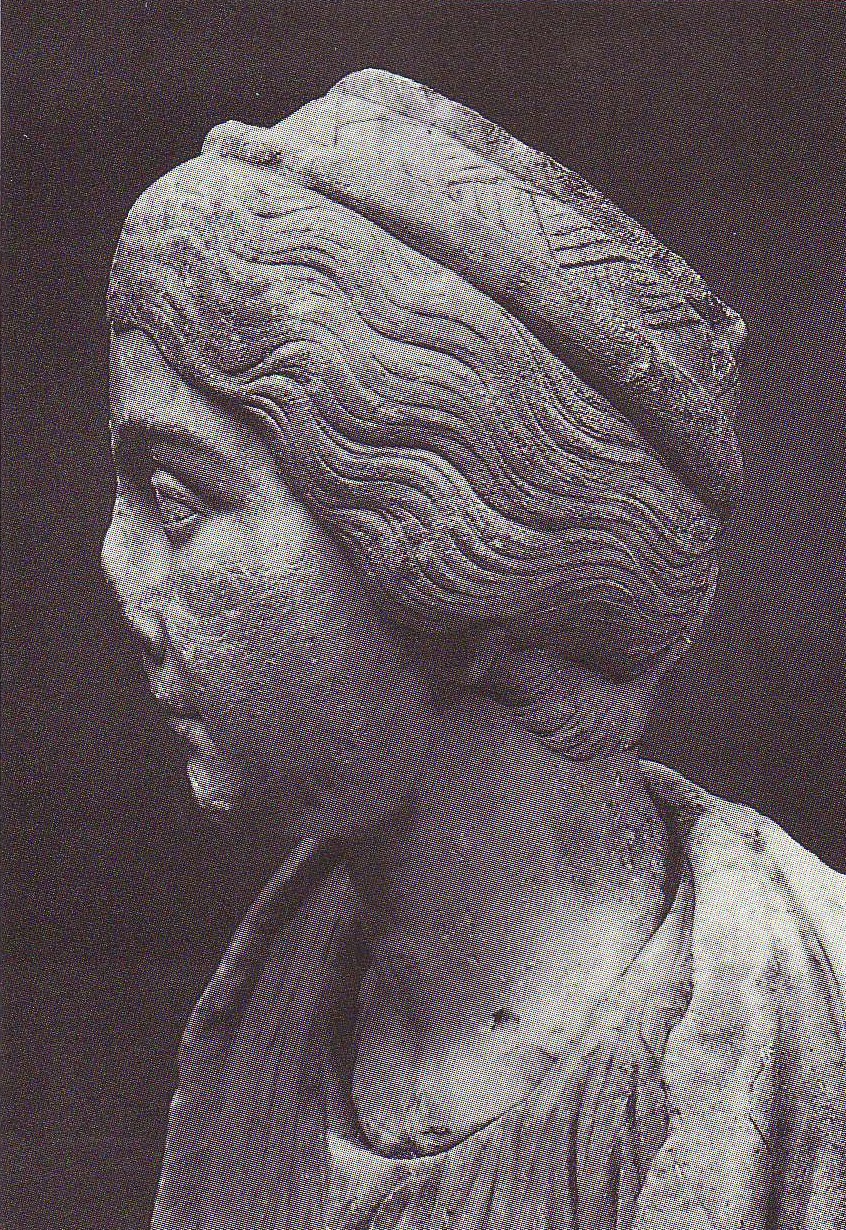
The bust is preserved essentially intact, together with its base and inset head, with the exception of the inset upper half of the bun. The tip of the nose is broken, while small breaks and chipping are evident sporadically on the surface of the marble, especially on the chin and the folds of the garments. Both the inset head and the construction of the headdress from two separate pieces of marble are rare in busts (see Despinis et al. 2003, 151 note 2 in cat. no. 264 [Th. Stephanidou-Tiveriou]; also Chioti 2012, 341, notes 46-47 for bibliography). It depicts a mature woman, turned slightly to the left, wearing a crinkly chiton, a himation that covers the shoulders and the lower part of the chest, and a cylindrical strophion on her head. Between the body and the cylindrical base there is a zone of acanthus leaves, probably indicating that the portrait is posthumous (cf. Jucker 1961, 33-38; contra [acanthus leaves as a symbol of prosperity, growth and rebirth] Daltrop 1965, 247-268; also Chioti 32 with bibliography in note 132). The face is oval, fleshy with a high forehead and smooth cheeks. The eyebrows are long and arched and the eyes large and almond-shaped. A “Venus-ring” is evident on the neck, probably an individual trait of the woman depicted. The lacrimal duct at the corner of the eyes is indicated, while the iris and pupil are not. The hair is divided at the top of the forehead into two masses of wavy locks which cover the ears (except for the lobes), and are gathered on the top of the skull in a bun (a small dowel hole for a metal pin is preserved on the surface of the marble for the insertion of its upper part, worked separately) which is held by the cylindrical strophion (it forms a Hercules-knot on the surface of the nape). Both the material and fan-shaped support on the back of the bust indicate that it is the product of an Attic workshop (for fan-shaped bust supports as an indication of workshop provenance see Fittschen 2001, 71-77), and was probably imported to Boeotia ready-made from Attica. The size of the body of the bust (for the dating of busts based on form see R.R.R. Smith ed., Aphrodisias II. Roman Portrait Statuary from Aphrodisias, Mainz am Rhein 2006, 227 with note 10 [R.R.R. Smith]) and the headdress which draws upon the fourth and fifth portrait types of Faustina the Younger (according to the classification of K. Fittschen, Die Bildnistypen der Faustina minor und die Fecunditas Augustae, Göttingen 1982; for analysis and parallels see Bonanno-Áravantinos 1997, 59-60; Chioti 2012, 151-152), place the bust safely in the decade 150-160 CE. Cf. also the rendering of the chiton of the portrait statue from the Olympia Nymphaeum, Olympia, Archaeological Museum inv. Λ 165 ({Γ111}), usually identified as the daughter of Herodes Atticus, Elpiniki (149-153 CE). The presence of the strophion points to an identification as either a priestess (more likely) or an initiate.
G. Körte, “Die antiken Skulpturen aus Boeotien”, AM 3 (1878), 419, no. 202; Chr. Karouzos, Το Μουσείον της Θήβας, Athens 1934, 47, no. 161 (mid-2nd c. CE); I. Threpsiadis, “Επανέκθεσις Μουσείου Θηβών”, ArchEph 1963 Chronicles, 22 (period of Faustina the Younger); H. Jucker, Das Bildnis im Blätterkelch: Geschichte und Bedeutung einer römischen Porträtform, Olten 1961, no. 8; G. Daltrop, review of H. Jucker, Das Bildnis im Blätterkelch. Geschichte und Bedeutung einer römischen Bildform, GGA 217 (1965), 256 (first half of the 3rd c. CE); C.C. Vermeule, Roman Imperial Art in Greece and Asia Minor, Cambridge MA 1968, 396 no. 3, 419 (Faustina the Younger); A. Datsouli-Stavridi, “Eικoνιστική κεφαλή Φαυστίνης της Nεωτέρας εις τo Moυσείoν Πατρών”, ΑΑΑ 6 (1973), 168 note 19; M. Wegner, R. Unger, «Verzeichnis der Kaiserbildnisse von Antoninus Pius bis Commodus II», Boreas 3 (1980), 33; M. Bonanno-Aravantinos, “Un ritratto di sacerdotessa da una casa sull'Areopago”, in L. Bacchielli, M. Bonanno-Aravantinos, S. Stucchi eds., Scritti di antichità in memoria di Sandro Stucchi. Volume 1, La Cirenaica, La Grecia e l'Oriente mediterraneo, Roma 1996, 344 fig. 7, 346 note 33; M. Bonanno-Αravantinos, “Due ritratti di età antonina nel Museo archeologico di Τebe”, in J. Bouzek, I. Ondrejova eds., Roman Portraits, Artistic and Literary, Acts of the Third International Conference on the Roman Portraits held in Prague and in the Bechině Castle from 25 to 29 September 1989, Mainz 1997, 59-60, pl. 18.3-6; M. Bonanno-Aravantinos, “I ritratti di età romana della Beozia. Considerazioni preliminary”, in V. Aravantinos ed., Επετηρίς της Εταιρείας Βοιωτικών Μελετών, Γ΄ διεθνές συνέδριο Βοιωτικών μελετών, Θήβα 4-8 Σεπτεμβρίου 1996, Athens 2000, 777-778, figs. 22-26; K. Fittschen, “Eine Werkstatt attischer Porträtbildhauer im 2 Jh. n. Chr.”, in C. Reusser ed., Griechenland in der Kaiserzeit: neue Funde und Forschungen zu Skulptur, Architektur und Topographie; Kolloquium zum 60. Geburtstag von Prof. Dietrich Willers, Bern, 12.-13. Juni 1998, Bern 2001, 74, no. 8 (early Antonine period); G. Despinis, Th. Stephanidou-Tiveriou, E. Voutiras eds., Κατάλογος γλυπτών του Αρχαιολογικού Μουσείου Θεσσαλονίκης ΙΙ, Thessaloniki 2003, 151 note 2 in cat. no. 264 [Th. Stephanidou-Tiveriou]; V. Aravantinos, Το Αρχαιολογικό Μουσείο Θηβών, Athens 2010, 351; Μ. Bonanno-Aravantinos, “La scultura di età romana nella Beozia: importazioni e produzioni locali”, in Th. Stephanidou-Tiveriou, P. Karanastasi, D. Damaskos eds, Κλασική παράδοση και νεωτερικά στοιχεία στην πλαστική της ρωμαϊκής Ελλάδας. Πρακτικά διεθνούς συνεδρίου, Θεσσαλονίκη, 7-9 Μαϊου 2009, Athens 2012, 240; E. Chioti, Αυτοκρατορικά και ιδιωτικά πορτρέτα της εποχής των Αντωνίνων στην Ελλάδα (Ph.D. thesis Aristotle University of Thessaloniki), Thessaloniki 2012, 151-152, 341-342, cat. no. 182, pl. 148, 151α (151-160 CE); M. Mikedaki, Tabula Imperii Romani: J 34 Athens. Boeotia, Athens 2019, 106 (150-160 CE); P. Konstantinidis, Γυναικείοι δυναστικοί εικονιστικοί ανδριάντες αυτοκρατορικής περιόδου από την Ελλάδα (τέλη 1ου αι. π.Χ. – 5ος αι. μ.Χ.), Athens 2024, 244 note 6γ, 325 note 229στ.



.jpg)