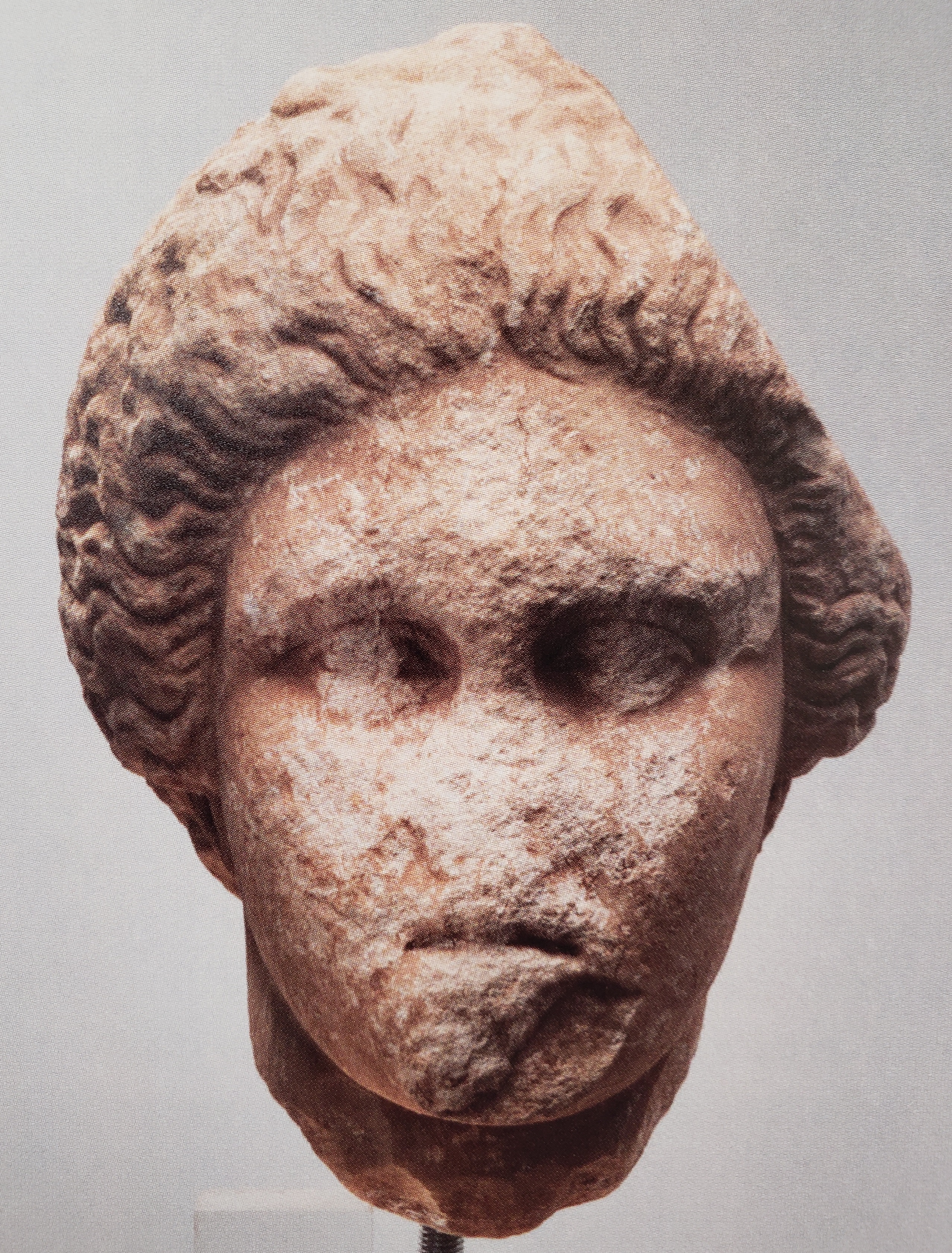
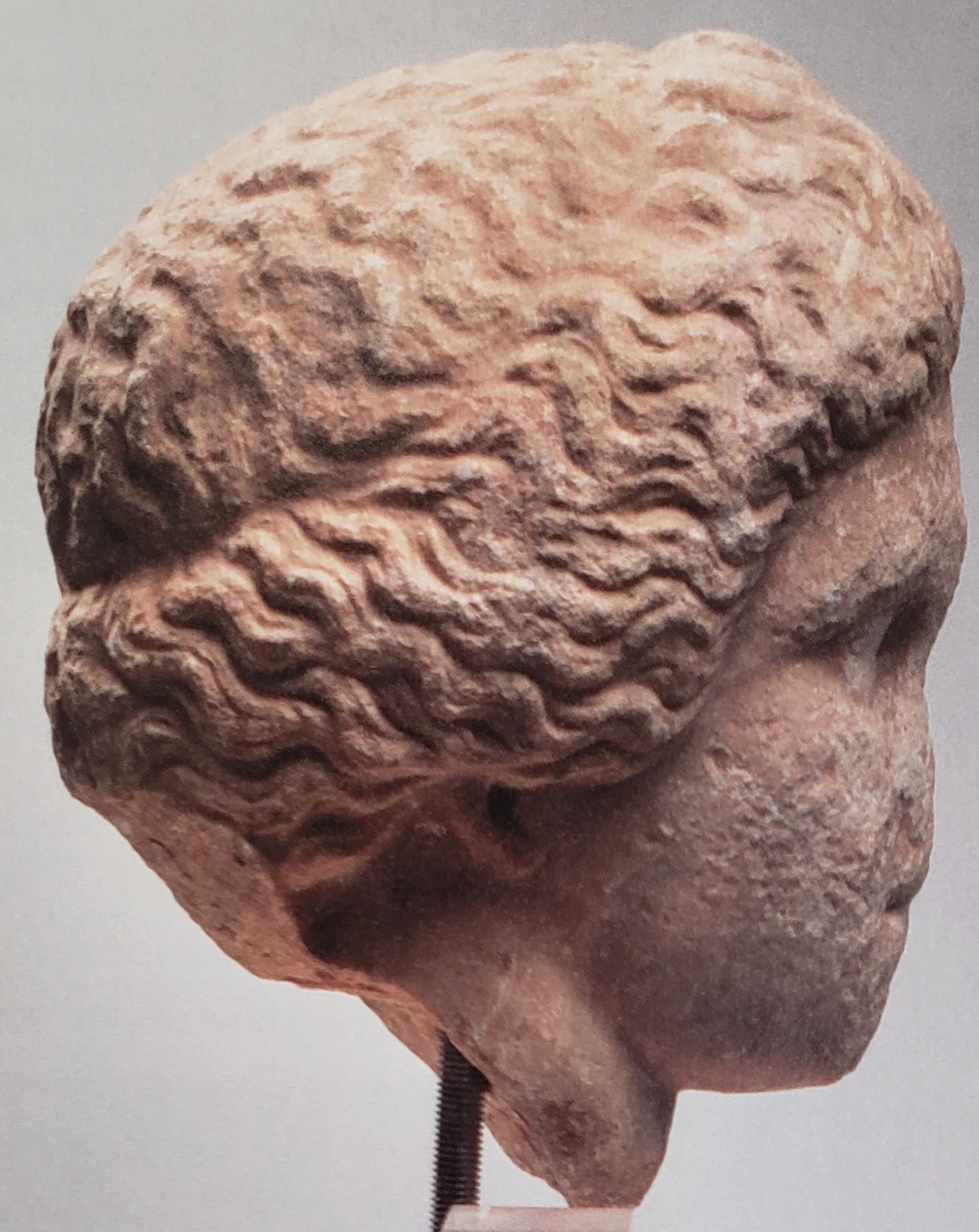
The face of the figure is not well-preserved. Broken (with signs of weathering on the surface of the marble) are the nose, eyes and eyebrows, as well as the front part of the cheeks, the mouth and the left part of the chin. Only the corners of the eyes and the central slit of the mouth are still discernible. Nevertheless, the oval shape of the face, the full cheeks and the overall rendering reveal a strong idealism for the face. The hair framing the face is combed in radial wavy strands that are directed towards the back of the skull. The overall mass of the hair (which ends in a bun at the nape, now partly broken off) is divided into two parts by a thin band, placed at approximately the height of the ears (the band is rendered schematically by a simple indentation on the surface of the marble). A small part at the left of the head was carved into a separate piece of marble that was attached to the rest of the skull by means of a metallic circular pin (for parallels of the piecing technique, already utilized in the Hellenistic period see P. Konstantinidis, Γυναικείοι δυναστικοί εικονιστικοί ανδριάντες αυτοκρατορικής περιόδου από την Ελλάδα (τέλη 1ου αι. π.Χ. – 5ος αι. μ.Χ.), Athens 2024, 325, note 229). The dating of the head is difficult. Although, as mentioned by H. Aurigny, the direction of the wavy locks of hair around the face is reminiscent of the hairstyle of Trajan's wife, Plotina, the hard, rigid hairdo of the latter is quite different from that in the Delphi head. At the sides, the wavy strands of hair, carefully worked with the point, are reminiscent of the generic headdress worn by goddesses of the Classical period, while the presence of the bun placed low, at the nape, brings equally to mind hairstyles of the Julio-Claudian era, as well as those of Faustina the Younger and, one of her daughters, Lucilla. The rendering of the texture of the hair is very close to that on the head of the Thessaloniki Archaeological Museum, inv. 881, dated to the Antonine period (G. Despinis, Th. Stephanidou-Tiveriou, E. Voutiras eds., Κατάλογος Γλυπτών του Αρχαιολογικού Μουσείου Θεσσαλονίκης ΙΙ, Thessaloniki 2003, cat. no. 232, figs. 661-664 [G. Despinis]). The head from Delphi should also be dated to the same period.
Η. Aurigny, “Portraits en marbre d’époque romaine à Delphes” in J.L. Martinez ed., Fouilles de Delphes IV. Monuments figurés: sculpture; fasc. 8:2. Un Âge d’or du marbre: la sculpture en pierre à Delphes dans l’Antiquité, Athènes 2021, 789-790, figs. 14a-d (period of Plotina?).