
 Museum/Current place of storage:
 |
Athens, National Archaeological Museum. |
 Inv. no:
 |
Γ 3630 |
 Dimensions:
 |
|
 Material:
 |
H. 1,675m. |
 Findspot:
 |
In Athens, in 1926, on the grounds of the Royal Stables in Stadiou street (along with the statue {https://achaeanwomen.eie.gr/γλυπτό/?statue_id=766}), in the NE ancient cemetery of the city (for the cemetery see E. Greco ed., Topografia di Atene 3. Quartieri a nord e a nord-set dell’Acropoli e Agora del Ceramico, Atene/Paestum 2014, 631-638; the plot of the Royal stables occupied the building block defined by Stadiou, Voukourestiou, Panepistimiou and Amerikis streets – see Greco 2014, 632, fig. 325). In the National Archaeological Museum of Athens since 1937. |
 Original Display Location:
 |
Most probably part of the sculptural decoration of an impressive funerary monument (mausoleum/Heroon). |
 Date:
Date: |
Early Antonine period. |
 Statuary Type (body) :
 |
“Fortuna Braccio Nuovo”. |
 Mode of Self-Representation (head):
 |
- |
 Civic Presence (Social Role Represented):
 |
Unknown. |
 Inscribed Base:
 |
No. |
 Author:
 |
Panagiotis Konstantinidis |
 Added:
 |
2024-09-09 |
 Edited:
 |
Description - Comments:
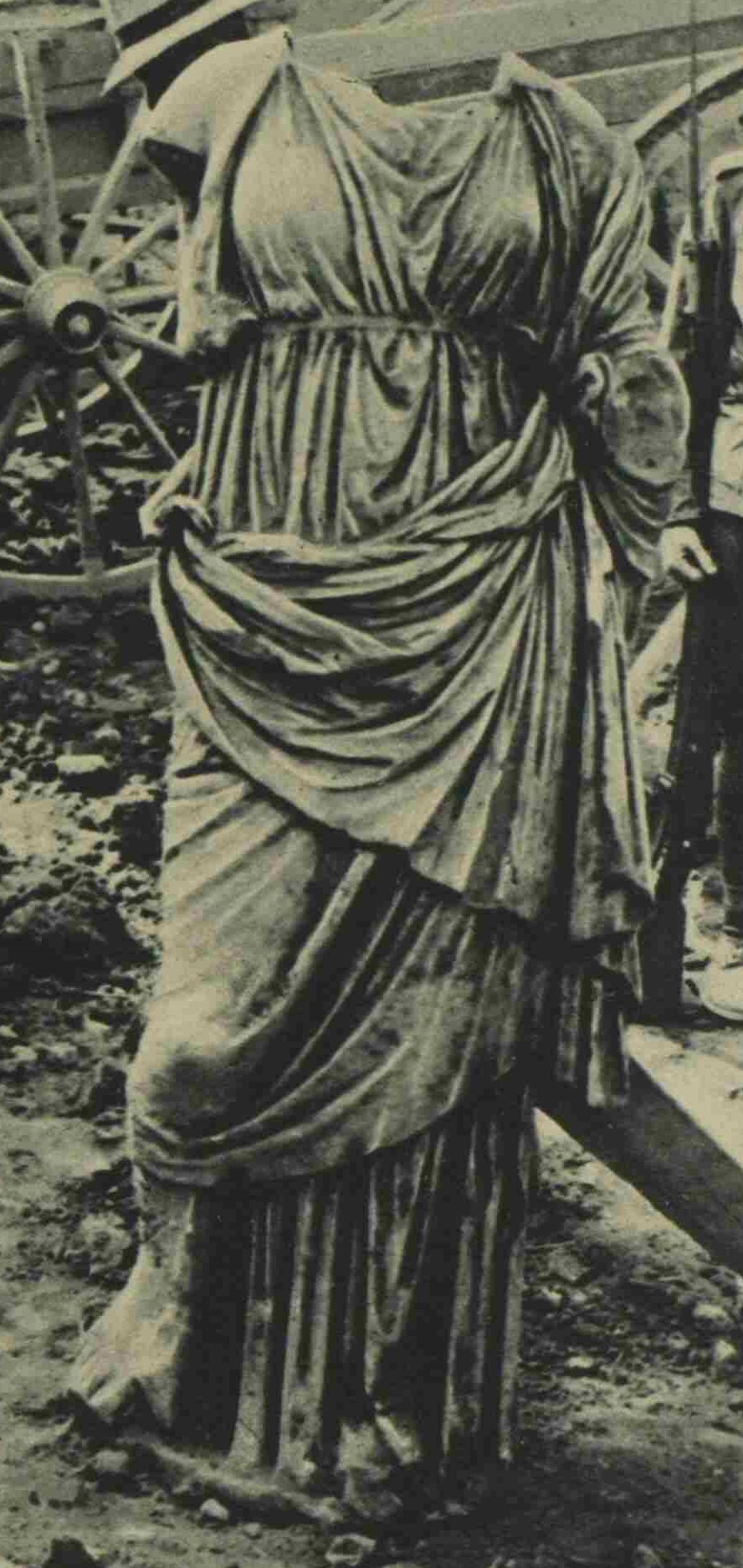
The statue is well preserved. Only the inset head with the neck, the right arm from the shoulder, and the left forearm are missing. The toes and small parts of the plinth are also broken off. Smaller breaks and chipping are evident sporadically on the surface of the marble, especially along the ridges of the folds of the garments. The statue depicts a standing, frontal female figure wearing a long chiton belted high just below the breasts, and a wide himation that covers the back of the figure and the left shoulder, continuing to the lower front part of the torso, where it creates a characteristic triangular overfold. It faithfully reproduces the statuary type of the so-called “Fortuna Braccio Nuovo”; there is no scholarly consensus on the dating of the original creation, with both the Late Hellenistic and the Early Imperial periods being proposed (all surviving copies date from the late 1st c. CE onwards; for the statuary type see G. Despinis, Th. Stephanidou-Tiveriou, E. Voutiras eds., Κατάλογος γλύπτών του Αρχαιολογικού Μουσείου Θεσσαλονίκης ΙΙ, Thessaloniki 2003, 88-89, cat. no. 227 [B. Schmidt-Douna]; Alexandridis 2004, 232-233 with bibliography). The type has been used for the representation of the goddess Fortuna, as well as for relatively few female portrait statues, all from the Antonine period onwards. The present statue also belongs to the same period (see Nippe 1989, 21, 27).
Bibliography:
Illustrated London News, August 21, 1926, 335; N. Kyparissis “Αι ανασκαφαί των βασιλικών στάβλων”, ArchDelt 9 (1924/1925), Appendix, 72, without fig.; C. Nippe, Die Fortuna Braccio Nuovo: stilistische und typologische Untersuchung, Berlin 1989, 84, cat. no. Κ13 with bibliography (140-150 CE); A. Alexandridis, Die Frauen des römischen Kaiserhauses: eine Untersuchung ihrer bildlichen Darstellung von Livia bis Iulia Domna, Mainz am Rhein 2004, 232, no. 3; https://arachne.dainst.org/entity/1093302?fl=20&q=Die%20Fortuna%20Braccio%20Nuovo&resultIndex=33