
 Museum/Current place of storage:
 |
Athens, Museum of the Ancient Agora (Stoa of Attalos). |
 Inv. no:
 |
S 1631 |
 Dimensions:
 |
|
 Material:
 |
Η. 0,34m., 0,22m. (head), w. 0195m., th. 0,25m. |
 Findspot:
 |
On the 15th of April 1952, during excavations of the American School of Classical Studies in the ancient Agora of Athens, in the southeast corner of the East Stoa, immediately north of the church of the Holy Apostles, in the destruction level of the Heruli invasion (267 CE). |
 Original Display Location:
 |
In the Agora (the exact display location is not known; it is not certain that it belongs to the Nymphaeum at the SE part of the Agora as often mentioned – cf. Dillon 2023, 13). |
 Date:
Date: |
Early principate of Claudius. |
 Statuary Type (body) :
 |
- |
 Mode of Self-Representation (head):
 |
The coiffure follows contemporary imperial fashion protypes (“Modefrisur”), while the face is idealized. |
 Civic Presence (Social Role Represented):
 |
Unknown (priestess?). |
 Inscribed Base:
 |
No. |
 Author:
 |
Panagiotis Konstantinidis |
 Added:
 |
2024-09-10 |
 Edited:
 |
Description - Comments:
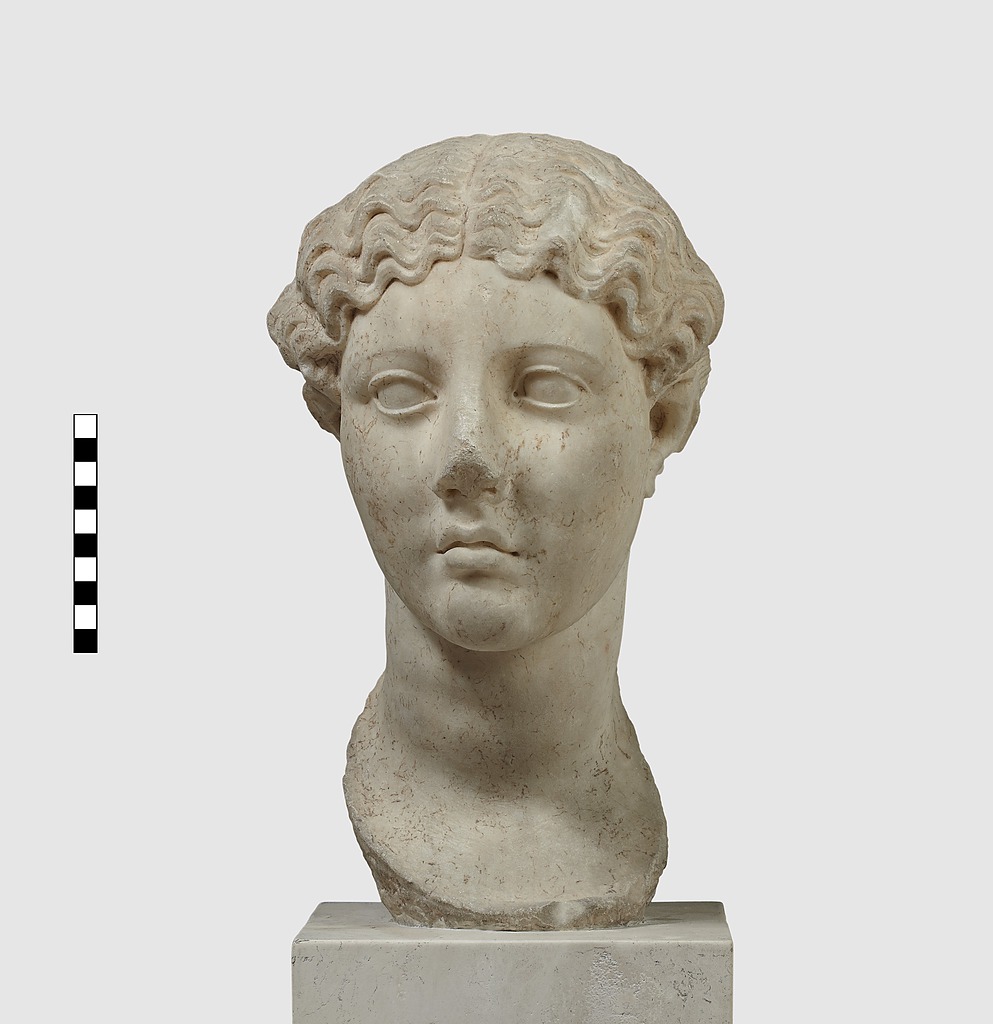
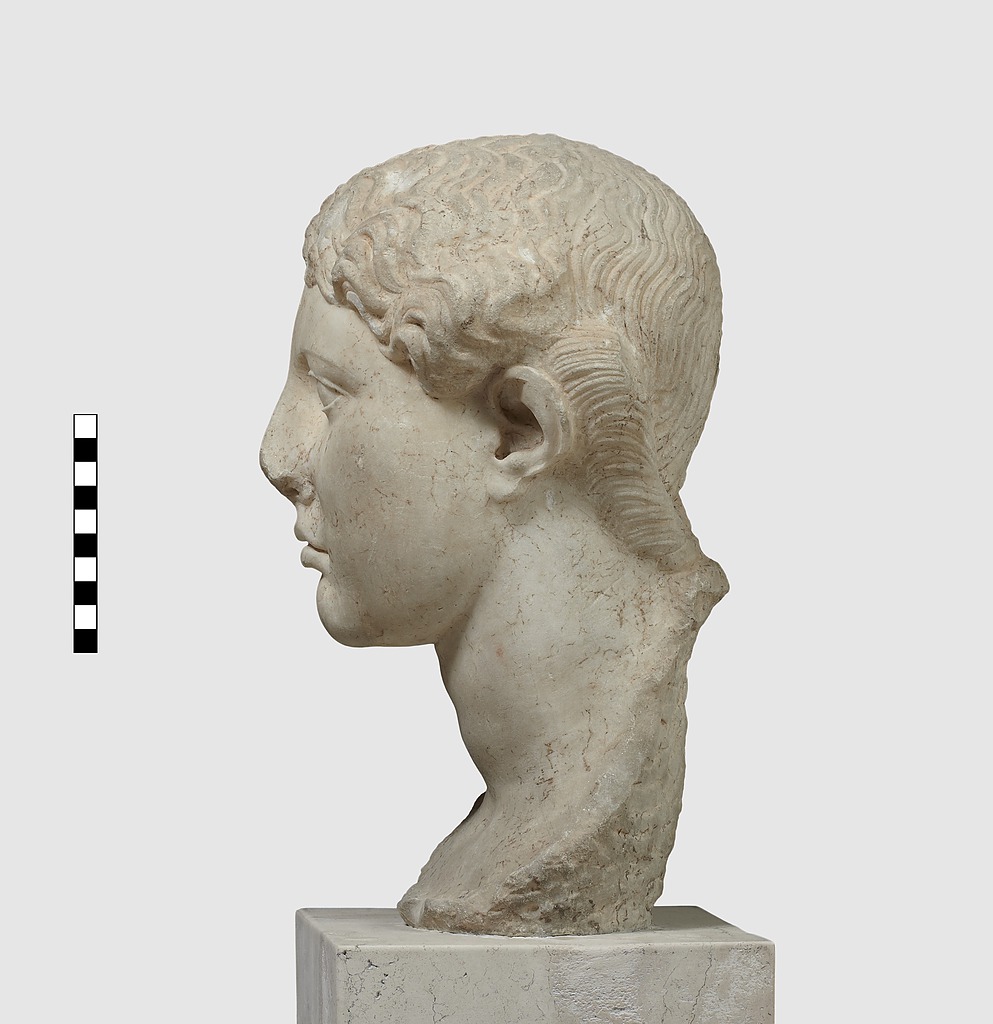
The head is preserved essentially intact, with the neck and the tenon for the insertion into body of the statue. The tip of the nose is broken off. Rasp marks are evident on the chest, neck and forehead. The head depicts a young woman turning slightly to the right. The eyebrows are thin (ending in sharp ridges on the surface of the marble), the eyes large with thin lids, the mouth small, slightly open, with fleshy curved lips. The mouth is worked with the drill. Two “Venus rings” are plastically rendered on the surface of the neck. The iris and pupil of the eyes would have been marked with paint. The coiffure is divided in the middle of the forehead into two equal parts and combed towards the back of the head in deep narrow waves that frame the forehead and temples, leaving the ears uncovered. Starting from behind the ears, the mass of hair forms a kind of twisted roll that ends low at the nape, where it is tied into an elongated bun (its lower part was carved onto the body of the statue). On the upper part of the head the coiffure is summarily worked. The texture of the individual locks of hair is rendered by means of incised wavy lines on the surface of the marble. Part of a forearm and hand holding a patera have been tentatively identified as belonging to the same statue as the portrait head (inv. no. S 1627: https://agora.ascsa.net/id/agora/object/s%201627?q=S1627&t=&v=list&sort=&s=1; found in the foundation of an early Byzantine building near the eastern end of the South Stoa). If the attribution is correct, then the person depicted could be identified as a worshiper or priestess. The headdress draws upon iconographic protypes of Antonia the Younger (see D. Boschung, “Die Bildnistypen der iulisch-claudischen Kaiserfamilie: ein kritische Forschungsbericht”, JRA 6 [1993], 51-52), while the narrow deep waves around the face are better suited to the Claudian period (see Kalavria 2015, 236 for two mid-1st c. CE parallels). The rendering of the locks of hair at the front part of the coiffure is similar to the examples of female coiffures on Attic tombstones of the Classical period mentioned by S. Dillon (2023, 13 note 64; cf. also the portrait statue {Γ54}, also mentioned by S. Dillon, again combining Classical elements with those of contemporary hairstyle fashion), from where the sculptor probably gets his inspiration. Nevertheless, the hairstyle is not the same, as contrarily argued by Dillon. In the Agora portrait there is no protruding part of locks around the head in the form of a crown that ends in a braid. The part which is tied in an elongated bun at the nape, begins, as already mentioned, behind the ears, while the rendering of the texture of the twisted locks resembles again to portraits of Antonia the Younger (see above) and not to female representations on Classical Attic tombstones.
Bibliography:
E.B. Harrison, The Athenian Agora I. Portrait Sculpture, Princeton N.J. 1953, 22-24, cat. no. 11, pls. 9-10; H.A. Thomson, “Excavation in the Athenian Agora: 1952”, Hesperia 22 (1953), 55-56, pl. 20b; E.C. Portale, “Una “nuova” Livia da Leptis Magna. Osservazioni sul contributo delle botteghe attiche nell’elaborazione e diffusione dell’immaginario imperiale”, in Th. Stephanidou-Tiveriou, P. Karanastasi, D. Damaskos eds., Κλασική παράδοση και νεωτερικά στοιχεία στην πλαστική της ρωμαϊκής Ελλάδας. Πρακτικά Διεθνούς Συνεδρίου, Θεσσαλονίκη, 7-9 Μαΐου 2009, Thessaloniki 2012, 480-481, with note 11, fig. 11; E. Greco ed., Topografia di Atene III, Atene-Paestum 2014, no. F.79, 1076, fig. 659 (R. Di Cesare); E. Kalavria, Αττικά πορτρέτα κατά την εποχή της ρωμαιοκρατίας (1ος αι. π.Χ. - αρχές 2ου αι. μ.Χ.), ζητήματα τυπολογίας, λειτουργίας και παραγωγής (PhD. thesis National and Kapodistrian University of Athens), Athens 2015, 236, 484-485, cat. no. 88, pl. 88 with references; S. Dillon, “Portraiture in the Greek East in the Roman Period: the View from the Athenian Agora” in B. Dufallo, R. Faber eds., Comparing Roman Hellenisms in Italy, Ann Arbor, 294, figs. 10.4-10.5; S. Dillon, “Female Portrait Statuary in Roman-period Athens: The Epigraphic and Sculptural Evidence”, Eugesta 13 (2023), 12-13, figs. 1-2; https://agora.ascsa.net/id/agora/object/s%201631?q=S1631&t=&v=list&sort=&s=5