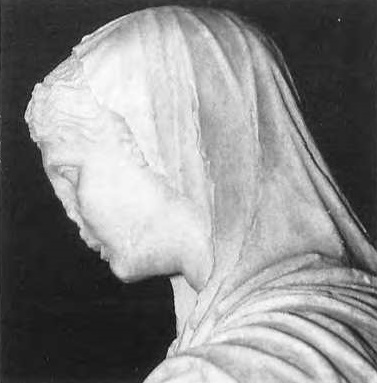
The statue is preserved essentially intact. Only the nose, left hand, and the index and thumb of the right hand are missing. Smaller breaks and chipping are observed sporadically on the surface of the marble, especially on the lips, along the ridges of the folds of the garments (and the lower edge of the himation), but also at the toes. The plinth is also broken in places all around. The rear is left rough-worked, indicating that it was not meant to be seen. The statue depicts a standing, frontal female figure, wearing a long chiton, a wide himation that covers most of the body (including the back of the head - where it creates folds - and the arms), and high-soled sandals. The head turns slightly downward and to the left. It faithfully reproduces the statuary type of the “Large Herculaneum Woman”. The face is oval, with smooth cheeks and forehead, full lips, large eyes and brows rendered by sharp ridges on the surface of the marble. Only the somewhat more pronounced nasolabial folds and the plastic rendition of two “Venus rings” on the neck escape the strongly idealized face. The coiffure is divided at the top of the forehead into two equal parts which are combed in gentle waves towards the back of the head, where they must have gathered in a bun, placed relatively high at the back of the skull, as can be inferred from the shape and the bulging himation at the back of the head. The texture of the individual strands of hair is rendered by means of engraved parallel lines on the surface of the marble. The simple classicizing arrangement at the front of the head is also present in Attic funerary reliefs of the Imperial period, which in turn are inspired by protypes of the Classical period (cf. D.W. von Moock, Die figürlichen Grabstelen Attikas in der Kaiserzeit: Studien zur Verbreitung, Chronologie, Typologie und Ikonographie, Mainz am Rhein 1998, cat. no. 206 pl. 26c-d, cat. no. 236, cat. no. 308 pl. 46d, cat. no. 319 pl. 48b, cat. no. 520; also {Γ48}); it reappears in portraits of the Trajanic period, combined with an open-nest bun consisting of braids (cf. e.g. the portrait head {Γ50}), as well as in the iconography of the empress Sabina (cf. the so-called “main” iconographic type of the empress [(Q)Haupttypus(Q)] - K. Fittschen, P. Zanker, Katalog der römischen Porträts in der Capitolinischen Museen und den anderen kommunalen Sammlungen der Stadt Rom III, Mainz am Rhein 1983, 10-12, cat. no. 10, pls. 12-13; for the iconography of the empress see also P. Konstantinidis, Γυναικείοι δυναστικοί εικονιστικοί ανδριάντες αυτοκρατορικής περιόδου από την Ελλάδα [τέλη 1ου αι. π.Χ. – 5ος αι. μ.Χ.], Athens 2024, 382). The present statue is also influenced by the latter portrait type. The stylistic rendering of the drapery of the garments also fits well into the late Trajanic - early Hadrianic period, hence, indicating a dating to the first quarter of the 2nd c. CE. for the statue (see Goette 1988, 251-254; Kalavria 2015, 253-254).
Illustrated London News, August 21, 1926, 335· N. Kyparissis, “Αι ανασκαφαί των βασιλικών στάβλων”, ArchDelt 9 (1924/1925), Appendix, 72, fig. 7; P. Amandry, R. Martin, “II. Découvertes et acquisitions nouvelles. Musées d'Athènes. Musée National”, BCH 71/72 (1947-1948), 387; M. Bieber, “The copies of the Herculaneum Women”, PAPS 106 (1962), 112, fig. 7; E. Schmidt, Römische Frauenstatuen, München 1967, 44 with note 232; S. Karusu, “Der Hermes von Andros und seine Gefährtin”, AM 84 (1969), 149-150, pls. 72-73; H. Kruse, Römische weibliche Gewandstatuen des zweiten jahrhunderts n.Chr., Göttingen 1975, 260, no. 22; M. Bieber, Ancient Copies: Contributions to the History of Greek and Roman Art, New York 1977, 150 with note 15, fig. 682; P. Karanastassis, “Untersuchungen zur kaiserzeitlichen Plastik in Griechenland, 1. Kopien, Varianten und Umbildungen nach Aphrodite-Typen des 5. Jhs. v. Chr.”, AM 101 (1986), 219-220 note 43, pl. 66.1 (late principate of Augustus – early principate of Tiberius); H.R. Goette, “Zwei ‘Fest-datierte’ griechische Statuen romischer Zeit”, AM 103 (1988), 251-254, pls. 36-37 (early 2nd c. CE – late reign of Trajan); N. Kaltsas ed., Εθνικό Αρχαιολογικό Μουσείο. Τα γλυπτά. Κατάλογος, Athens 2001, 242, cat. no. 508; J. Trimble, Women and Visual Replication in Roman Imperial Art and Culture, Cambridge 2011, 361-362, cat. no. 1; A. Alexandridis, Die Frauen des römischen Kaiserhauses: eine Untersuchung ihrer bildlichen Darstellung von Livia bis Iulia Domna, Mainz am Rhein 2004, 239, no. 22 (Hadrianic period); N. Katsas, G. Despinis eds., Πραξιτέλης, exhibition catalogue, Athens 2007, 176, no. 55 with fig. (M. Giannopoulou); J. Daehner eds., The Herculaneum Women. History, Context, Identities, Los Angeles 2007, 93, fig. 4.3 (J. Daehner; Hadrianic); E. Kalavria, Αττικά πορτρέτα κατά την εποχή της ρωμαιοκρατίας (1ος αι. π.Χ. - αρχ. 2ου αι. μ.Χ.), ζητήματα τυπολογίας, λειτουργίας και παραγωγής (PhD thesis, National and Kapodistrian University of Athens), Athens 2015, 253-254, 489-490, cat. no. 95, pl. 95 (early Hadrianic period); S. Dillon, “Attic Funerary Portraiture in the Roman Period”, in M. Blömer, R. Raja eds., Funerary Portraiture in Greater Syria, Turnhout 2019, 214, fig. 13.1.