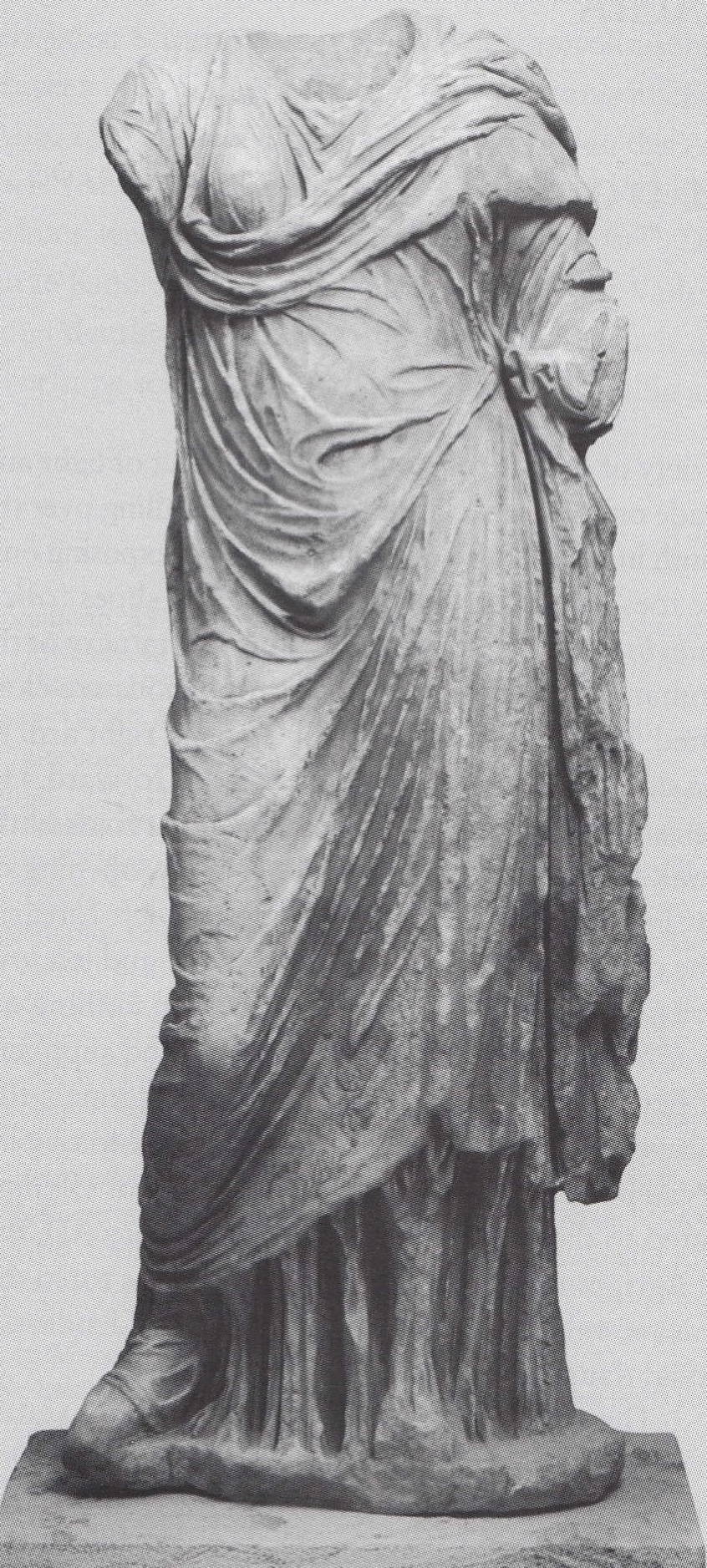
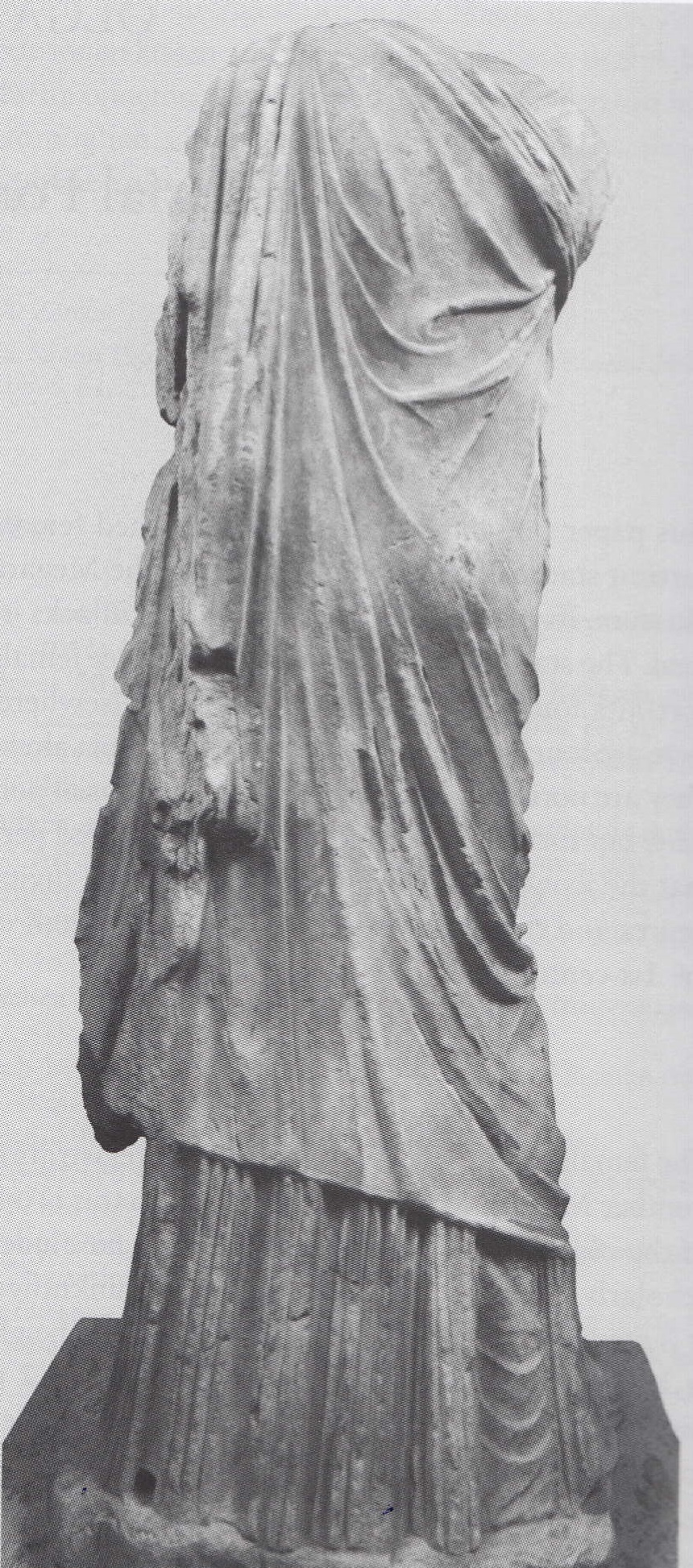
The figure is well preserved. The arms, the right from just below the shoulder, the left bent at the elbow from about the beginning of the forearm (a circular dowel hole for the attachment of a separate piece of marble is evident on the surface of the marble), and the inset head are missing. The plinth is also broken all around. Smaller breaks and chipping are evident sporadically on the surface of the marble, especially along the ridges of the folds of the garments. At the back, near the plinth, there is a small rectangular hole for the insertion of probably a metal cramp in order to strengthen the anchoring of the statue to the base. The rear is summarily executed, indicating that it was probably not meant to be seen. The standing, frontal figure wears a long chiton, a himation that covers almost the entire body and chest (except for the right shoulder and breast), and closed leather shoes (calcei muliebres). The statuary type of the so-called “Ephesos Kore/Persephone” is faithfully reproduced. The right part of the chest is left uncovered, while the himation forms an S-shaped mass of drapery that is carried diagonally across the chest from the right armpit to the left shoulder, where it is partially unfolded. On the left part of the body, at the height of the waist, a characteristic for the statuary type circular mass of folds is created, held by the elbow. The weight of the body falls on the left leg, while the right leg, bent, is carried sideways and slightly backwards. Stylistically, the rendering of the drapery is close to works of the end of the 1st c. and the beginning of the 2nd c. CE, such as the portrait statue of Antonia Cleodike from the Heraion of Olympia ({Γ105}) dated to the period of Trajan, as well as the portrait statue from Patras ({Γ69}) in the same statuary type, dated to the same period (ca. 100 CE). The Megara statue should also be dated to the same period.
Ο. Palagia, “An Imperial Portrait from Megara”, in E. Voutiras, E. Papagianni, N. Kazakidi eds., Bonae Gratiae. Μελέτες ρωμαϊκής γλυπτικής προς τιμήν της Καθηγήτριας Θεοδοσίας Στεφανίδου–Τιβερίου, Thessaloniki 2017, 173-179 (second half of the 1st c. CE; stola; empress).