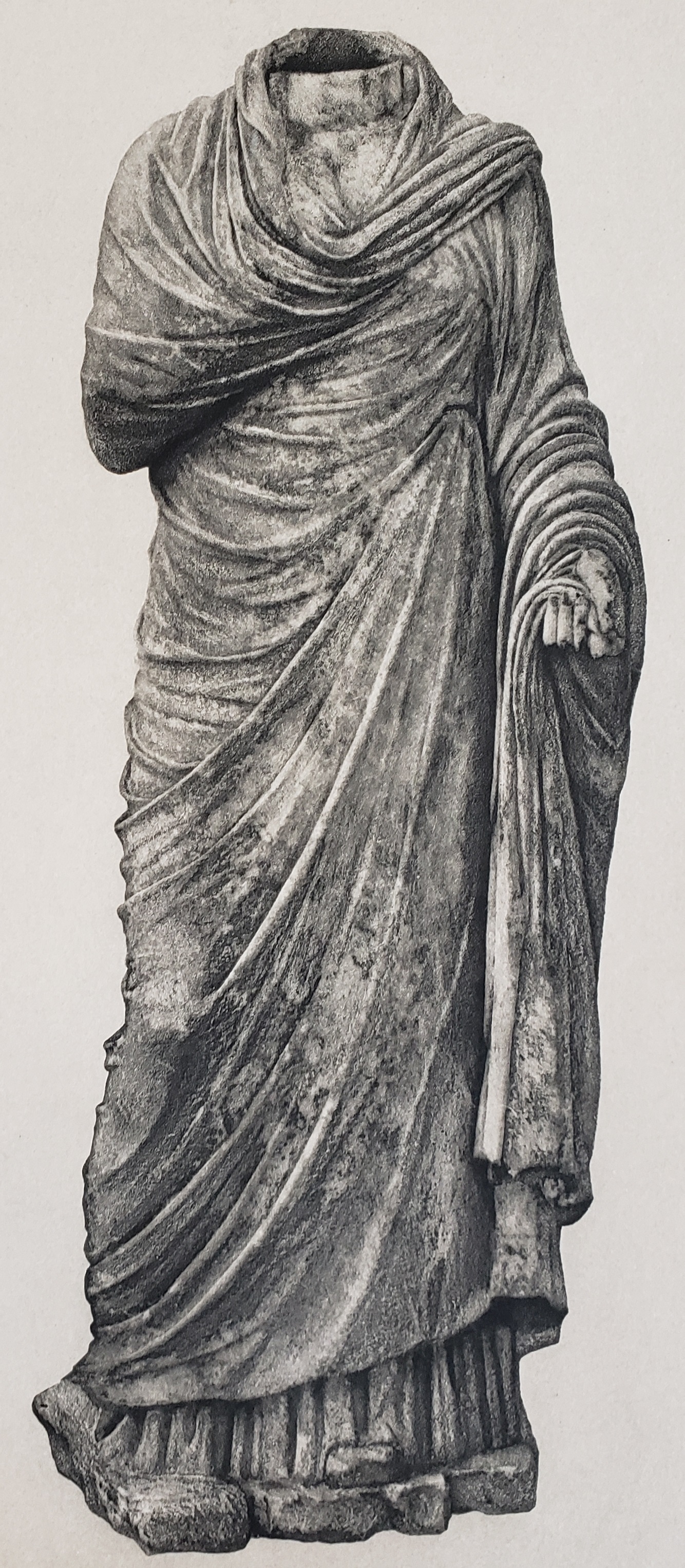
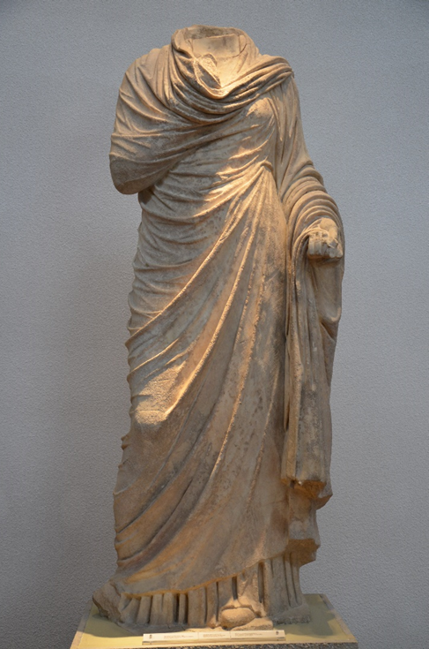
The statue is well preserved. Only the head from the middle of the neck, the right wrist and the tip of the right foot are missing. Smaller breaks and chipping are evident sporadically on the drapery of the garments. It depicts a frontal female figure standing on a rectangular plinth wearing a long chiton, a wide himation that is wrapped tightly around the body and closed leather shoes (calcei muliebres). The left leg bears the weight of the body, while the right leg is slightly bent and placed sideways. The extended left hand, bent at the elbow, holds a small part of the himation. It belongs to the so-called “palliata” statuary type, the female equivalent of the so-called “arm-sling” type of the himation-clad man (or “Normaltypus” or “Aeschines” type(Q)) which dominated male portraiture throughout the Hellenistic period, and continued to be common during the imperial period in the Greek East. The himation covers the entire body (including the shoulders and the left arm, except for the wrist), while the right arm is carried bent diagonally on the chest, with the wrist projecting from an opening of the himation in front of the neck (“arm-sling”). R. Bol identifies the figure with Regilla’s mother, Atilia Caucidia Tertulla (attributing to it the base Bol 1984, 135, no. 19, pl. 12), and places it in the third from the right niche of the upper floor of the Nymphaeum’s exedra. Conversely, K. Hitzl and A. Kropp (2013) place the statue in the fifth from the left niche of the ground floor of the Nymphaeum’s exedra.
G. Treu, Olympia III. Die Bildwerke von Olympia in Stein und Thon, Berlin 1894, 261 fig. 293, 268, pl. 68.4; H. Kruse, Römische weibliche Gewandstatuen des zweiten jahrhunderts n.Chr., Göttingen 1975, 376, cat. no. D91; R. Bol, Das Statuenprogramm des Herodes-Atticus-Nymphäums, OlForsch 15, Berlin 1984, 135, no. 19 (base), 177, cat. no. 40, pls. 42-43 (Atilia Caucidia Tertulla); A. Alexandridis, Die Frauen des römischen Kaiserhauses: eine Untersuchung ihrer bildlichen Darstellung von Livia bis Iulia Domna, Mainz am Rhein 2004, 270, no. 13 (“Palliata”); Κ. Hitzl, A. Kropp, “Das Heiligtum von Olympia im 2. Jh. n. Chr. - Alte und neue Impressionen”, Boreas 36 (2013), 53-89; P. Konstantinidis, Γυναικείοι δυναστικοί εικονιστικοί ανδριάντες αυτοκρατορικής περιόδου από την Ελλάδα (τέλη 1ου αι. π.Χ. – 5ος αι. μ.Χ.), Athens 2024, 171 note 268;
https://arachne.dainst.org/entity/1083484?fl=20&q=%22Olympia,%20Griechenland%22&resultIndex=93