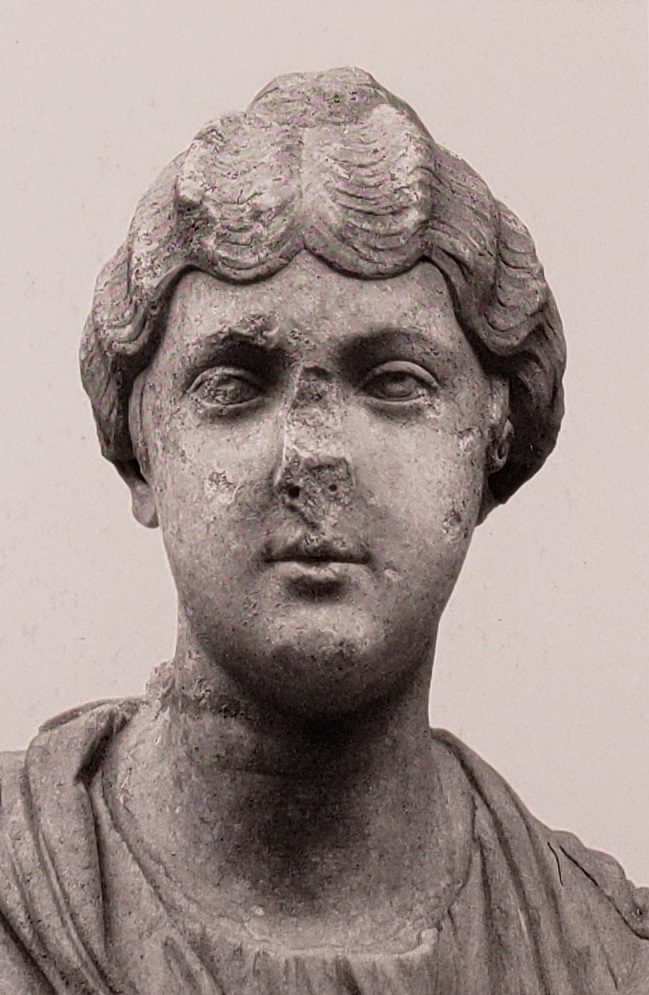
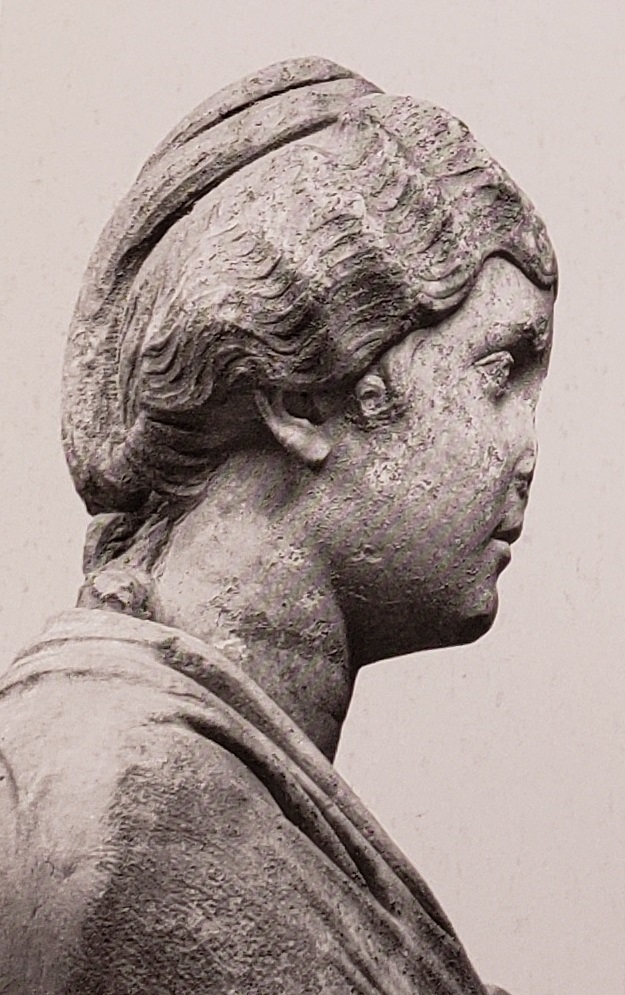
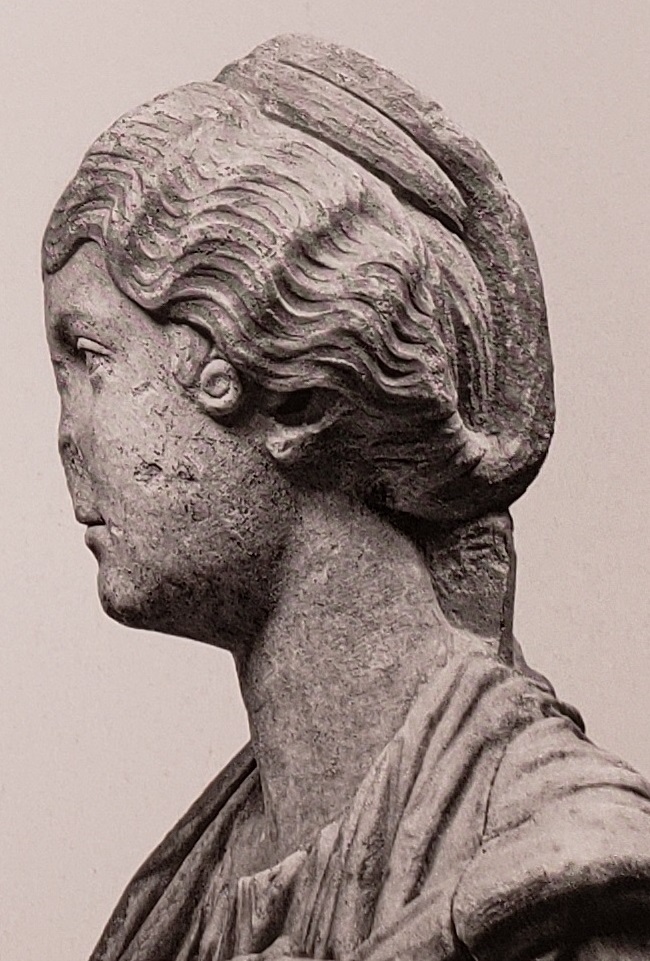
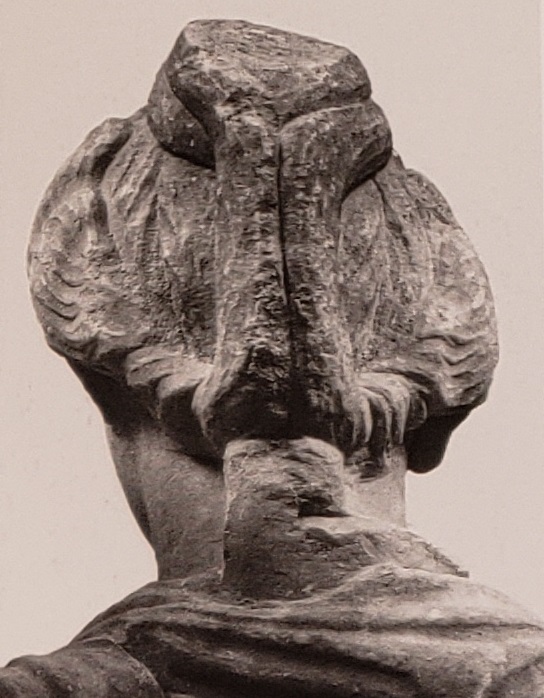
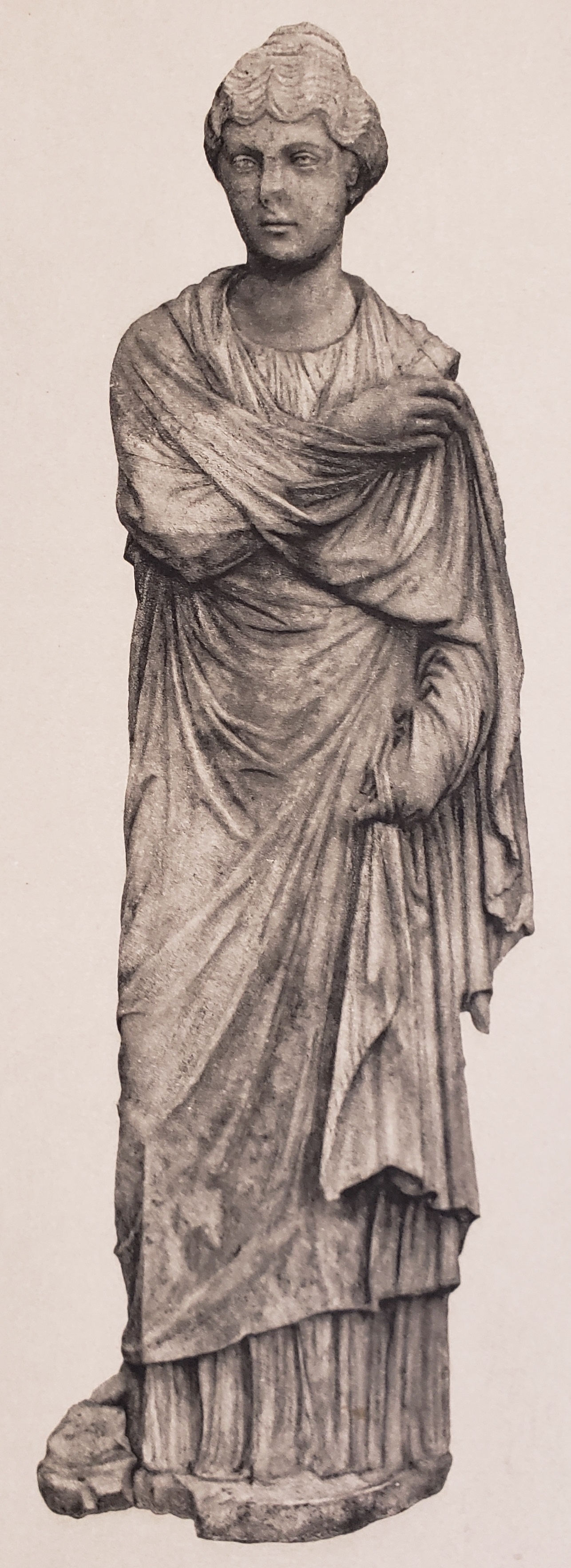
The statue survives essentially intact, along with the inset head and neck. The nose is broken (only the two drill holes for the nostrils are preserved), while smaller breaks and chipping are evident sporadically on the surface of the marble, especially on the cheeks, forehead, chin and headdress. It depicts a frontal female figure standing on a circular plinth wearing a long chiton, a wide himation that wraps around the body (overlocking along the vertical edges of the garment is rendered with indentations on the surface of the marble, while across the lower edge of the himation runs a parallel press fold; for press folds, indicative of high quality and expensive garments see {Γ99}), as well as closed leather shoes (calcei muliebres). The statuary type of the “Small Herculaneum Woman” is faithfully replicated. The face is oval with full cheeks and the mouth narrow with fleshy lips. The eyes are small, almond-shaped, with pupil and iris marked, the eyebrows are thin, the chin is round (all probably individual traits of the woman depicted). The coiffure depends on the third portrait type of Faustina the Younger, dated to 150 CE (K. Fittschen, Die Bildnistypen der Faustina minor und die Fecunditas Augustae, Göttingen 1982, 39-40, 48-49, pls. 15-16). More specifically, the hair is divided at the top of the forehead into two equal parts, which are combed in wide waves to the sides and back, where they join in a large braid that rises vertically to the upper part of the skull. There it forms a bun in the shape of a truncated cone. In the front part of the coiffure, the texture of the hair is worked with the flat chisel on the surface of the marble, while the back and top part of the head is left coarsely chiseled (indicating that this part of the statue was not meant to be seen). On the surface of the nape a mass of marble, joined with the vertical braid, has not been chiseled off. The ears are half covered by the mass of the coiffiure, while two spiral locks of hair are left free on the surface of either temple. The statue can be dated fairly precisely to the period 149-153 CE, during the principate of Antoninus Pius, based on the surviving inscriptions on the pedestals of the statues of the Nymphaeum (Bol 1984, 98-100). Based on the slightly smaller size of the statue compared to the majority of the rest of the statues of the Nymphaeum, which indicates the younger age of the figure, and the type coiffure that excludes her being a member of the Antonine imperial family, the young woman depicted is today almost unanimously identified as Athenais, the daughter of Herodes Atticus, who stood with her brother Regillus on the inscribed base IvO 625/626 (also Bol 1984, 132-134, no. cat. 16/17, fig. 60, pl. 11) in a niche of the Nymphaeum’s exedra (child portrait statue of Regillus: Bol 1984, 185, cat. no. 46, pls. 57-58; we do not know the exact date of Athenais’ birth; the latter is usually placed around 143 CE, which probably makes her between six and ten years old in the period 149-153 CE; see also P. Konstantinidis 2024, 63-65; Fittschen 2021, 190 where it is argued that the children of M. Aurelius were depicted in the Nymphaeum older than their actual age, almost as adults). According to R. Bol, the statue stood in the first from the right niche of the upper floor of the Nymphaeum’s exedra, while according to K. Hitzl and A. Kropp in the first from the right niche of the lower floor of the Nymphaeum’s exedra. Lastly, as argued by K. Fittschen (2021, 190), the statue could alternatively be the representation of the second daughter of Herodes Atticus, Elpinike, although the same scholar is more in favor of identifying Elpinike’s portraits in the series of copies of the so-called (Q)Loukou/Newby Hall(Q) iconographical type (Fittschen 2021, 188-189, no. 112, pl. 121; for Elpinike’s age see idem 188 note 2). R. Bol recognizes Elpinike in the headless portrait statue from the Nymphaeum {Γ111}.
G. Treu, Olympia III. Die Bildwerke von Olympia in Stein und Thon, Berlin 1894, 274-275, pls. 68.1, 69.5; H. Kruse, Römische weibliche Gewandstatuen des zweiten jahrhunderts n.Chr., Göttingen 1975, 316-317, cat. no. C 32; R. Bol, Das Statuenprogramm des Herodes-Atticus-Nymphäums, OlForsch 15, Berlin 1984, 132ff cat. no. 16/17, fig. 60, pl. 11 (base), 180-182, cat. no. 43, pls. 48-50 (Athenais); R. Bol, “Die Porträts des Herodes Atticus und seiner Tochter Athenais”, AntK 41 (1998), 127 no. 3; J. Daehner ed., The Herculaneum Women: History, Context, Identities, Los Angeles/Dresden 2007, 101-102, fig. 4.14 (J. Daehner); A. Alexandridis, Die Frauen des römischen Kaiserhauses: eine Untersuchung ihrer bildlichen Darstellung von Livia bis Iulia Domna, Mainz am Rhein 2004, 246, no. 71; E. Chioti, Αυτοκρατορικά και ιδιωτικά πορτρέτα της εποχής των Αντωνίνων στην Ελλάδα (PhD thesis Aristotle University of Thessaloniki), Thessaloniki 2012, 401, no. 1 with bibliography; Κ. Hitzl, A. Kropp, “Das Heiligtum von Olympia im 2. Jh. n. Chr. - Alte und neue Impressionen”, Boreas 36 (2013), 70, 71, 76, 79, pl. 16.7; H.R. Goette, "The Portraits of Herodes Atticus and His Circle", in O. Palagia (ed.), Handbook of Greek Sculpture, Berlin 2019, 236 with note 35, 252 no. ΙΙI.2; K. Fittschen, Privatporträts mit Repliken. Zur Sozialgeschichte römischer Bildnisse der mittleren Kaiserzeit, Wiesbaden 2021, 189, cat. no. 113c, pls. 122.7-9, 123.1,3 with bibliography (153 CE); P. Konstantinidis, Γυναικείοι δυναστικοί εικονιστικοί ανδριάντες αυτοκρατορικής περιόδου από την Ελλάδα (τέλη 1ου αι. π.Χ. – 5ος αι. μ.Χ.), Athens 2024,63-64, 417 note 596;
https://arachne.dainst.org/entity/1083478?fl=20&q=%22Olympia,%20Griechenland%22&resultIndex=38