
 Museum/Current place of storage:
 |
Corinth, Archaeological Museum. |
 Inv. no:
 |
S 2667 |
 Dimensions:
 |
|
 Material:
 |
H. 0,245m., w. 0,175m., th. 0,195m. |
 Findspot:
 |
On June 21 1961 in the well in the sanctuary of Demeter and Kore on Acrocorinth together with the portrait head {https://achaeanwomen.eie.gr/γλυπτό/?statue_id=678} (for the sanctuary see in brief N. Bookidis, R.S. Stroud, Demeter and Persephone in Ancient Corinth, Princeton 1987; G.D.R. Sanders, J. Palinkas, I. Tzonou-Herbst, Ancient Corinth: Site Guide, Princeton 2018, 129-133, αρ. 49). |
 Original Display Location:
 |
Inside the temenos of the sanctuary of Demeter and Kore. |
 Date:
Date: |
Period of Hadrian. |
 Statuary Type (body) :
 |
- |
 Mode of Self-Representation (head):
 |
The hairstyle follows generic classicizing protypes, while the face is idealized (“non-portrait”). |
 Civic Presence (Social Role Represented):
 |
Priestess or devotee of Demeter (as indicated by the strophion). |
 Inscribed Base:
 |
No |
 Author:
 |
Panagiotis Konstantinidis |
 Added:
 |
2024-09-13 |
 Edited:
 |
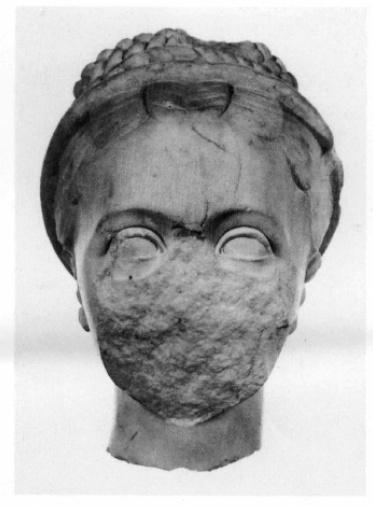
Description - Comments:
The head is mediocrely preserved, up to the base of the neck. Broken are the lower part of the face from below the eyes to the chin, as well as the ears. It depicts a teenage girl who has an oval smooth face, small eyes with wide lids and thin eyebrows ending in sharp edges. The hair is combed in the melon hairstyle both at the front and back of the cylindrical strophion (its ends are left free on the surface of the neck). More specifically, the hair is arranged in parallel vertical “slices” (its texture is schematically indicated by a series of shallow, parallel, widely spaced incisions) ending in braids which form a cylindrical bun placed diagonally at the back of the skull. Both the front and rear part of the head is worked with equal diligence. Workmanship is characterized by the same “sharpness”, (Q)clarity(Q) and accuracy of technique that we see in the head {Γ76}. It is stylistically close to the portrait-head {https://achaeanwomen.eie.gr/en/sculpture/?statue_id=678} and should be dated to the same period, the late principate of Trajan or – more likely – the principate of Hadrian (see the analysis in de Grazia Vanderpool 1993, 133-134). The strophion identifies the girl as a young priestess or devotee of Demeter. The presence of two other similar, the one slightly later, examples of girl portraits from the same sanctuary ({Γ76} and {Γ78}) probably indicates the habit of erecting portrait-statues of young priestesses or adherents of the worshiped deity within the sacred temenos, as already known from the sanctuary of Artemis Orthia in Messene (cf. {Γ125}, {Γ126}, and {Γ127}).
Bibliography:
R. Stroud, “The Sanctuary of Demeter and Kore on Acrocorinth. Preliminary Report I: 1961-1962”, Hesperia 34 (1965), 21, pl. 10c (Antonine); C. De Grazia Vanderpool, Excavations of the American School of Classical Studies at Corinth. The Roman Portraiture (PhD thesis Columbia University), New York 1973, 150-153, cat. no. 27, pl. 36 (late Trajanic- early Hadrianic); C. de Grazia Vanderpool, “A Roman Portrait in the Tripolis Museum”, in O. Palagia, W. Coulson eds., Sculpture from Arcadia and Laconia. Proceedings of an International Conference Held at the American School of Classical Studies at Athens, April 10-14, 1992, Oxford 1993 (Oxbow Monograph 30), 131-132, fig. 4 (Hadrianic); M. Tasopoulou, Το πορτρέτο της εποχής του Τραϊανού στην Ελλάδα, Thessaloniki 2018 (MA thesis Aristotle University of Thessaloniki), 56-57, 67, pl. 66, fig. 22.