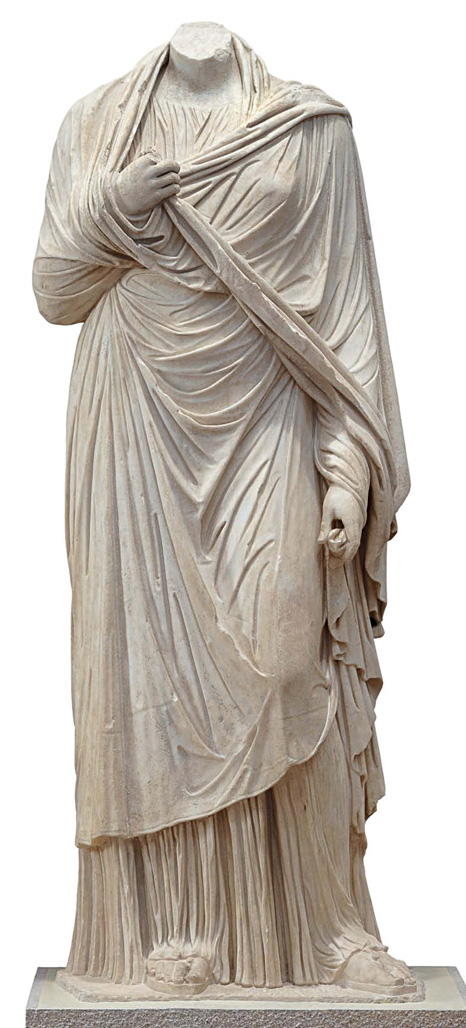
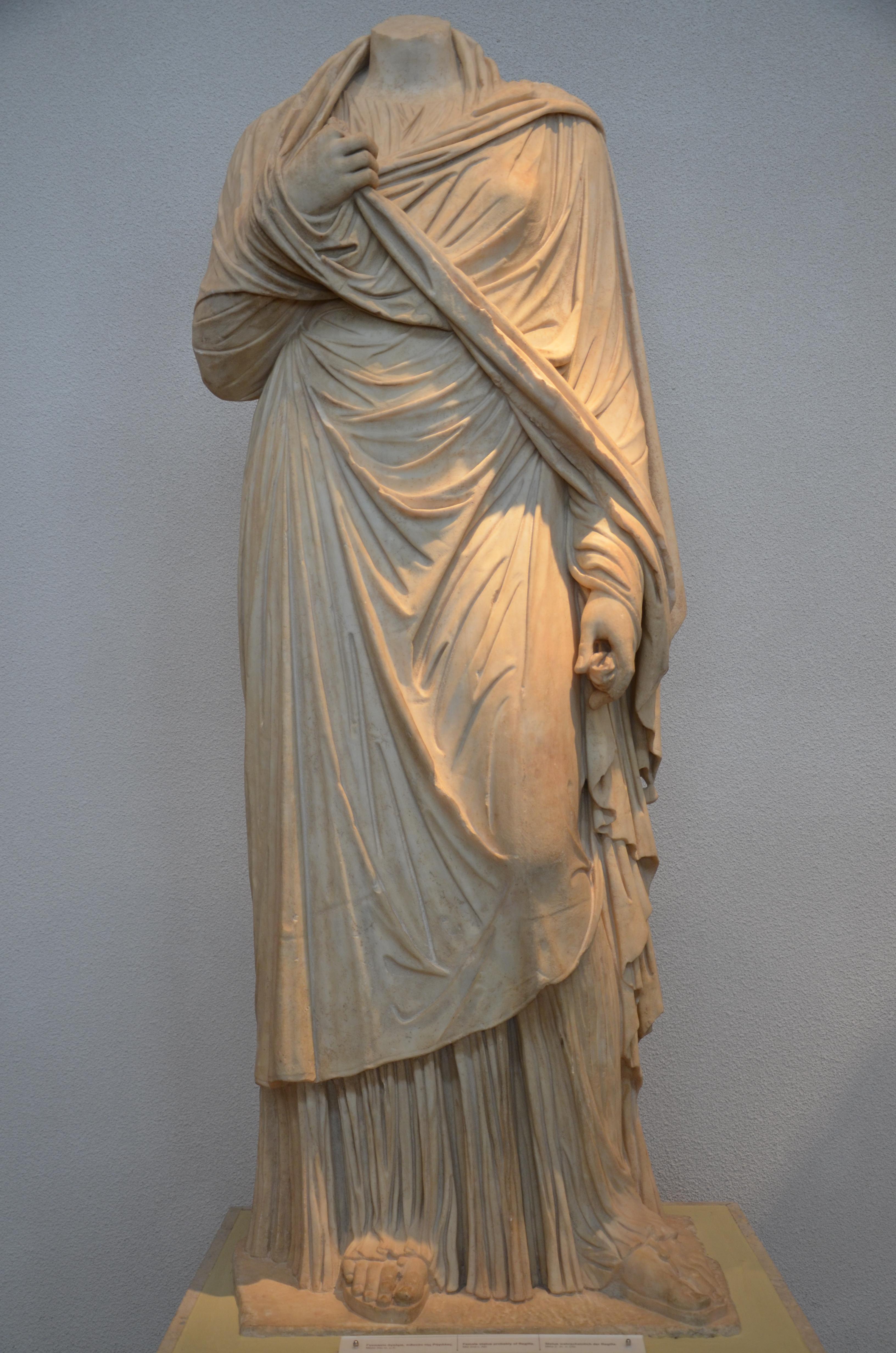
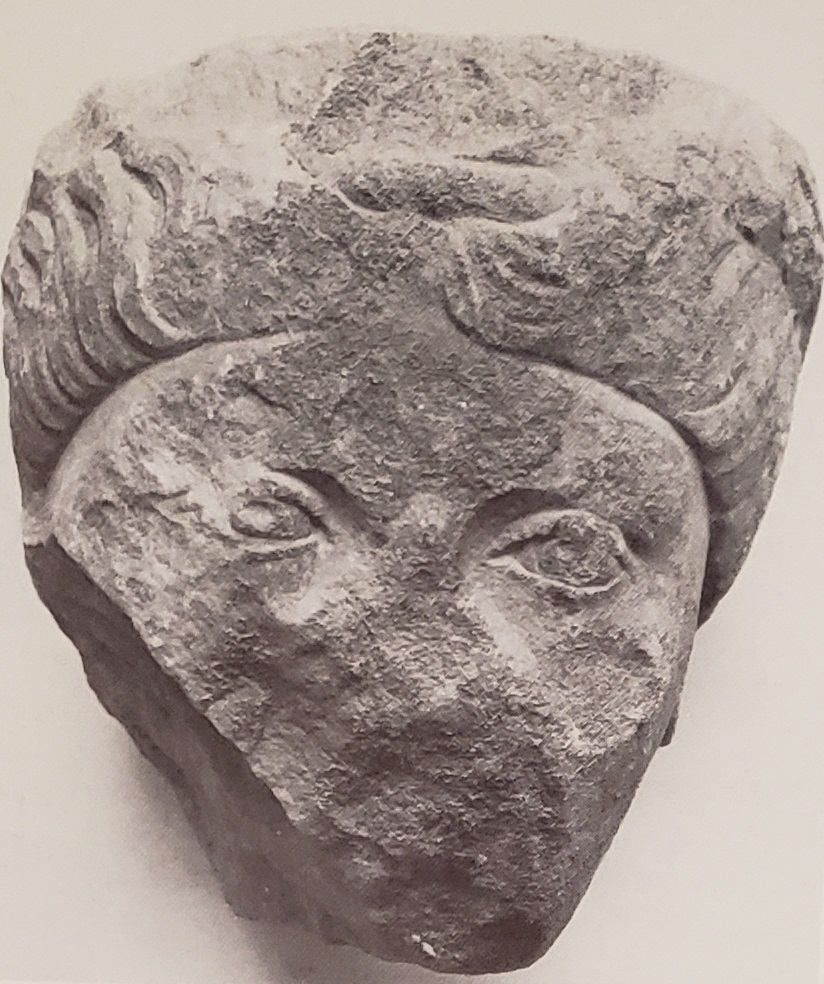
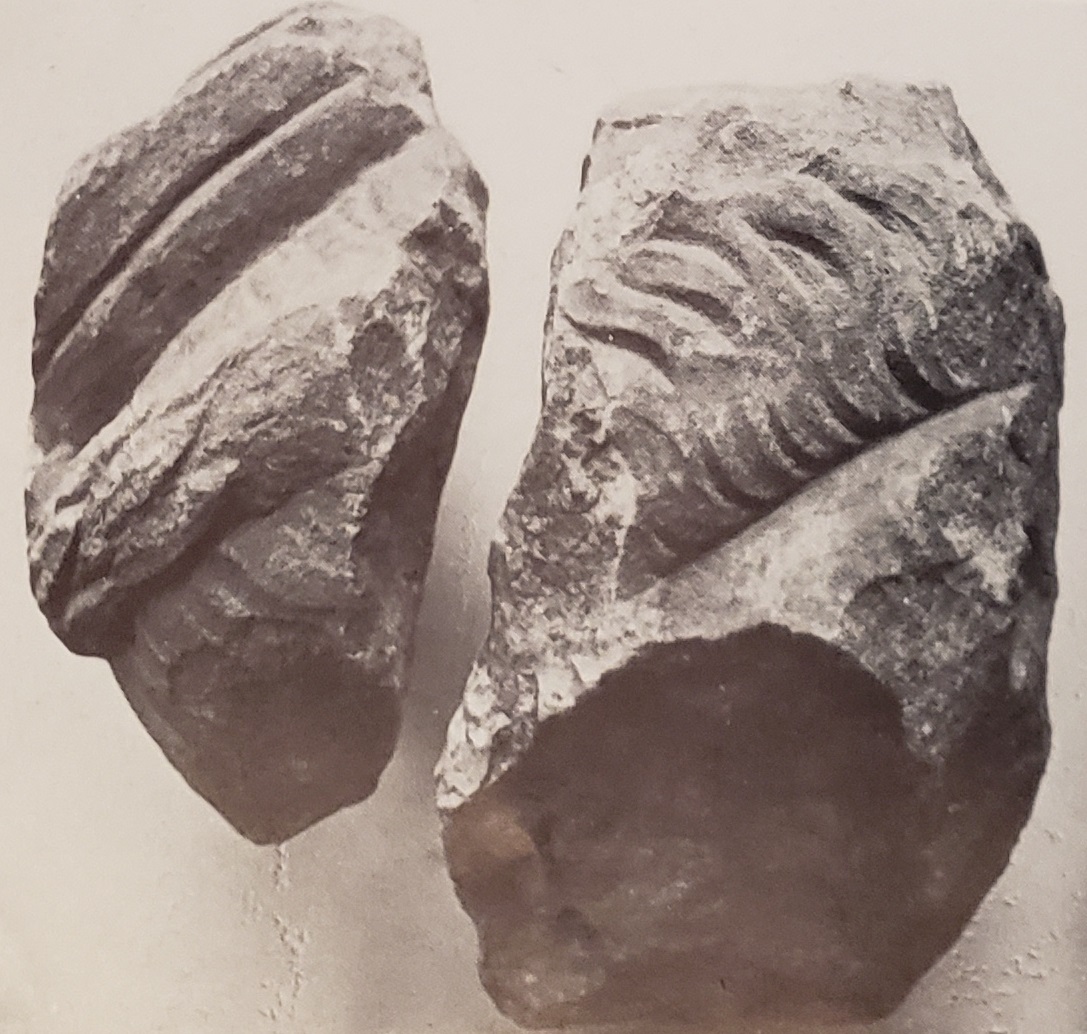
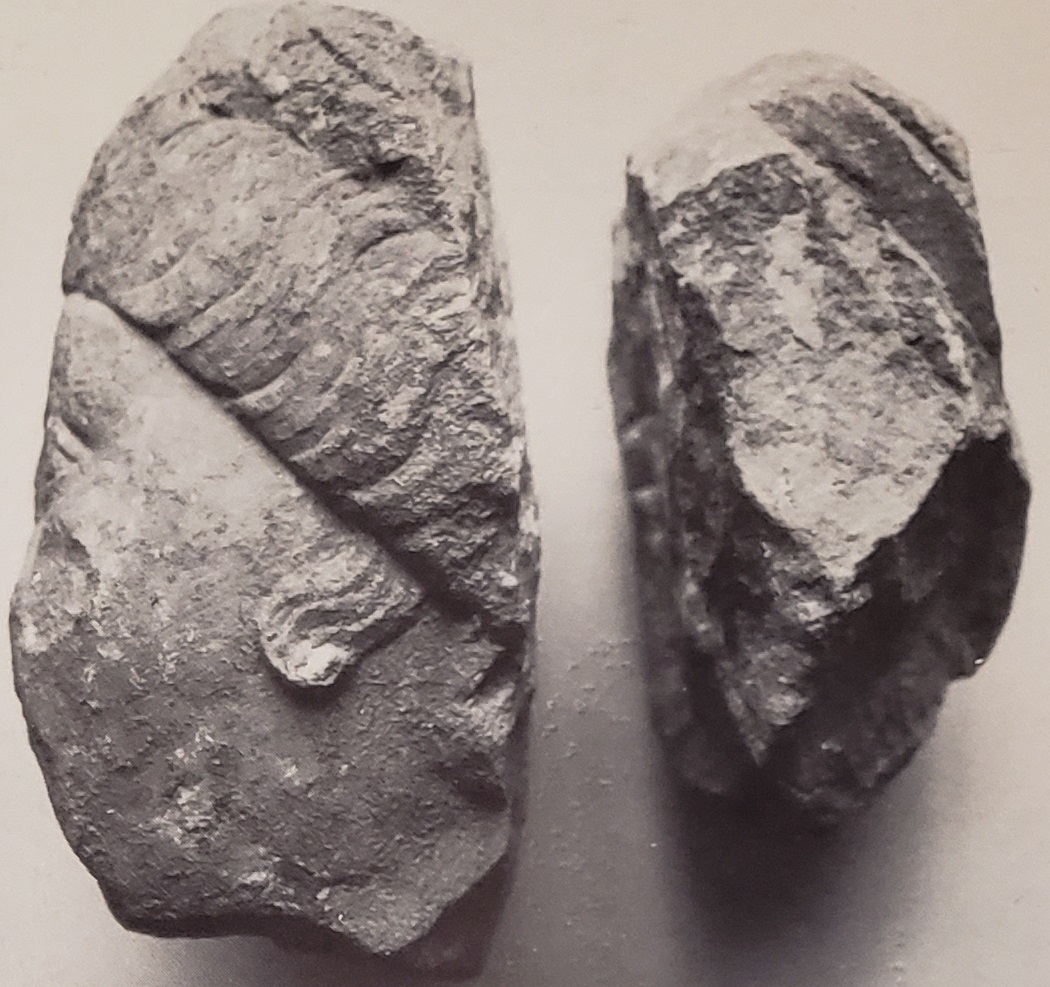
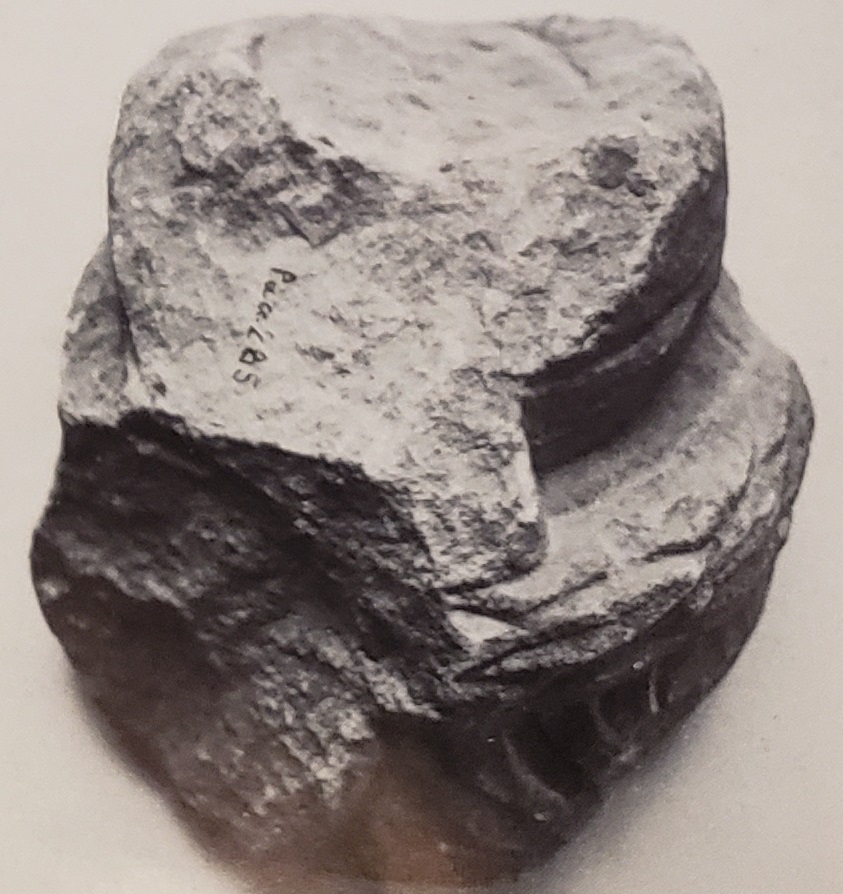
The statue is in a good state of preservation. The head from the middle of the neck and the index finger of the right hand are missing. Smaller breaks and chipping are evident sporadically on the surface of the marble. It depicts a frontal female figure standing on a rectangular plinth, wearing a long chiton, a wide himation that is wrapped tightly around the body, and sandals. The weight of the body is carried on the right leg, while the left is slightly bent. The statuary type of the “Large Herculaneum Woman” is faithfully replicated. The edges of the himation are held by the hands of the figure forming a triangle on the right side of the torso, characteristic of the statuary type. R. Bol identifies the figure as Regilla, the wife of Herodes Atticus (connecting it to the fragmentary base IvO 627; Bol 1984, 136-141, cat. no. 20), and places it in the fifth niche from the left of the ground floor of the Nymphaeum’s exedra . The same scholar attributes to the statue the fragmentary portrait head Λ 163α (Bol 1984, 172-173, pl. 34), which was found in the lime kiln in the area of the treasure-house of Cyrene and wears a wreath (priestess). Conversly, G. Treu had attributed the head to the portrait statue {Γ111} holding a patera, identifying her with Regilla as a priestess of Demeter Chamyne. The head, which bears traces of burning (from the lime kiln), is preserved in two fragments with only part of the eyes (with the iris and pupil indicated) and headdress; the hair is parted at the top of the forehead into two parts of S-shaped flat locks which frame the face (covering the upper part of the ears) and form a round “open nest” bun placed diagonally at the back of the skull. An S-shaped free lock of hair falls on the surface of the left temple. The coiffure belongs to the reign of Trajan (cf. the coiffure of the portrait statue {914} from the Nymphaeum, as well as the portrait head from Chersonesos in Crete, Herakleion Archaeological Museum inv. no. 389, M. Lagogianni-Georgakarakos, Die Römischen porträts Kretas I: Bezirk Heraklion, Athen 2002, 76-77, cat. no. 46, pl. 51, reign of Trajan; M. Tasopoulou, Το πορτρέτο της εποχής του Τραϊανού στην Ελλάδα [MA thesis Aristotle University of Thessaloniki], Thessaloniki 2018, 108-109, cat. no. 39, pl. 34, reign of Trajan), and, in our view does not draw upon the first portrait type of Faustina the Younger (Bol 1984, 173). If this is correct, then the portrait head should either be disassociated from the portrait statue Λ 156 (149-153 CE) or be identified as a female member of the family of Herodes Atticus (priestess) sporting an older coiffure, as in the case of the portrait statue {Γ110}, again sporting a Trajanic headdress. Lastly, K. Hitzl and A. Kropp (2013) place the statue in the sixth from the left (central) niche of the ground floor of the Nymphaeum’s exedra.
G. Treu, Olympia III. Die Bildwerke von Olympia in Stein und Thon, Berlin 1894, 274, 276, figs. 304a-b, pl. 67.3; H. Kruse, Römische weibliche Gewandstatuen des zweiten jahrhunderts n.Chr., Göttingen 1975, 284, 374, cat. no. B29; R. Bol, Das Statuenprogramm des Herodes-Atticus-Nymphäums, OlForsch 15, Berlin 1984, 136-141, cat. no. 20 (base), 171-173, cat. no. 36, pls. 32-34 (Regilla); A. Alexandridis, Die Frauen des römischen Kaiserhauses: eine Untersuchung ihrer bildlichen Darstellung von Livia bis Iulia Domna, Mainz am Rhein 2004, 241, no. 88; J. Trimble, Women and Visual Replication in Roman Imperial Art and Culture, Cambridge 2011, 125-126, 365-366, no. 6; Κ. Hitzl, A. Kropp, “Das Heiligtum von Olympia im 2. Jh. n. Chr. - Alte und neue Impressionen”, Boreas 36 (2013), 53-89; H.R. Goette, "The Portraits of Herodes Atticus and His Circle", in O. Palagia (ed.), Handbook of Greek Sculpture, Berlin 2019, 236 with note 35, 252 no. ΙΙ.1; J. Barringer, Olympia. A Cultural History, Princeton/Oxford 2021, 223, fig. 5.15 (Regilla); P. Konstantinidis, Γυναικείοι δυναστικοί εικονιστικοί ανδριάντες αυτοκρατορικής περιόδου από την Ελλάδα (τέλη 1ου αι. π.Χ. – 5ος αι. μ.Χ.), Athens 2024, 171, note 268, 399 note 532;
https://arachne.dainst.org/entity/1083479?fl=20&q=%22Olympia,%20Griechenland%22&resultIndex=60