
 Museum/Current place of storage:
 |
Patras, Archaeological Museum |
 Inv. no:
 |
129 |
 Dimensions:
 |
|
 Material:
 |
Η. 1,64m. |
 Findspot:
 |
In July 1943 at the junction of Gerokostopoulou and Kanakari streets at the center of modern Patras (Kruse 1975, 377). The findspot lies within the northern cemetery of ancient Patras (see I. Dekoulakou, "Monumenti delle necropolis di Patrasso durante il dominio romano", in Patrasso colonia di Augusto e le trasformazioni culturali, politiche ed economiche della Provincia di Acaia agli inizi dell'età imperiale romana: atti del Convegno internazionale, Patrasso 23-24 marzo 2006, Atene 2009, 182-183; see also {https://achaeanwomen.eie.gr/γλυπτό/?statue_id=659}-{https://achaeanwomen.eie.gr/γλυπτό/?statue_id=662}), identifying the statue as funerary. |
 Original Display Location:
 |
Probably part of the sculptural decoration of a funerary monument-mausoleum. |
 Date:
Date: |
Ca. 100 CE. |
 Statuary Type (body) :
 |
“Kore/Persephone” of the “Ephesos” type. |
 Mode of Self-Representation (head):
 |
- |
 Civic Presence (Social Role Represented):
 |
Unknown. |
 Inscribed Base:
 |
No. |
 Author:
 |
Panagiotis Konstantinidis |
 Added:
 |
2024-09-12 |
 Edited:
 |
Description - Comments:
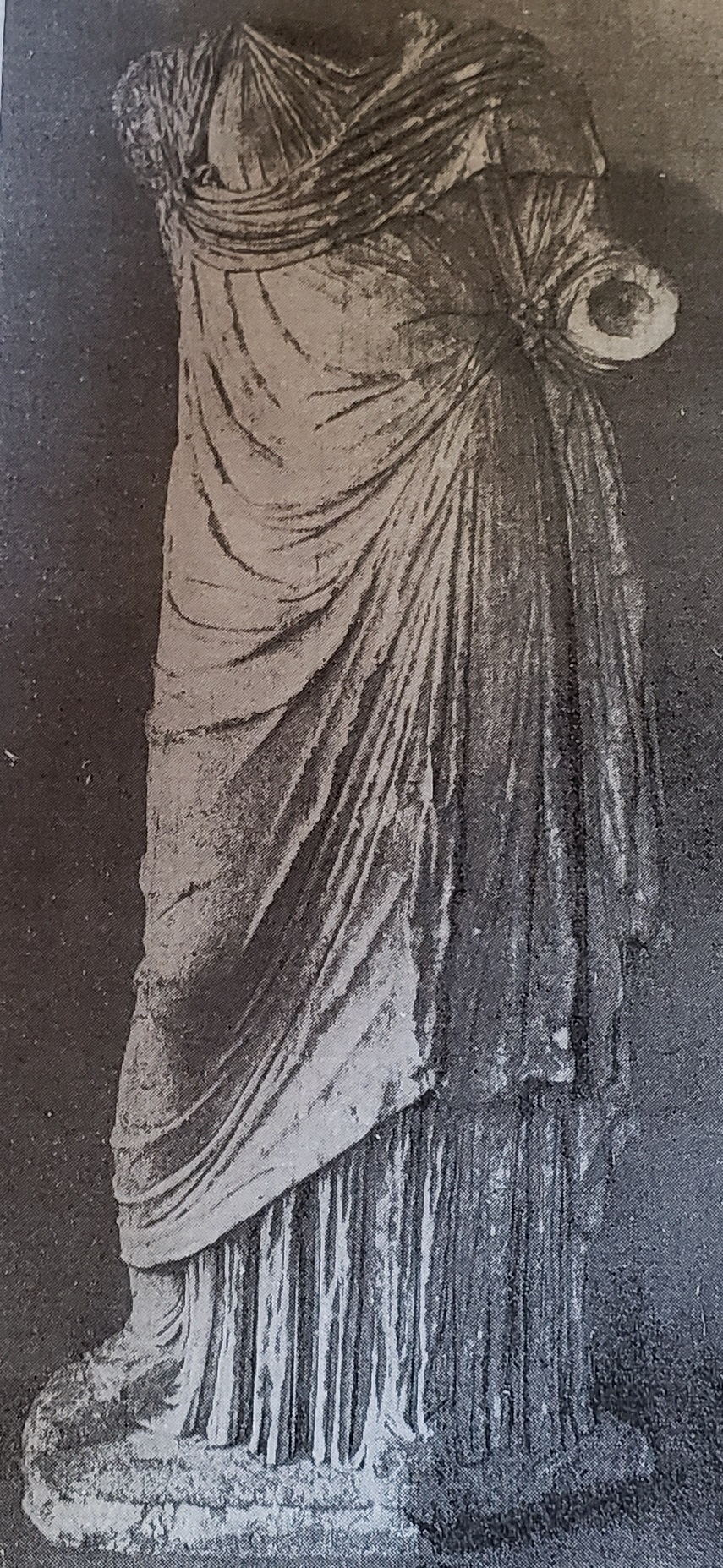
The statue is well preserved. The arms, the right from the shoulder, the left bent at the elbow form the mid-forearm (a deep inset cavity with a smaller circular dowel-hole for a metal tenon survives on the marble surface), and the inset head are missing. The left part of the plinth is broken. Smaller breaks and chipping are evident sporadically on the surface of the marble, especially along the ridges of the folds of the garments. The standing, frontal figure wears a long chiton, a long himation that covers almost the entire chest area and left shoulder, and closed leather shoes (calcei muliebres). The right part of the chest is left uncovered. The himation forms an S-shaped elongated mass of drapery, placed diagonally across the chest, from the right armpit to the left shoulder, where it is partially unfolded. A characteristic for the statuary type circular mass of drapery of the himation is also gathered on the left, at waist level, where it is held by the elbow. The weight of the body falls on the left leg, while the right leg, bent, is carried sideways and slightly backwards. The statue replicates faithfully the so-called “Ephesos Kore/Persephone” statuary type. Stylistically, the rendering of the drapery of the garments is close to works of the end of the 1st - the beginning of the 2nd c. CE, such as the portrait-statue of Antonia Cleodice from the Olympia Heraion ({Γ105}) dated to the Trajanic period, as well as a portrait-statue from Megara ({Γ63}) which must be dated to the same period (ca. 100 CE). Based on the findspot, the northern cemetery of ancient Patras, the statue must have been part of the sculptural decoration of a funerary building-mausoleum, similar to the one excavated in the plot of 80-82 Ermou street in the same cemetery that included two portrait statues in the round (see {Γ67}; cf. also {Γ68}).
Bibliography:
H. Kruse, Römische weibliche Gewandstatuen des zweiten jahrhunderts n.Chr., Göttingen 1975, 184, 377-378, cat. no. D 95, pl. 68 (Antonine period, ca. 150 CE); S. Schmidt, “Uber den Umgang mit Vorbildern. Bildhauerarbeit im 4. Jahrhundert v. Chr.”, AM 111 (1996), 192, note 2 no. 10; L. Kolonas, M. Stavropoulou-Gatsi, Το Αρχαιολογικό Μουσείο Πατρών, Athens 2017, 50 (the findspot is confused with that of the portrait-statue in the “Large Herculaneum Woman” type from the Roman villa in the area called “Βουδ” of the city of Patras; second half of the 2nd c. CE).