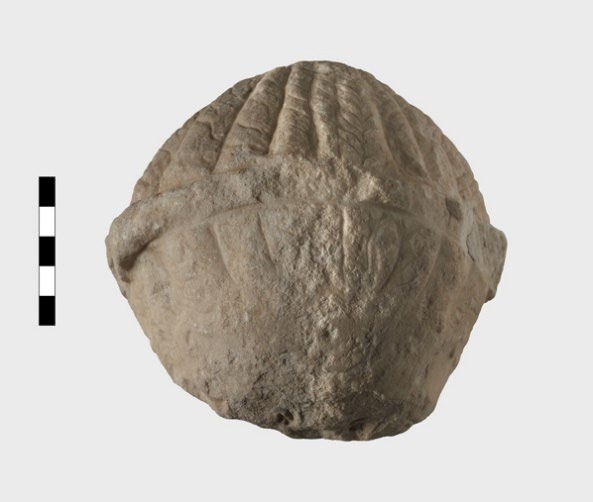
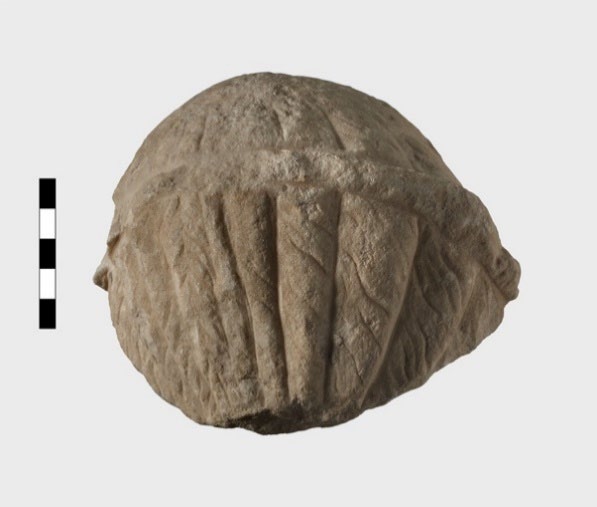
Only the upper part of the head from the eyes upwards is preserved (visible are the inner corners of both eyes, as well as the outer corner of the left one). The entire surface of the marble bears traces of weathering, while small breaks are also observed sporadically on the surface of the marble. She wears a “melon” coiffure, characteristic of young age, consisting of nine “slices”, and a strophion (broken in places). A small lock of hair is left free on the surface of the right temple. The texture of the individual strands of hair is indicated by incised diagonal curved lines on the surface of the marble. The small part of the temples and forehead that survives testifies to the polished surface of the face. The strophion indicates that the girl depicted either held a cult office or was an initiate of an unknown to us cult. Portraits of young girls from Athens wearing wreaths or strophia or both have been tentatively identified as Arrhephoroi by G. Dontas (G. Dontas, Corpus Signorum Imperii Romani. Greece I.1 Les portraits attiques au Musée de l'Acropole, Athens 2004, 58, 60). An analogous head in the National Archaeological Museum of Athens ({Γ25}) wears a strophion and an olive wreath (arrhephoros?), while three portraits of girls sporting “melon” coiffures and strophia have been found in the sanctuary of Demeter and Kore in Corinth ({Γ76}, {Γ77}, {Γ78}). S. Dillon's suggestion that the present portrait could depict a hearth initiate is, in our opinion, unlikely, because all surviving examples of boy hearth initiates bear myrtle wreaths not solely strophia (cf. E.B. Harrison, The Athenian Agora I. Portrait Sculpture, Princeton N.J. 1953, cat. nos. 41 and 46; see also K. Clinton, “The Sacred Officials of the Eleusinian Mysteries”, TAPS 63 [1974], and the analysis in {Γ61}).
S. Dillon, “Female Portrait Statuary in Roman-period Athens: the Epigraphic and Sculptural Evidence”, Eugesta 13 (2023), 18-19, figs. 19-20 (hearth initiate? [παῖς αφ’ἐστίας]).